





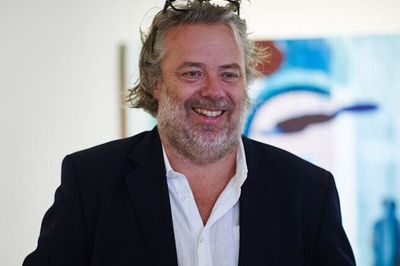

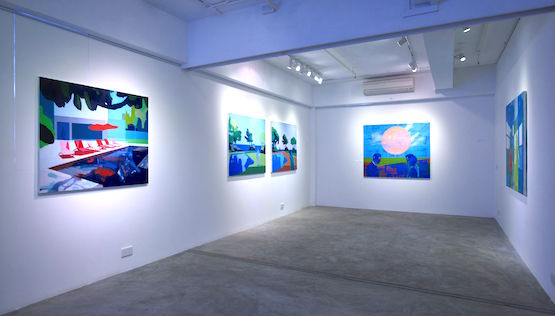
Having already shown extensively in Europe, the Danish artist, Kenneth Blom (b. 1967), has brought his paintings to Asia for the first time with a solo-exhibition at Pékin Fine Arts, Hong Kong. With a clear signature style, Blom’s melancholic architectural, figurative and landscape paintings cast a cool blue light across the gallery space. On the eve of the opening, Ocula sat down with the artist to discuss his practice and continued dedication to his medium.
Walking into the gallery space, your personal aesthetic is particularly strong. Please could you explain your process of creation?
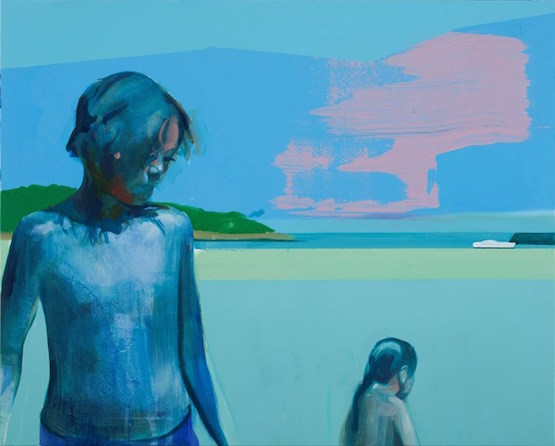
The process always begins with a strong composition, making up the circles and lines, and then at the end I put in the people … it all depends on the composition. So in a way I work abstractly when I do these things; I’m not a figurative painter when I do the process but it ends up being that.
So does the imagery come from your imagination rather than reality?
No, it’s a mix. I mean you walk around, you see people as you do now [points to the exhibition], but it’s a mix between fantasy and reality. I need [people] to be alive. I need them to start to walk, to fight, to kiss, to scream. In a way it’s a real life story I’ve tried to talk about, but it’s not from [the] real. Mostly I don’t use models; I just use the idea.
Your earlier works are very traditional, figurative images. Did you start by drawing and painting from life models initially?
Yes. I had a straight academic education, but since I was fifteen I have always loved Danish farmer paintings … the lonely boy standing on the road—it went to me directly. And when I was studying art in Düsseldorf, it was quite another stage of art: conceptual, rough work, reduced installations. We went to this big show in Copenhagen, and I remember I just couldn’t get it, so I went back to [painting] private small rooms. So I’m a rather old fashioned painter, but I see now that painting changes all the time, and that’s why I love the medium.
You say your paintings are old-fashioned; they also appear quite distant, almost dystopian.
You can use painting—and this is why I think it’s so important—to give [the viewer] a little break; it stops time for just a little while. You can walk into a gallery and be quiet in front of a painting. It gives a little break from the rushing time. I love that this medium [does that].
While many other artists jump between video and installation, painting and sculpture you religiously remain a painter. What is it about the medium that appeals so much?
I think it’s just like going into a friendship for a long time—it creates a special kind of friendship. You can also have friends that maybe last for two weeks, which are also interesting, but there’s something about working for a period and going really into the stuff. Now we have to be careful because you can choose to do both dancing and making art, or sound and installation, or theatre, whatever, which is right. I love to paint so I thought, well I think I’m going to paint for some years now and see what that is, and I couldn’t stop. So you lose something by doing that, but you also gain something; you’re in focus your whole life. I am trying to make the best painting and then I will quit; it won’t happen (laughs). —[O]
Main image: Kenneth Blom. Courtesy Pékin Fine Arts.


A respected voice in contemporary art discourse.
Focusing on ambitious storytelling and insightful art-world commentary. Ocula Magazine publishes in-depth interviews, critical essays and timely analysis on the artists, exhibitions and ideas driving the global art world.
Learn more about Ocula Magazine
Showcasing the best of the art world.
Ocula partners with galleries from around the world to highlight their artists, artworks and exhibitions. Gallery membership is by application and invitation, with each member vetted by an independent panel.
Learn more about Ocula Membership
Specialises in the sale of major artworks.
Led by a team with deep ties to the world’s leading auction houses, galleries and collectors. Ocula’s advisory team offers bespoke services to high-net-worth clients from around the world who are looking to acquire the best of contemporary and modern art.
Learn more about our team and services