





The art world in focus
Subscribe to our newsletter for news and insights on artists, galleries and exhibitions.

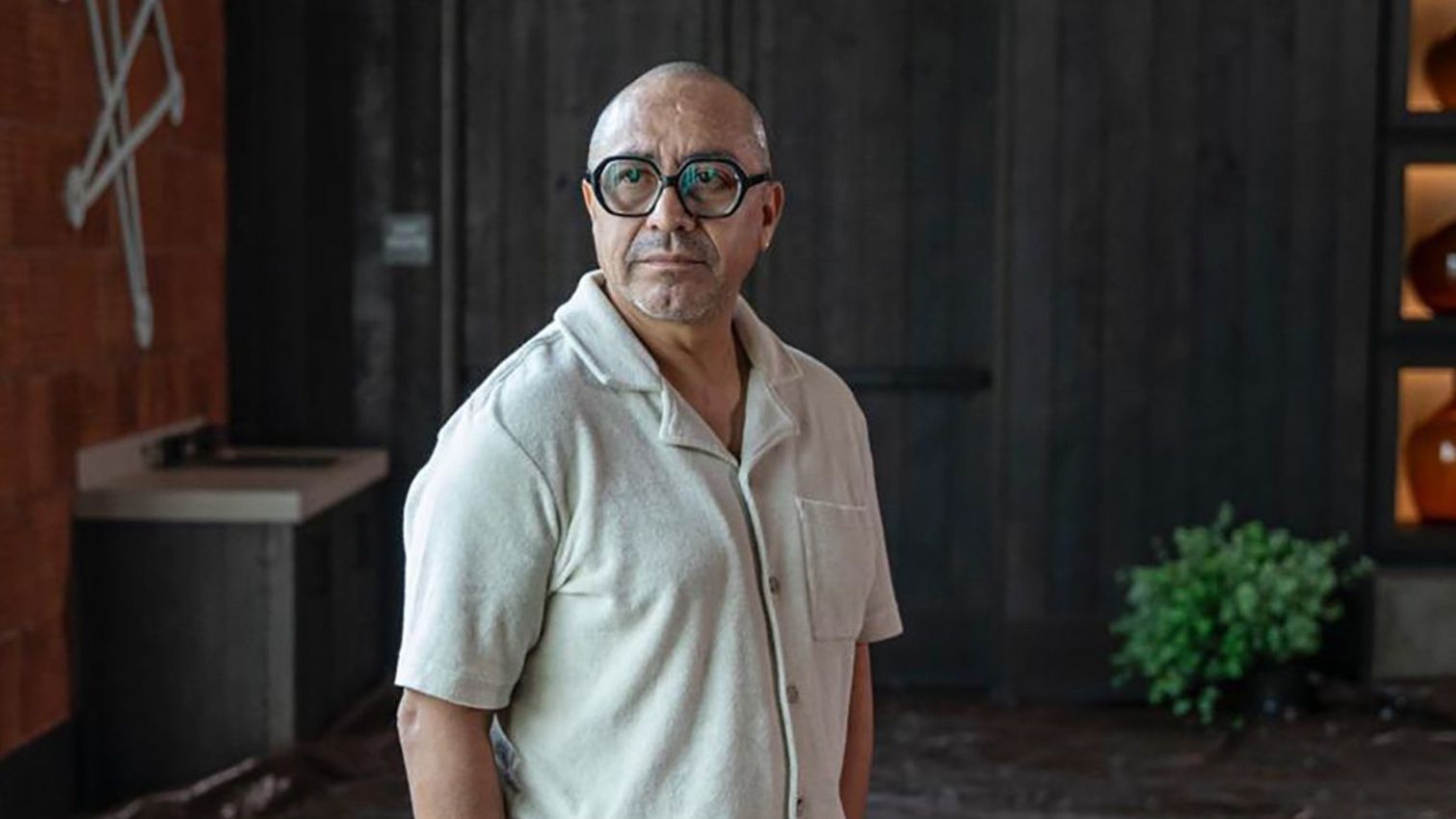
Mexican artist Abraham Cruzvillegas speaks to Ocula about his new permanent installation in St Helena, inspired by the surrounding Napa Valley.
Abraham Cruzvillegas’ site-specific installation will be unveiled at Louis M. Martini Winery in St Helena, California, on 24 January.
Titled Two Untitled Maps (An Alchemical Self-Portrait) (2024), the two-part installation is conceived in response to the Napa Valley.
Cruzvillegas told Ocula: ‘The names of species, peoples, and places can provide much more information about the locale through a historical perspective—including considerations about migration, economic, environmental, and political facts—that can be linked to human development on Earth.’
Cruzvillegas, who is based in Mexico City, made several site visits to develop the work, which he described as stimulating: ‘All my senses were impacted. From collecting a grape from an old vine and smashing it inside my mouth, breathing the air, and getting the light in the fields over Monte Rosso; speaking with the people who take care of the plants, listening to them speak about gophers; speaking with the wine maker and witnessing the different stages of making wine; smelling the fruit perfume in the tanks—everything was precious material for my project.’
‘Almost immediately, I started thinking about the maps as open tools for anyone to construct their own perception and ideas. Alchemy, in terms of transformation, became central in the project, not only for the entire process of wine making, but for the more specific moment of sipping a glass of wine as a substance producing a change inside our bodies’ metabolism, one that connects everything together—nature, culture, history, life, and chemistry—in a convivial moment of social celebration and joy.’
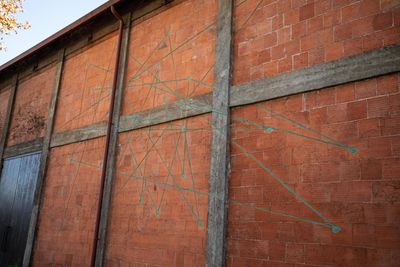
The exterior component of Two Untitled Maps comprises a wall drawing carved directly into the terracotta facade of the establishment’s tasting room. The geometric, web-like arrangement of lines and circles in matte green indicates species of flora and fauna endemic to the valley.
Cruzvillegas described: ‘We painted over the grooves using a combination of pigments with epoxy resin and lime. Lime is important, as it is often used in agriculture—including vineyards—for enriching and protecting soil.’
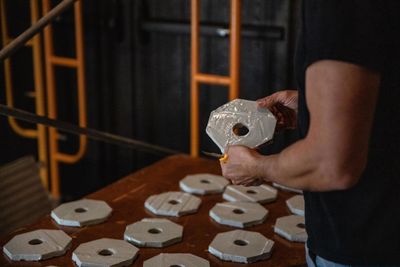
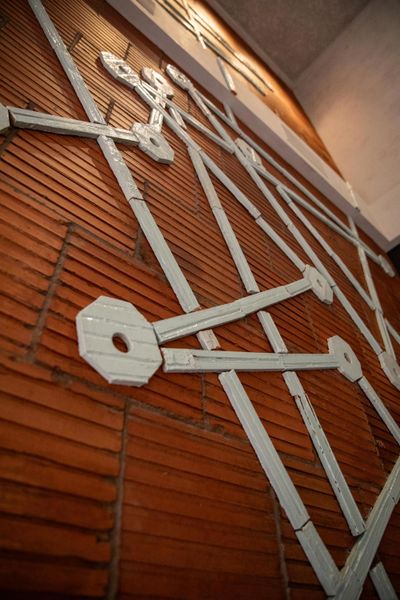
On a high wall inside the tasting room, a glossy, pale, handmade relief drawing refers to sites in the map of the Napa region, indicating Native peoples’ settlements and local wine denominations. It is made from terracotta tiles left over from a renovation in 2019.
‘We cut [the tiles] in line segments, and painted over the material with pigments, epoxy resin, and lime powder, in order to make green lines describing the map, connecting points like a constellation,’ Cruzvillegas said.
‘These additive and subtractive methods are in dialogue [with each other] both formally and symbolically, referring simultaneously to the inside and the outside. Contrasts in technique, texture, and meaning give diverse possibilities for interpretation, both visually and conceptually.’
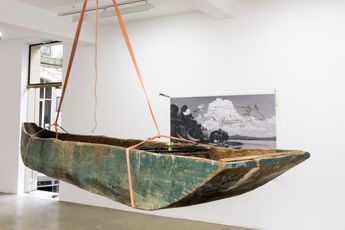
The artist consistently uses locally found and repurposed materials in his practice. For his Turbine Hall commission at Tate Modern in 2015, he collected and displayed soil from parks across London in a large grid of triangular planters. He considers his assemblages and installations as expanded ‘self-portraits’, underpinned by the concept of autoconstrucción or ‘self-construction’, which references the improvisational approach to house-building that he grew up with in Colonia Ajusco, Mexico City.
Cruzvillegas is the second artist commissioned for Louis M. Martini Winery’s art programme helmed by curator Georgia Horn, who told Ocula: ‘Abraham’s interest in migration, adaptation, geography, community, and materiality aligns beautifully with our mission of exploring the intersections between place, history, and ecology.’
Horn described Cruzvillegas’ work as ’[provoking] curiosity about the interconnected relationships between the natural and cultural forces that shape Napa Valley.’
‘At the same time, the meaning of the work remains open to individual interpretation. When I introduce the piece, I often begin by asking: what do you see? Because I want people to feel comfortable approaching these installations without prior knowledge.’
Michael Claypool, estate director at Louis M. Martini added: ‘Abraham’s curiosity led to a deep collaboration with all aspects of the winery to better understand and explore the relationship between the history, land, and people.’
Louis M. Martini Winery’s annual commission project was inaugurated in August last year with Open Field Poem (2023), a kinetic installation by Italian artist-filmmaker Rosa Barba. —[O]
A respected voice in contemporary art discourse.
Focusing on ambitious storytelling and insightful art-world commentary. Ocula Magazine publishes in-depth interviews, critical essays and timely analysis on the artists, exhibitions and ideas driving the global art world.
Learn more about Ocula Magazine
Showcasing the best of the art world.
Ocula partners with galleries from around the world to highlight their artists, artworks and exhibitions. Gallery membership is by application and invitation, with each member vetted by an independent panel.
Learn more about Ocula Membership
Specialises in the sale of major artworks.
Led by a team with deep ties to the world’s leading auction houses, galleries and collectors. Ocula’s advisory team offers bespoke services to high-net-worth clients from around the world who are looking to acquire the best of contemporary and modern art.
Learn more about our team and services