






Grace Wright’s Painted Cacophonies Entice and Repel in Equal Measure

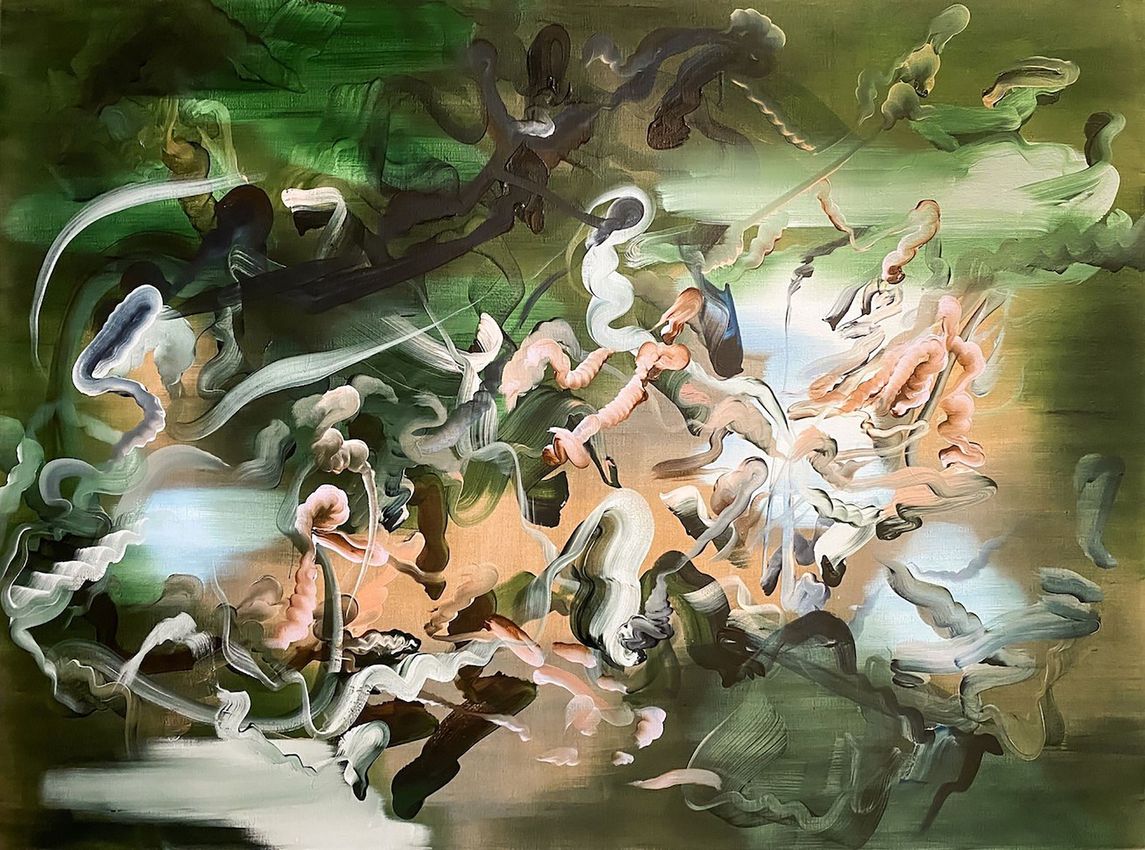

Grace Wright’s painting draws on a wide range of influences, from Western art history to dance, nature, and digital visual culture. In Alpha Paradise, her inaugural exhibition with Gow Langsford Gallery in Auckland in 2020, compositional cues from 17th-century painting emerged within large-scale acrylic works built up through dense layering. Curving, interlocking forms move across the canvases, structured through high-contrast colour relationships—Prussian blue set against acid yellow, viridian green against passages of pink and umber.
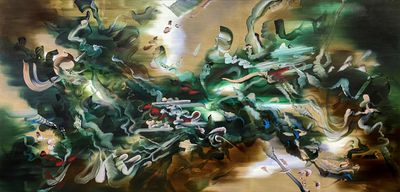
At over 3.6 metres in length, Final Fantasy (2020) extends this approach at scale. Broad fields of dark green and brown are interrupted by areas of illumination, as if lit from behind, while thick, looping strokes push outward and fold back into the surface. The paint alternates between tightly controlled passages and more erratic marks, creating a sense of pressure building and releasing across the canvas.
Produced following New Zealand’s first Covid lockdown, these works reflect Wright’s heightened sensitivity to colour during a period of isolation, which she has described as evoking ‘some kind of uncertain cosmic future’. This interest in expanded, non-linear space connects to her study of Hilma af Klint during her MFA at the University of Auckland in 2019. Rather than direct quotation, such influences are absorbed into a process that combines intuitive decision-making with a defined set of working parameters.
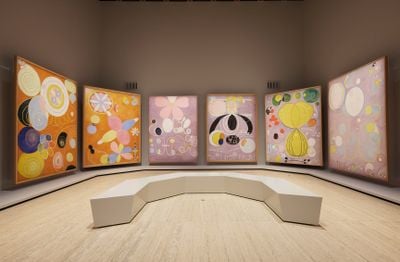
Wright paints without preparatory drawings, allowing each composition to develop incrementally. This approach recalls Surrealist automatism, but is shaped by constraints: she pre-mixes her palette before beginning and rotates the canvas throughout, such that no single orientation determines the final image. As a result, forms appear to shift direction, resisting a fixed top or bottom.
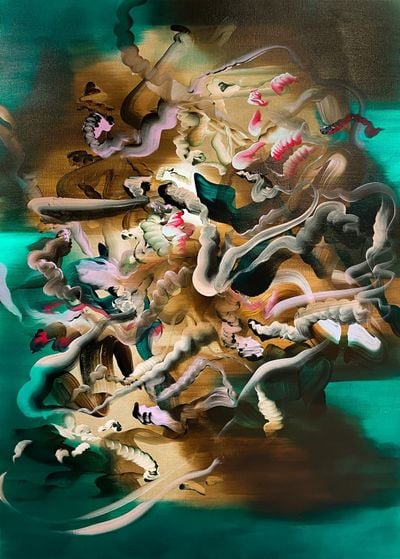


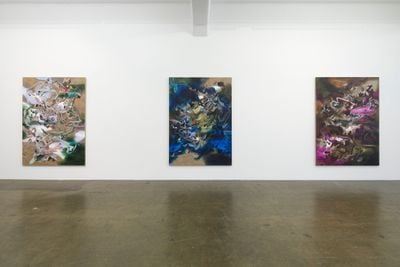
A turning point came after Wright encountered Albert Oehlen’s work at the New Museum in 2015, prompting a move away from flatter, graphic compositions toward more layered and spatially complex painting. In Fantasia for a Late Night, Wright’s exhibition at Parlour Projects in Hawke’s Bay in 2020, this shift was evident in large-scale works, including a triptych, where smeared bands of colour intersected with tightly wound, rope-like strands of paint that clustered in some areas and thinned out in others.
“These are not ‘pretty paintings’; they are works that want to enthral and repulse in equal measure to create a visceral experience.”
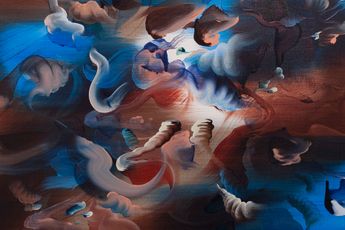
While the rhythmic quality of Wright’s mark-making is often linked to her background in dance and music, the paintings also register the body more directly. Elongated, tubular strokes stretch and kink across the surface, while passages of pink and deep red gather into forms that suggest internal matter—veins, tissue, or exposed layers beneath skin. In Underestimating Courage (2021), shown at Gallery 9 in Sydney, saturated reds and pinks dominate the canvas, cut through by lines of blue that branch and spread, creating a network that reads simultaneously as vascular and atmospheric.
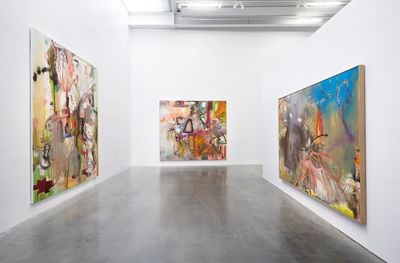
These are paintings that you expect to be ‘pretty’, but they deliberately are not. Rich, clashing colours are both seductive and repellent, resulting in an unease that saves these paintings from toppling into the decorative.
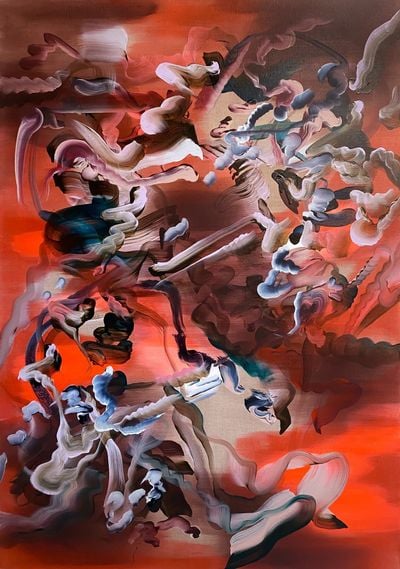
Scale is also a deliberate choice, driven by theoretical interest. Wright uses large canvases to position the viewer physically in front of the work, while also asserting the presence of her own body within a tradition of large-scale abstraction historically associated with white, male American painters.
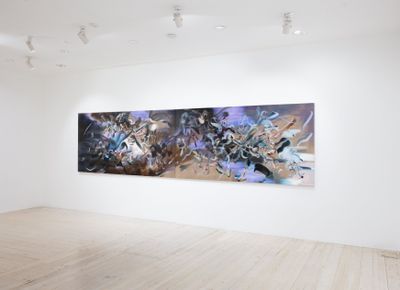
In Wright’s particular brand of abstraction, linear progression is a myth in a world experienced through extreme shifts of scale and different subconscious and conscious interpretations, where the good, the bad and the ugly can be one in the same, and grand gestures can suggest both the expanse of the universe and molecular detail. —[O]


A respected voice in contemporary art discourse.
Focusing on ambitious storytelling and insightful art-world commentary. Ocula Magazine publishes in-depth interviews, critical essays and timely analysis on the artists, exhibitions and ideas driving the global art world.
Learn more about Ocula Magazine
Showcasing the best of the art world.
Ocula partners with galleries from around the world to highlight their artists, artworks and exhibitions. Gallery membership is by application and invitation, with each member vetted by an independent panel.
Learn more about Ocula Membership
Specialises in the sale of major artworks.
Led by a team with deep ties to the world’s leading auction houses, galleries and collectors. Ocula’s advisory team offers bespoke services to high-net-worth clients from around the world who are looking to acquire the best of contemporary and modern art.
Learn more about our team and services