






Bold, Bulbous, and Irregular: The Ceramics of Kazunori Hamana

Kazunori Hamana, Yukiko Kuroda, Untitled (2019/2020). Ceramic, Urushi (Japanese lacquer) and tin. © Kazunori Hamana and Yukiko Kuroda. Courtesy the artists and Blum & Poe, Los Angeles/New York/Tokyo.

Bold, bulbous, and irregular, Kazunori Hamana creates vast ceramics that absorb and update Japanese craft traditions.
Guided by nature and executed through intuition, his striking vessel sculptures are imbued with an appreciation for the concepts of wabi-sabi, aspects of which advocate for the acceptance of impermanence.
Blum & Poe Los Angeles recently presented his first exhibition since announcing his representation, bringing together a series of floor-based sculptures including collaborative pieces made with artist Yukiko Kuroda.


Based in Isumi, a rural village in Japan’s Chiba prefecture, Hamana works concurrently as a rice farmer, artist, and fisherman.
Moving here from Tokyo, where he ran a restaurant and trainer shop in the fashionable Harajuku district, he has cultivated a practice that harmonises with his surroundings.

It follows that his work is made with natural clay sourced from the country’s Shiga prefecture. Hamana follows a demanding process building his vessels from coils before applying and texturing the works with abstract and geometric patterns in his own mineral glazes.
In shape, Hamana experiments with the traditional Japanese tsubo jar. Conventionally used for storage, this wide shouldered jar is liberated from its uniform curves. As he has explained, ‘Clay is a natural thing; it changes. I don’t want to fight with nature, so I follow it.’
Hamana allows his vessels to tilt and bulge unevenly. Their lips undulate. A work like Untitled (2021) collapses in on itself. Others like Untitled (2019/2020) make explicit their precocity with thick stitches of tin weaving in and out of their cracks.
The surfaces are equally fragile. Scratches and scores mark them, as do their immediate environmental surroundings. In an interaction with the atmosphere, once fired and glazed, Hamana lets his objects sit by the seashore.
Amid the rice fields and flora, the pieces react with the salty air. Flecks of salt might add to their patterning while the colours, exposed to the rainfall, might crumble and flake away. Hamana’s collaboration with Yukiko Kuroda has added to this atmospheric transformation.
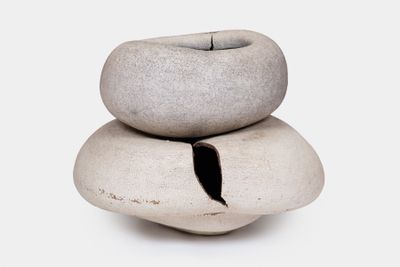
Kuroda marks the works with fragments of rice grains and integrates other materials in an unorthodox process of kintsugi. Through this art of repair, bamboo, antique paper, straw and coloured urushi, a Japanese lacquer, are introduced.
Hamana’s delicate and innovative works are well recognised. Notably, the artist exhibited with Minoru Nomata at White Cube, Paris, 2021. He has been exhibited internationally at institutions, including, Headlands Center for the Arts, CA, 2021; Towada Art Center, Japan, 2017; Yokohama Museum of Art, Japan, 2016.
He was selected for an exhibition curated by Japan’s leading artist, Takashi Murakami at Blum & Poe, Los Angeles and New York, 2015-2016. With prices ranging from $15-30,000, this first show has proved popular with healthy sales. —[O]
Main image: Kazunori Hamana, Yukiko Kuroda, Untitled (2019/2020). Ceramic, Urushi (Japanese lacquer) and tin. © Kazunori Hamana and Yukiko Kuroda. Courtesy the artists and Blum & Poe, Los Angeles/New York/Tokyo.


A respected voice in contemporary art discourse.
Focusing on ambitious storytelling and insightful art-world commentary. Ocula Magazine publishes in-depth interviews, critical essays and timely analysis on the artists, exhibitions and ideas driving the global art world.
Learn more about Ocula Magazine
Showcasing the best of the art world.
Ocula partners with galleries from around the world to highlight their artists, artworks and exhibitions. Gallery membership is by application and invitation, with each member vetted by an independent panel.
Learn more about Ocula Membership
Specialises in the sale of major artworks.
Led by a team with deep ties to the world’s leading auction houses, galleries and collectors. Ocula’s advisory team offers bespoke services to high-net-worth clients from around the world who are looking to acquire the best of contemporary and modern art.
Learn more about our team and services