





Johnson Chang on Leung Kui Ting
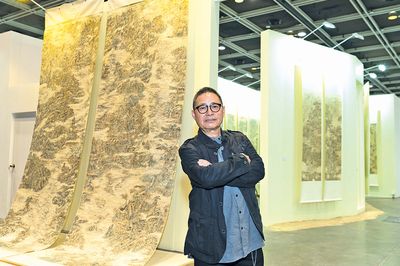
Leung Kui Ting. Courtesy Hanart TZ Gallery.
Born in Guangzhou in 1945, Leung Kui Ting moved to Hong Kong as a child and has since become a defining figure in the city’s New Ink landscape. Over several decades, his work has navigated the tension between continuity and rupture in Chinese painting, drawing classical literati motifs into conversation with contemporary visual culture and technologies. It is this layered practice that underpins his exhibitions at Hanart TZ Gallery in Hong Kong, where Leung’s landscapes—stitched with survey lines, grids, and broken ink strokes—have come to exemplify a distinctly Hong Kong articulation of ink’s afterlives.
Hanart TZ, founded by curator and gallerist Johnson Chang in 1983, has long served as a key platform for positioning artists such as Leung within broader debates about Chinese cultural lineage, modernity, and the evolution of shanshui. Chang, a pivotal advocate for Hong Kong and for contemporary Chinese art, has followed Leung’s trajectory from early experiments integrating Western and Chinese visual theories to his more recent “re-engineered” landscapes that register both ecological anxiety and digital-age perception. It is in the context of one such Hanart TZ exhibition, and this enduring curatorial relationship, that the following conversation between Chang and Anna Dickie took place, in which Chang reflects on Leung Kui Ting’s evolving ink practice, describing how he folds the contemporary into the traditional.
Leung Kui Ting is known to experiment with many different styles that combine classical ink painting with modern art concerns. Are you able to discuss this?
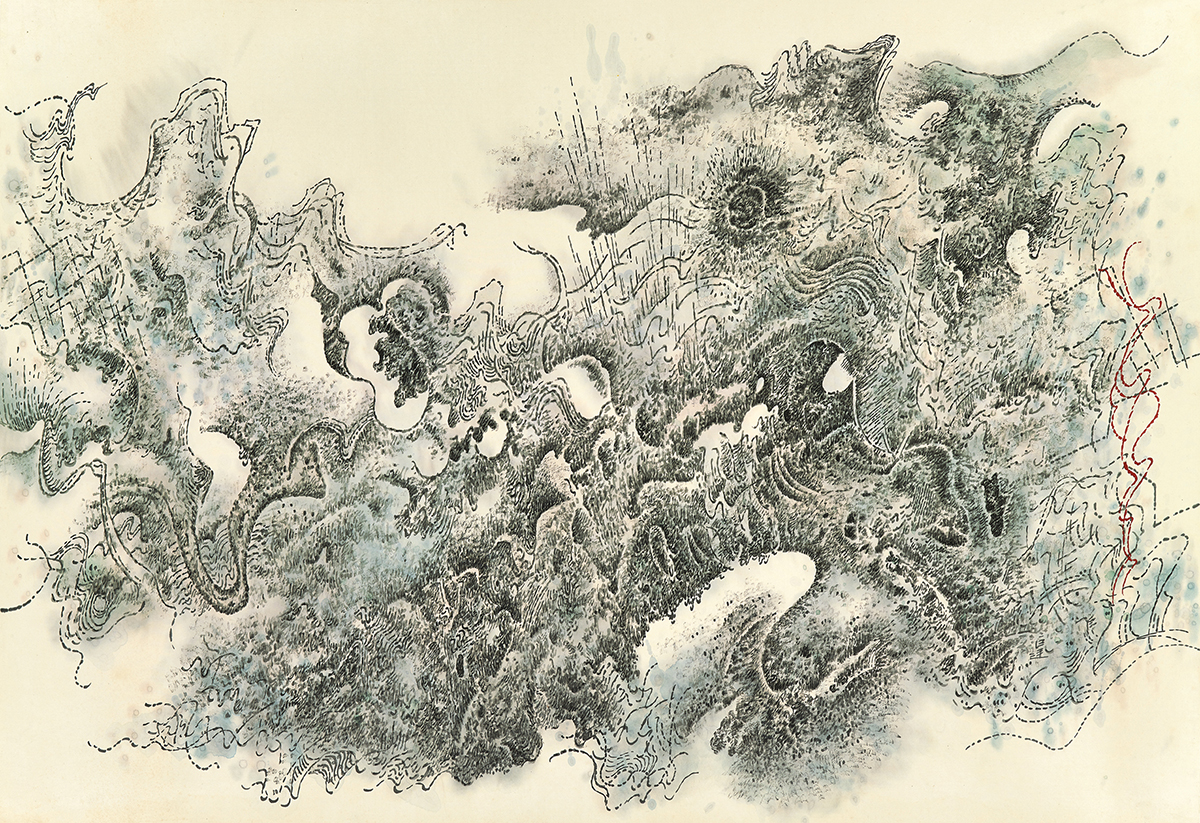
Leung Kui Ting’s works embrace a new, integrated narrative, where the contemporary becomes organically infused with the traditional. The broken ink-line that emerged as an important texture stroke in his art at this time is a symbol inspired by Chinese calligraphy but transformed into a new language. In his new compositions, he begins to create a new methodology to reflect a contemporary view. The combination can be seen in his ‘Words from Stones’ series. It emphasises the structural elements of the stone to create interior worlds that are both complex and strange, in some ways expressing the chaos and confusion of history, while his three-dimensional installations show a transition from two-dimensional pictorial space to three-dimensional space and towards constructing a pathway from illusion to reality.
Leung trained as a graphic designer and this appears to have influenced his work?
Leung’s training in graphic design raised his awareness of the flatness of the painting surface. This awareness is made evident by the joint process of graphic dissection and freestyle brushwork. This issue of ‘flatness’ has been important for Western modern artists when challenging the illusionistic tradition of representational oil painting. It was particularly topical in the 1960s in America among practitioners of abstract art. For Chinese ink painters, the awareness of flatness was never an issue because representational illusion was never a dominant force. What this technique does bring to attention—when used by Hong Kong New Ink artists—is modern urban man’s alienation from nature in the brave new world of virtual-real representation.
The rocks, trees and mountains that have been the subject of the literati painters often feature in Leung’s work. Can you discuss this focus in more detail?
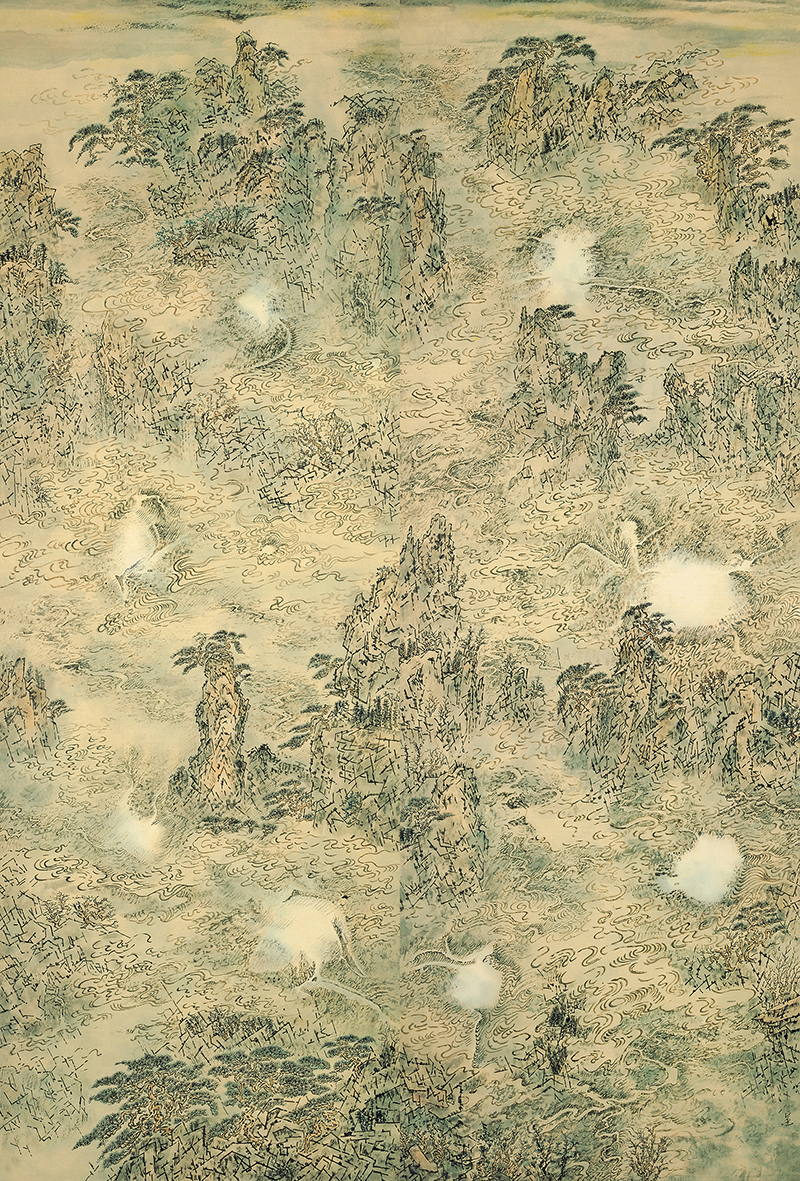
Leung Kui-Ting’s paintings constitute his answer to challenges faced by traditional landscape art in an era when nature is violated by massive human intervention and pollution. Leung uses contemporary technological visuality as a tool to re-engineer certain landscape painting genes, without diminishing landscape’s fundamental qualities of spirit-resonance (qiyun) and integral grace (quwei). Leung’s recent works speak to the fact that the geographical perspective of landscape art has already been modified through the imposed perspective of the ubiquitous monitor screens of global positioning. He brings the geometrical lines of scientific survey and of monitor screens into his paintings, and incorporates the grid-line as the basis of his texture strokes (cunfa). Cunfa is the technical foundation of traditional landscape—the gene of its mountains and rockery. A renovation of cunfa is nothing short of a radical remake of Chinese landscape art.
Leung’s work features in The Weight of Lightness: Ink Art (13 October 2017at M+—the museum’s first presentation of ink art. Can you discuss his work in the context of this exhibition?
The major museum exhibition, The Weight of Lightness: Ink Art at M+ in Hong Kong, features an early work by Leung Kui Ting that demonstrates his experiments with the material and language of Chinese ink landscape painting, as well as his repositioning of perspective. Since then, Leung has developed a new method of spatial juxtaposition and of interfering with the traditional methods of texture strokes (cunfa) in mountain landscapes (shanshui).—[O]
Main image: Leung Kui Ting. Courtesy Hanart TZ Gallery.

A respected voice in contemporary art discourse.
Focusing on ambitious storytelling and insightful art-world commentary. Ocula Magazine publishes in-depth interviews, critical essays and timely analysis on the artists, exhibitions and ideas driving the global art world.
Learn more about Ocula Magazine
Showcasing the best of the art world.
Ocula partners with galleries from around the world to highlight their artists, artworks and exhibitions. Gallery membership is by application and invitation, with each member vetted by an independent panel.
Learn more about Ocula Membership
Specialises in the sale of major artworks.
Led by a team with deep ties to the world’s leading auction houses, galleries and collectors. Ocula’s advisory team offers bespoke services to high-net-worth clients from around the world who are looking to acquire the best of contemporary and modern art.
Learn more about our team and services