




Time Machine: Hiroshi Sugimoto Reflects on 4 Photographic Series
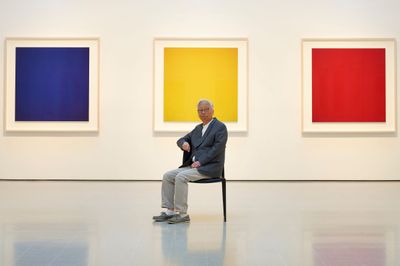
Hiroshi Sugimoto with his 'Opticks' series at the Hayward Gallery, London. Photo: Rachael Smith.

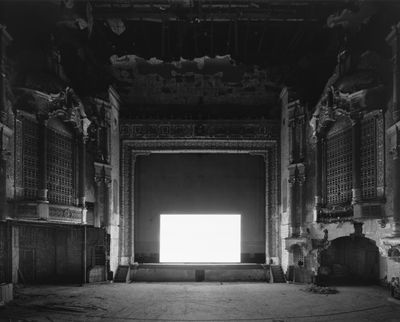
Hiroshi Sugimoto‘s photographic practice is a contradiction. Grounded in thoughtful study and technical excellence, his work has a meditative quality that embodies both Conceptual art’s conviction for idea over form and Buddhism’s philosophy that form is emptiness. Yet he is also happy to experiment with photography’s trickery; to take us for a walk around a volcanic landscape with early man, put us in the room with a surprisingly lifelike rendering of Napoleon Bonaparte, or show us the impossibility of a darkened theatre bathed in light.
A master of analogue processes, Sugimoto often uses an 8x10 large-format camera and develops his images on film. On other occasions, he purposely blurs images or harnesses 400,000 volts of electricity to produce a photograph.
Hiroshi Sugimoto: Time Machine (2 August–27 October 2024) is currently on view in Sydney at the Museum of Contemporary Art Australia. It is the third iteration of Sugimoto’s most comprehensive survey, previously shown at the Hayward Gallery in London (2023) and the UCCA Center for Contemporary Art in Beijing (2024).
Sugimoto has described his practice as a ‘time machine’, and nearly 100 works from 1972 to 2022 bring this vision to life in the MCA exhibition. I spoke with Sugimoto in Sydney on the eve of the exhibition opening, where he talked about four of his acclaimed series of photographs on show, from the early ‘Sea of Buddha’ to the more recent ‘Opticks’.
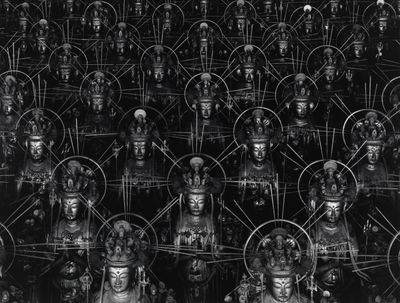
1. ‘Sea of Buddha’ (1995)
The series ‘Sea of Buddha’ takes us back to 12th-century Japan. Sugimoto negotiated for years with temple authorities for permission to photograph the 1,001 Buddhas of Sanjusangendo (the temple of 33 bays) in Kyoto. Viewing the work is a kind of meditation of looking, and the observant viewer is rewarded with the realisation that each boddhivista is unique.
HS: This is the 12th-century idea of presenting the image of heaven—Buddha is welcoming you after you die and bringing you up to heaven. Every one of the Buddhas has a different face and different ornament. It was a crazy amount of energy to spend. When I saw Walter De Maria’s [installation], The Broken Kilometer (1979), in New York City in the seventies, I saw a similar concept between the broken kilometre composed of 500 solid-brass rods and these 1,001 gold-leaf Buddhas. I thought, even 12th-century Japanese art can be conceptual.
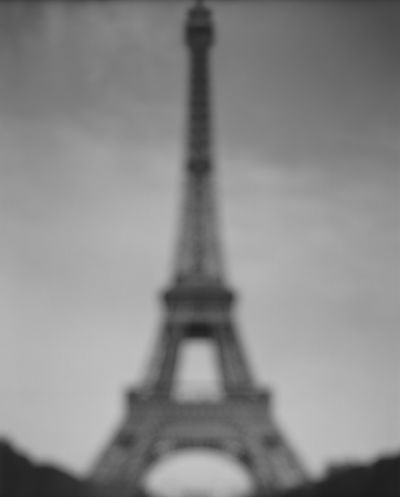
2. ‘Architecture’ series (1997–ongoing)
The ‘Architecture’ series, where images of iconic buildings are blurred, appear to be about memory and perception: we don’t need sharp detail to recognise these buildings as they are already mapped in our brains. There is something that happens with the blurring: it’s a personal, emotional kind of response that perhaps wouldn’t occur with an in-focus image.
HS: I developed an interest in architecture early in my photographic practice. When I started showing my pieces in major museums and I was given floor-section plans and wall-section plans, I started designing the space with an old-fashioned drafting machine. Then, I designed my own studio and my apartment in Tokyo, and I always worked with traditional Japanese craftsmen. Even in New York—we moved to the current studio in 2001—in one year of construction all our staff became craftsmen and carpenters, even welding the pipes for the darkroom. So, craftsmanship is very important.
“I had the idea to set the focus beyond the infinity point
I was commissioned in 1997 by Museum of Contemporary Art, Los Angeles, to photograph 20th-century architecture, and I spent a year or two just travelling around the world photographing these iconic buildings. I had the idea to set the focus beyond the infinity point—to twice infinity—which, in the end creates the blurred effect.
The buildings are mostly around a hundred years old, very decayed; some houses, the paint is peeling off. But if I can make it out of focus, it’s more representative of the first image the architect imagines or envisions—that’s the theory. Even after it is blurred, it won’t melt, it just stays. The core visions of the shape stay strong.
Through the process everything is melted and even creates a beautiful kind of skin. These are ideal visions ... architects usually have to fight with the conditions, the budget, and other people’s requests. So probably the first inner vision that they conceived might be like my blurred photography.
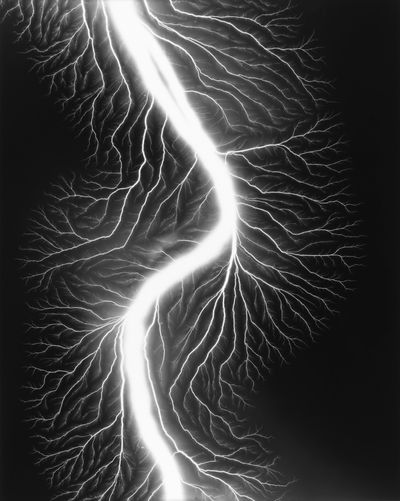
3. ‘Lightning Fields’ (2006–ongoing)
In a practice where thoughtful study and patience leave little to chance, ‘Lightning Fields’ feels like the artist’s Wild West, an experimental suite that puts the camera aside and works directly with an electricity generator and Himalayan salt to create organic, otherworldly images on photographic paper. Although this off-grid adventure might seem out of control, it is Sugimoto’s interest in the history of science and in scientific processes that is at the heart of the project.
HS: This is an experimental series; it still uses a photographic process of developers and fixers, but there is no camera at all—no lens. It was an interesting idea for me to test the phenomenon of electricity, which William Henry Fox Talbot studied alongside his friend Michael Faraday, whose formulation of the law of electromagnetic induction led to the invention of electric generators and transformers.
“It’s an amazing phenomenon when organic shapes start appearing.
I found many devices that Talbot tested with Faraday when they were conducting experiments, and the relationship to photography interested me. In the early stages of scientific research and through his study of electricity, Talbot happened to discover a way to fix the visual changes of light-sensitive silver nitrate, and so came the invention of photography. Mine is a similar line of inquiry: I’m curious about the science.
We invented many tools in the process [of creating the works] and used many materials: steel, copper, huge sheets of aluminium. The film is very large too, over a metre. We used a Van de Graaff generator—a modern version of the electrostatic devices that Talbot used. The negative side of the generator is connected to a metal sheet, which the film is set on, and the positive side is connected with what is called a discharge wand. As I charged the film, the air around me became charged. The static charge builds up on the surface of the film and then discharges to the metal plate like a bolt of lightning. It made the hair on my arms stand up.
It’s an amazing phenomenon when organic shapes start appearing. We used Himalayan salt [to create these patterns], made millions of years ago when the Himalayan mountains were under the sea, so the salt is made from ancient materials. I wanted to try to recreate the right conditions for the formation of life. So maybe I should continue studying; if I find the origins of life, I will win the Nobel Prize [laughs].
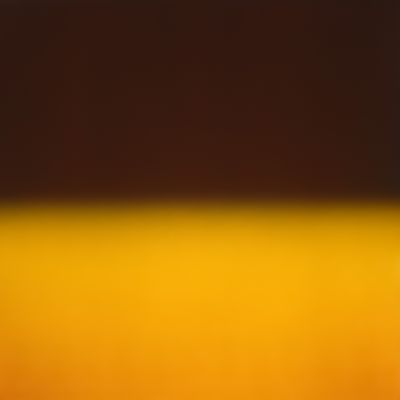
4. ‘Opticks’ (2018–ongoing)
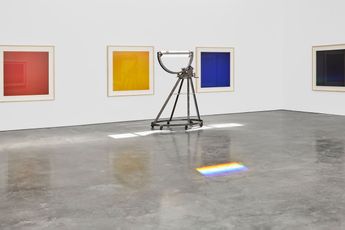
Sugimoto’s ‘Opticks’ series represents his first foray into colour, offering the awe of imagining a sunrise or sunset from space. In reality, these squares of stunning beauty are created via a precisely placed prism to capture the rainbow colours of light.
HS: Their purpose is to describe how beautiful light and colour can be. Some have compared these with paintings by Rothko. I think I have an advantage, compared to painters who are using pigment as a material, as I use the photon through photography to represent light itself. It’s a more direct relationship with the quality of the light that is reproduced as photography. For painters, it’s always a reflection of the pigment, while mine is a straight, pure translation from the light. I think I have an advantage. But price wise, there’s no comparison. I am discriminated against [laughs]. —[O]
Hiroshi Sugimoto: Time Machine is on view at the Museum of Contemporary Art Australia until 27 October 2024.
Main image: Hiroshi Sugimoto with his 'Opticks' series at the Hayward Gallery, London. Photo: Rachael Smith.

A respected voice in contemporary art discourse.
Focusing on ambitious storytelling and insightful art-world commentary. Ocula Magazine publishes in-depth interviews, critical essays and timely analysis on the artists, exhibitions and ideas driving the global art world.
Learn more about Ocula Magazine
Showcasing the best of the art world.
Ocula partners with galleries from around the world to highlight their artists, artworks and exhibitions. Gallery membership is by application and invitation, with each member vetted by an independent panel.
Learn more about Ocula Membership
Specialises in the sale of major artworks.
Led by a team with deep ties to the world’s leading auction houses, galleries and collectors. Ocula’s advisory team offers bespoke services to high-net-worth clients from around the world who are looking to acquire the best of contemporary and modern art.
Learn more about our team and services