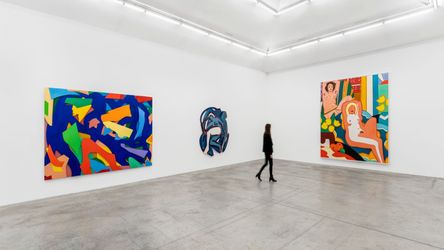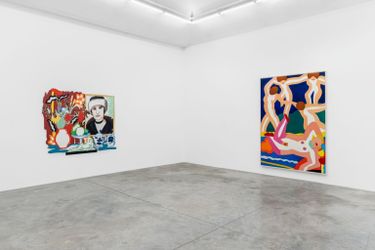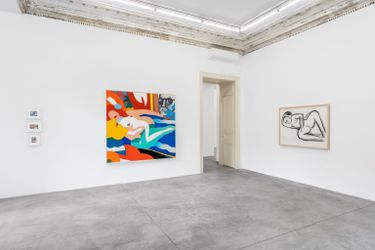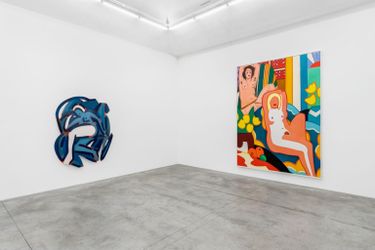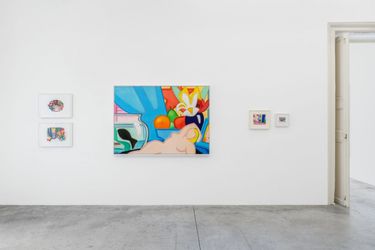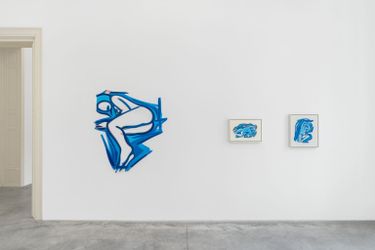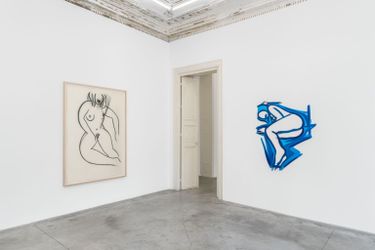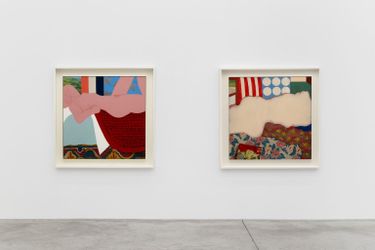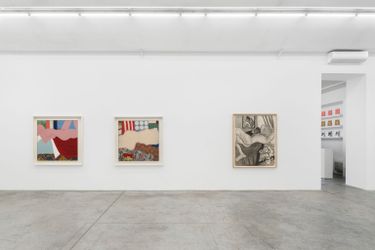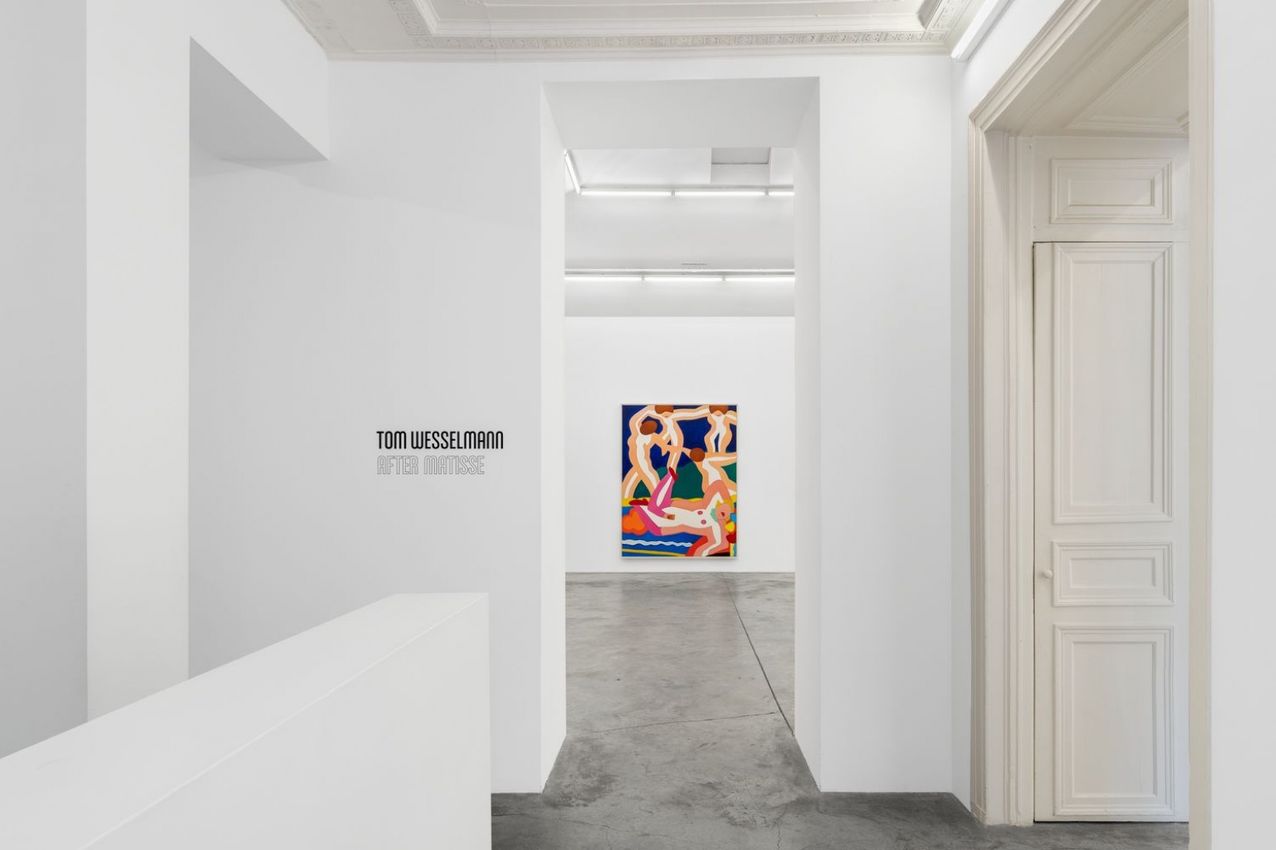
Almine Rech Paris is pleased to present Tom Wesselmann’s fourth solo exhibition with the gallery, on view from 11 June to 30 July 2022.
Tom Wesselmann (1931–2004) forged his distinctive, figurative fusion of colour and line through a longtime engagement with Matisse. Wesselmann first learned about the French master while studying at Cooper Union (1956–1959), where his teacher Nicholas Marsicano encouraged him ‘to find your own way. . . You can’t do what Matisse did.’1
Wesselmann’s goal to bypass De Kooning and find his own direction was satisfied by his adaptations of the controlled, precise contours; bold, flat colours; and sensual imagery popularised by Matisse2. The exhibition of Matisse’s cut-outs in 1961 at the Museum of Modern Art, New York, may have reaffirmed his interest in Matisse as a precedent for exploring variations of a subject in serial form.3
Wesselmann repeatedly referenced Matisse in the Great American Nude series, launched in 1961— eventually creating one hundred works, spanning almost ten years. In the 1980s Wesselmann launched a series of laser-cut, painted metal drawings, several of which were based on one of his favourite models, Monica Serra4. Wesselmann also created a series of cut-out aluminium still lifes adapting Matisse’s motifs in the 80s, amplifying this theme in the 1990s in such homages to Matisse and his contemporaries as Still Life with Matisse and Johns (3D) of 19935. Wesselmann saw the the landmark 1992 Matisse retrospective at the Museum of Modern Art which was an’“overwhelming’ experience for him.
Wesselmann’s last major series, the monumental Sunset Nudes, were among his most ambitious and chromatically brilliant, asserting ‘in no uncertain terms his allegiance to Matisse.’6 As observed by John Wilmerding, Matisse seemed to return to Wesselmann during his final months, ‘not just as his most potent inspiration but also as an almost hallucinatory vision.‘7 As Wesselmann was slowed down by heart disease, he perhaps found allegiance with Matisse, who had faced his own daunting challenges late in life. The master himself appears in Sunset Nude with Matisse Self-Portrait and related studies in the form of a 1937 self-portrait charcoal drawing, ‘in convincingly trompe l’oeil shades of black and white.’8 Gazing at the artist and the viewer, Matisse surveys an eroticised, schematic nude with turquoise stockings embedded in an abstract colourful environment evoking the precisely contoured forms and hedonistic warmth of Matisse’s cut-outs. The Matisse references in these late works are painted rather than collaged, creating a greater sense of unity among polarities shared by the two artists: colour and line, abstraction and figuration, sensuality and intellect.
For Wesselmann, Matisse’s work served as a springboard into a more overt, brash eroticism that is specifically American. Noting his own use of oversimplified curves and greater involvement with strongly coloured, positive/negative shapes to disrupt compositional harmony, Wesselmann stated, ‘Subtlety is the European concept and does not interest me.’9 Nevertheless, Wesselmann’s oeuvre, especially his late work, suggests that he saw himself as an American heir of Matisse’s, flouting decorum with the discipline of a highly skilled artist who made multiple studies and worked in a variety of mediums. Consulting his library of Matisse publications from 1931 to 1992, Wesselmann created inventive variations on Matisse’s classic themes of the nude and the still life that are highly original compositions in their own right.10
— Gail Stavitsky, author and Chief Curator, Montclair Art Museum
1 Wesselmann, interview with Irving Sandler, January 3–February 8, 1984, Archives of American Art, Smithsonian Institution, Washington, D.C., p. 12. See also John Wilmerding, Tom Wesselmann: His Voice and Vision (New York: Rizzoli, 2008), p. 36, citing the importance of Ernst Gombrich’s The Story of Art for introducing Wesselmann to art-historical precedents for the nude and to Matisse.
2 David McCarthy, The Nude in American Painting, 1950–1980 (Cambridge and New York: Cambridge University Press, 1998), pp. 92–94.
3 Wesselmann did not, however, own a copy of the exhibition catalogue and there are no journal entries referring to him visiting the show; information courtesy of Jeffrey Sturges.
4 Wilmerding, Tom Wesselmann, p. 144, 160.
5 Ibid.
6 Richard Kalina, “Pop’s High Modernist,” Art in America (December 2006): 126.
7 Wilmerding, Tom Wesselmann, p. 253.
8 Judd Tully, Tom Wesselmann—Sunset Nudes, exh. cat. (New York: Robert Miller Gallery, 2006), n.p.
9 Journal, year, p. 4, copy courtesy of Jeffrey Sturges. See also Slim Stealingworth, Tom Wesselmann, pp. 18–20: “The ideal was competition rather than harmony. . . . The curves were not from Matisse; they were a means to help the positive and negative shapes break free from each other.”
10 There are eleven publications on Matisse in Wesselmann’s library, including several with marked pages, such as the 1970 centenary exhibition catalogue.


Tom Wesselmann was born in Cincinnati, Ohio, on February 23, 1931. He attended Hiram College in Ohio from 1949 to 1951 before entering the University of Cincinnati. In 1953, his studies were interrupted by a two-year enlistment in the army, during which time he began drawing cartoons. He returned to the university in 1954 and received a bachelor’s degree in psychology in 1956. During this time, he decided to pursue a career in cartooning and so enrolled at the Art Academy of Cincinnati. After graduation he moved to New York City, where he was accepted into the Cooper Union and where his focus shifted dramatically to fine art. He received his diploma in 1959.


Almine Rech opened its doors on April 1st, 1997 in the 13th arrondissement in Paris. The gallery was founded on an axis of California Minimal, Perceptual art and Conceptual art, representing artists such as James Turrell, John McCracken and Joseph Kosuth.

A respected voice in contemporary art discourse.
Focusing on ambitious storytelling and insightful art-world commentary. Ocula Magazine publishes in-depth interviews, critical essays and timely analysis on the artists, exhibitions and ideas driving the global art world.
Learn more about Ocula Magazine
Showcasing the best of the art world.
Ocula partners with galleries from around the world to highlight their artists, artworks and exhibitions. Gallery membership is by application and invitation, with each member vetted by an independent panel.
Learn more about Ocula Membership

Specialises in the sale of major artworks.
Led by a team with deep ties to the world’s leading auction houses, galleries and collectors. Ocula’s advisory team offers bespoke services to high-net-worth clients from around the world who are looking to acquire the best of contemporary and modern art.
Learn more about our team and services