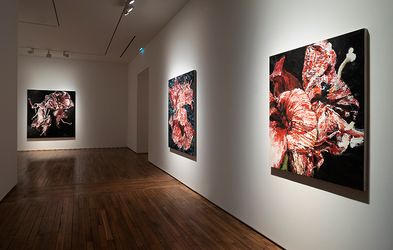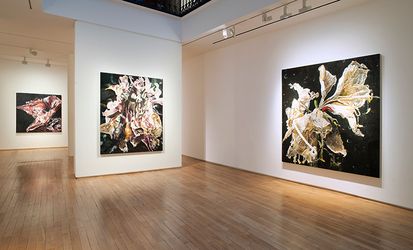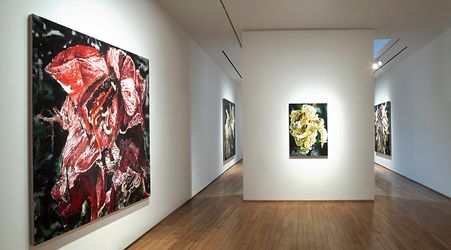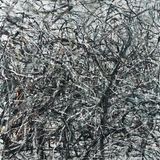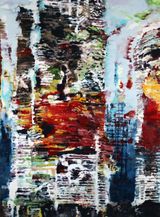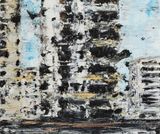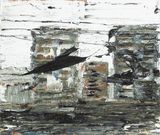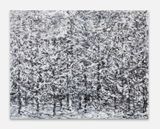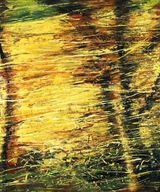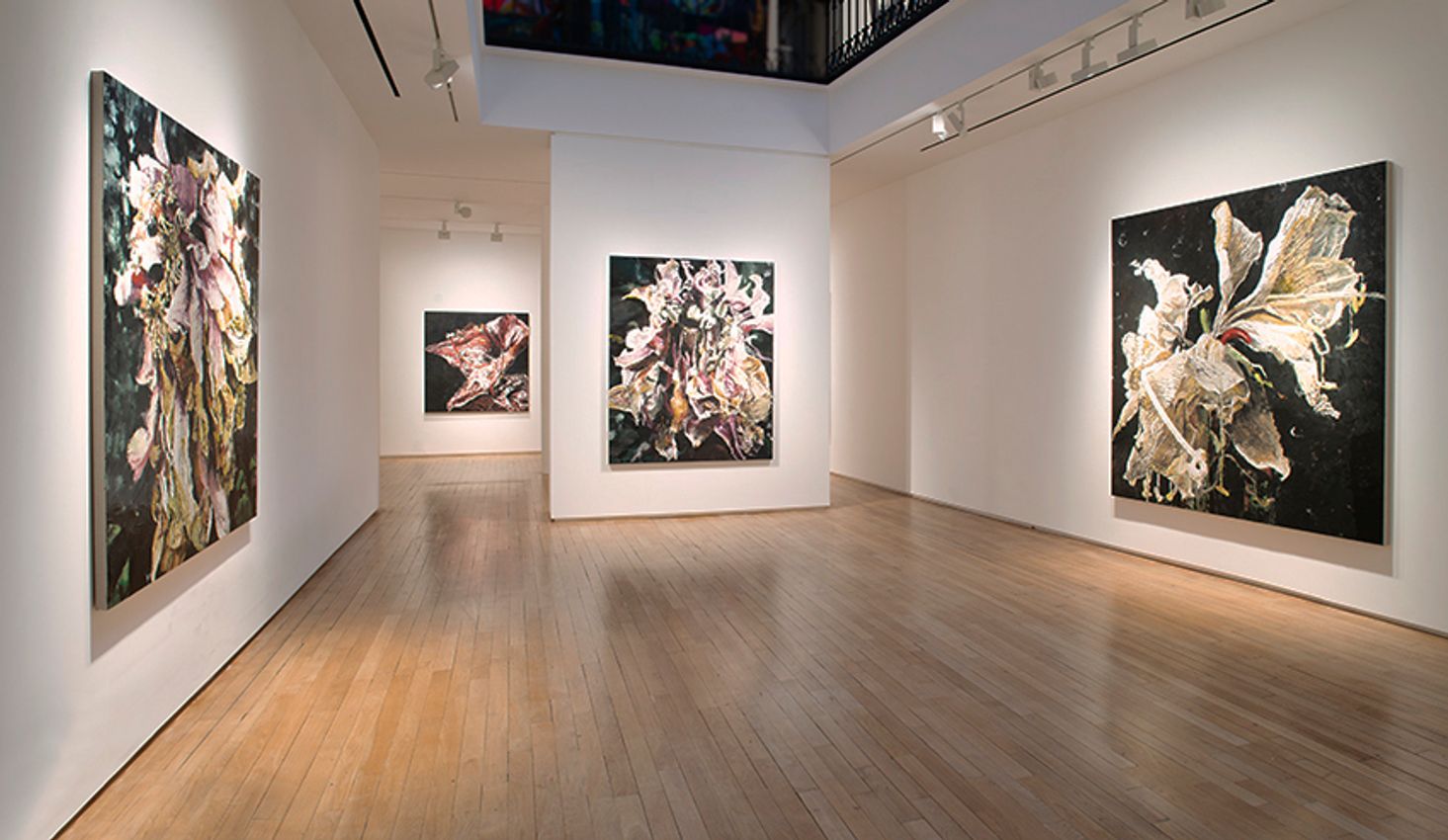
For his return to Galerie Templon, the painter Philippe Cognée, famous for his blurred wax-paintings, is branching off in a radically different direction. After exploring supermarkets, highways, skyscrapers and slaughterhouses, his focus is now on flowers, which he masterfully metamorphoses into monumental vanities.
For many years, Philippe Cognée seemed obsessed with everyday life. He made a name for himself with his monochrome paintings of fridges and washing machines that filled the entire plane of the canvas. Observing the world through the prism of photography, video or Google map, he developed large scale compositions featuring high-rises, supermarkets, roads, deserted suburbs and anonymous crowds, toeing the line of abstraction. His visual language of richly textured and sensual wax, melted, crushed, ripped off with plastic film, offered a stark contrast to an ostensibly dull and uniform reality. The challenge was of a tall order: demonstrating how art could still surprise us with an original interpretation of our environment and bring out the sublime within a uniform, modern and often disembodied reality.
By embracing the theme of flowers, Philippe Cognée seems to have chosen yet another banal subject. His sunflower hearts, peonies and amaryllis, dried or wilted, are, however, so vastly enlarged and so deformed by the wax that they are hardly recognizable. His encaustic techniques have become more complex than ever. Applied with a brush or slow-dripped, smoothed with an iron or artificially corrugated, wax presents itself as a material split between two states, echoing the ephemeral in-between state of these flowers, between life and death.
These new pieces seem to reconnect with the fundamentals of painting, evoking traditional Flemish still life bouquets as well as Vincent Van Gogh and Georgia O’Keeffe. Through this process, however, Philippe Cognée is also confronting the fundamentals of his own practise. His proliferating flowers echo a nature full of magic and mystery, as fragile as it is indomitable, a possible legacy of his childhood spent in Benin. They act as the ‘memento mori’ haunting many of his past series such as those dedicated to recycling factories (2005), vanities (2006) and slaughterhouses (2008).
At a time when the question of civilizational and environmental decline torments our societies, Philippe Cognée offers an exhilarating yet subtle answer: a ‘poetry of decadence.’
Born in 1957, Philippe Cognée works between Nantes and Paris. A Villa Medici’s laureate in 1990 and nominated for the Prix Marcel Duchamp in 2004, Philippe Cognée was professor at the Paris Ecole Nationale Supérieure des Beaux Arts for many years.His work has been the subject of numerous solo exhibitions, including at MAMCO (Museum of Modern and Contemporary Art), Geneva (2006), the FRAC Haute Normandie (2007), Musée de Grenoble (2013), Château de Chambord (2014) and Fondation Fernet-Branca de Saint Louis (2016). His work features in a great many museum collections, such as at the Musée National d’Art Moderne - Centre Pompidou, Fondation Cartier and Collection Louis Vuitton in Paris as well as the Museum Ludwig in Cologne and Musée Cantonal des Beaux-Arts in Lausanne. His work will be at the heart of an exhibition at the Domaine de Chaumont-sur-Loire in 2020 and Musée Bourdelle in Paris in 2021.Philippe Cognée has been represented by Galerie Templon since 2002.


Philippe Cognée was born in 1957 in Nantes, France, where he lives and works. His paintings use wax that is heated and crushed, producing a blurred effect and raising questions such as the thinning away of the image and the human condition in the light of humans’ relationship to their urban environment. The artist draws inspiration from photos and videos of elements such as motorways, buildings and aerial shots. His work questions the role of art in a society where new digital technologies have ushered in the era of the image, both omnipresent and diminished.


The gallery was founded in 1966 by Daniel Templon, who was then only 21. It first opened rue Bonaparte, in Saint-Germain-des-Prés in Paris, before moving in 1972 to its current location, rue Beaubourg, in the Marais, close to the Pompidou Center, which opened in 1977. Daniel Templon first gained recognition by exhibiting conceptual and minimal artists such as Martin Barré, Christian Boltanski, Donald Judd, Joseph Kosuth, Richard Serra. In the seventies and eighties, Daniel Templon was one of the pioneers of the contemporary art and introduced many important American artists to the French public: Dan Flavin, Ellsworth Kelly, Willem de Kooning, Frank Stella, Andy Warhol. The gallery quickly became one of the references in contemporary art in France. In 1972, Daniel Templon and Catherine Millet co-founded the monthly art magazine ART PRESS.

A respected voice in contemporary art discourse.
Focusing on ambitious storytelling and insightful art-world commentary. Ocula Magazine publishes in-depth interviews, critical essays and timely analysis on the artists, exhibitions and ideas driving the global art world.
Learn more about Ocula Magazine
Showcasing the best of the art world.
Ocula partners with galleries from around the world to highlight their artists, artworks and exhibitions. Gallery membership is by application and invitation, with each member vetted by an independent panel.
Learn more about Ocula Membership

Specialises in the sale of major artworks.
Led by a team with deep ties to the world’s leading auction houses, galleries and collectors. Ocula’s advisory team offers bespoke services to high-net-worth clients from around the world who are looking to acquire the best of contemporary and modern art.
Learn more about our team and services