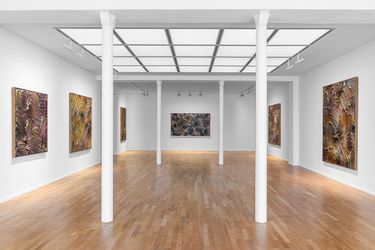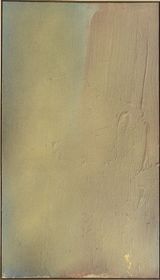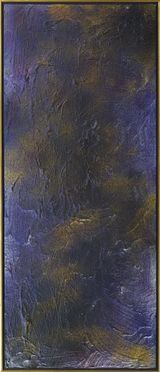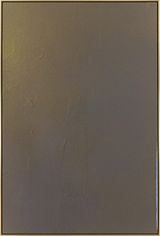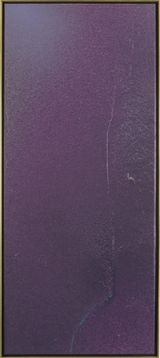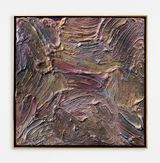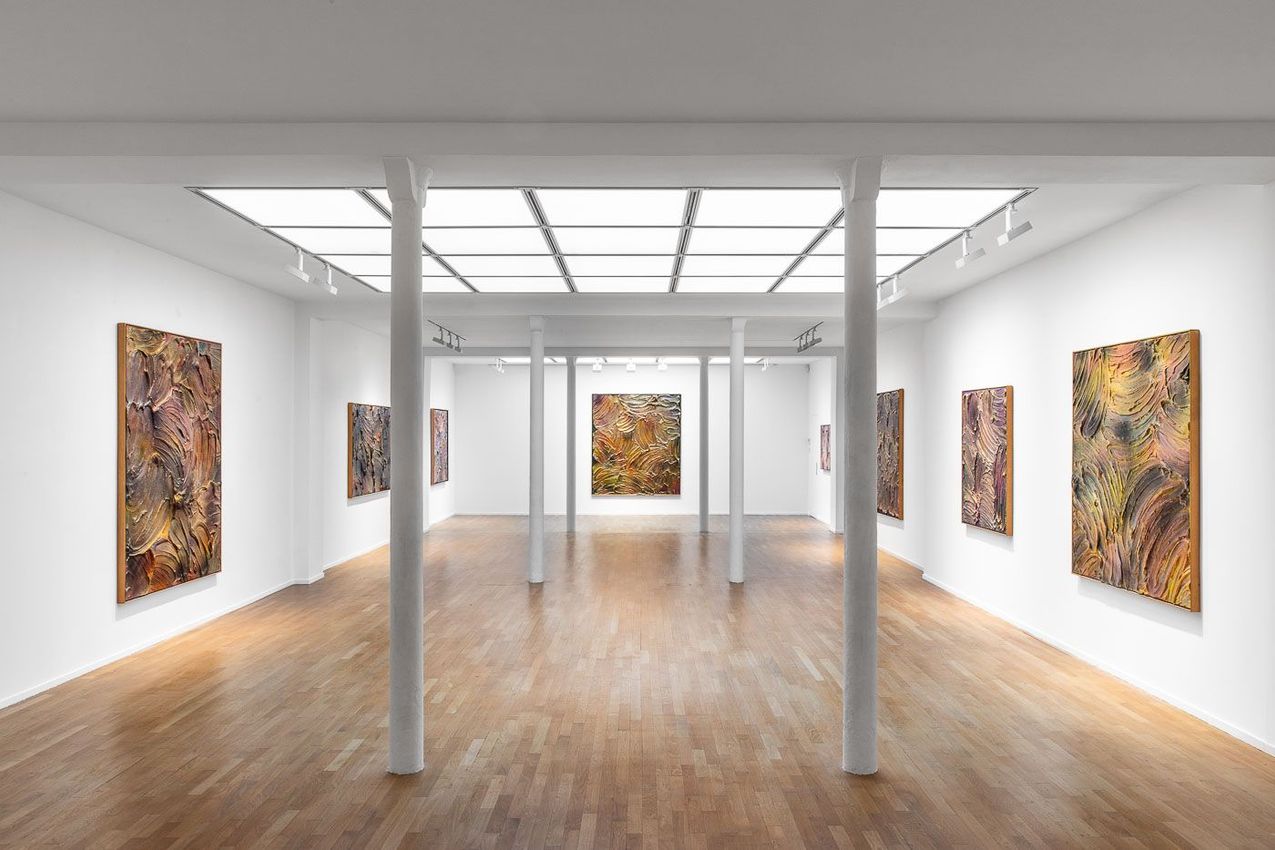
The series of Mitt paintings, not often exhibited during Jules Olitiski’s lifetime, bear witness to his unwavering passion for experimenting with colour and light. In the late 80s he was one of the first artists to grasp the brand-new artistic possibilities of the new range of paints supplied by Golden Artists Colors Inc., the pioneering acrylic paint company. After throwing and spraying an abundance of material and raw colour on the canvas, Olitski used mittens to spread it in a ballet of ample rippling movements that only looked improvised. The works shatter the codes of “simple” painting while flirting with the codes of sculpture. The canvases reveal a subtle play of surfaces where both the acrylic paint and the light are sensually sculpted. In the artist’s hands, the material is alternately luminous or sombre, matt or glowing, elastic or adhesive.
Starting in the 60s, Olitski pioneered an experimental practice, termed “modernist”, making it possible “to experience painting as painting” (Michael Fried). He then shifted to an approach unfettered by modernist leanings, oscillating between the materiality and immateriality of colour. With the Mitt paintings, he no longer confined himself to questioning the essence of the painting; the works also delve into the ambiguous nature of its surface and the notion of the random, in the form of the mysterious bond between hand and picture. The series thus marks the culmination of decades of artistic exploration and reflection on the power of the abstract.

Born in 1922 in Soviet Russia, Jules Olitski emigrated to the USA at a very young age. He was a master of Color Field Painting. After perfecting a spray-painting technique for laying colour onto his canvases, in the 1970s he went on to develop new techniques, spreading colours with a cloth or scraper or laying them on with a roller to create thickly structured surfaces. Jules Olitski died in 2007.


The gallery was founded in 1966 by Daniel Templon, who was then only 21. It first opened rue Bonaparte, in Saint-Germain-des-Prés in Paris, before moving in 1972 to its current location, rue Beaubourg, in the Marais, close to the Pompidou Centre, which opened in 1977. Daniel Templon first gained recognition by exhibiting conceptual and minimal artists such as Martin Barré, Christian Boltanski, Donald Judd, Joseph Kosuth, Richard Serra. In the seventies and eighties, Daniel Templon was one of the pioneers of the contemporary art and introduced many important American artists to the French public: Dan Flavin, Ellsworth Kelly, Willem de Kooning, Frank Stella, Andy Warhol. The gallery quickly became one of the references in contemporary art in France. In 1972, Daniel Templon and Catherine Millet co-founded the monthly art magazine ART PRESS.

A respected voice in contemporary art discourse.
Focusing on ambitious storytelling and insightful art-world commentary. Ocula Magazine publishes in-depth interviews, critical essays and timely analysis on the artists, exhibitions and ideas driving the global art world.
Learn more about Ocula Magazine
Showcasing the best of the art world.
Ocula partners with galleries from around the world to highlight their artists, artworks and exhibitions. Gallery membership is by application and invitation, with each member vetted by an independent panel.
Learn more about Ocula Membership

Specialises in the sale of major artworks.
Led by a team with deep ties to the world’s leading auction houses, galleries and collectors. Ocula’s advisory team offers bespoke services to high-net-worth clients from around the world who are looking to acquire the best of contemporary and modern art.
Learn more about our team and services