Esther Schipper is pleased to announce Ballardian House, Jean-Pascal Flavien’s second solo exhibition with the gallery.
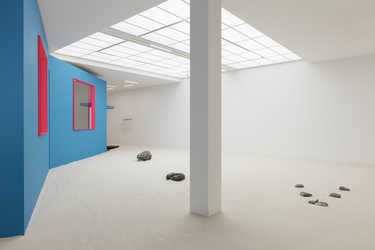
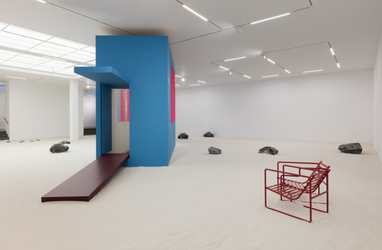
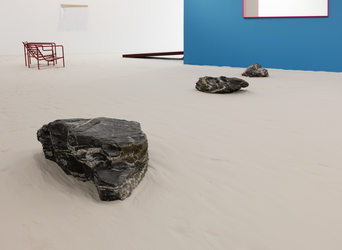
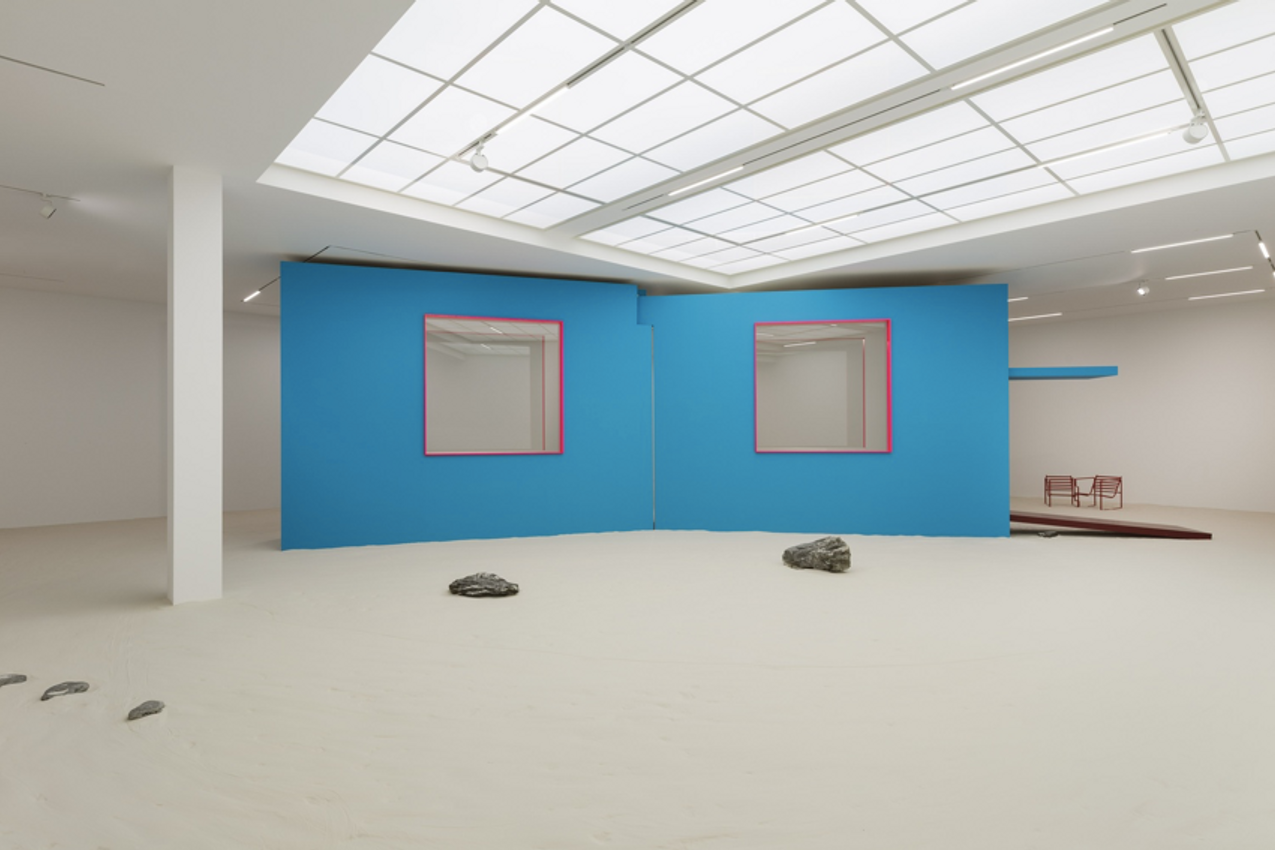
Jean-Pascal Flavien has constructed a life-sized house within the exhibition space. Set in the midst of a sandy ground with a number of rocks, the environment evokes a desert. Made of two near identical structures, posed at an angle and apparently held by a central hinge, the house, entitled ballardian four, addresses a notion of doubling, coupling, and splitting—processes that continue throughout the exhibition. The two parts constitute separate but connected elements: while one section of the house is accessible and may accommodate a living inhabitant, its double is inhabited only by a stone. The landscape thus enters the building and becomes trapped in this museum-like space: like a vitrine, the closed-off structure holds its contents in a state of being looked at. Building and landscape are contingent, organizing one another in a reciprocal exchange of qualities.
Ballardian House creates a concrete setting, while evoking an entire fictional universe. Dissolving demarcation between mental space, built structure and surrounding landscape, Jean-Pascal Flavien’s house draws on the writings of J.G. Ballard whose highly charged dystopian scenarios often displace psychological and existential conditions onto buildings and landscapes. The house will include custom-made furnishings, specific to its premise, drawing both on Jean-Pascal Flavien’s formal vocabulary and on a condensed Ballardian world. New sculptural works inside the building will also draw on texts: represented by conglomerates of citations from Ballard’s writing, these works are neither real nor abstract but exist at once in multiple fictional locations and realities—as if the words were bringing to completion what is not physically present. In addition, the landscape outside the house will include a pair of entangled chairs that echo the house’s act of doubling yet also invoke the presence of inhabitants, just as doubling rows of small boulders recall an archaic meeting place but also incorporates an instance of mirroring. The sculptures can appear to shift between states: at times present as discrete objects, at others fusing more resolutely chameleon-like into the fantastic landscape Ballardian House conjures up.
Jean-Pascal Flavien’s practice combines elements from architecture, sculpture, and the performative. The artist’s houses are based on imaginary settings imposed by the artist and/or requirements determined by function and imagined site. Each house bespeaks certain circumstances (technical, aesthetic and existential) but in turn may also itself produce such conditions. The structures are conceptual entities, representing ideas, locations, and events in which the architectural conditions can determine the behavior of its inhabitants (and vice versa).
Jean-Pascal Flavienwas born in 1971 in Le Mans, France. He studied Fine Arts in Rennes, Bologna, Lorient, and participated in the Graduate Program of the University of California, Los Angeles. The artist lives and works in Berlin.
Flavien’s recent solo exhibitions include: dancers sleeping inside a building, Les Ateliers de Rennes – Biennale d’Art Contemporain, Musée de la Danse, Rennes (2016); folding house (to be continued), NMNM – Nouveau Musée National de Monaco (2016); folding house, NMNM – Nouveau Musée National de Monaco (2015); statement house (temporary title), RCA, London (2015); night house at daytime, textes de nuit, Angle Art Contemporain, Saint-Paul-Trois-Châteaux (2013); Cinonema, no drama cinema, South London Gallery, London (2012); breathing house, la maison respire, Parc Saint Léger, Centre d’art contemporain, Pougues-les-Eaux (2012); Jean-Pascal Flavien, Kunstverein, Langenhagen (2012), and PLAY, HEDAH/Jan van Eyck Academie, Maastricht (2011).
Recent group exhibitions include: The Way We Perform Now, Ujazdowski Castle – Centre for Contemporary Art, Warsaw (2017); Meeting Points 8, Beirut Art Center, Beirut (2017); Variable Dimensions – Artists and Architecture, MAAT, Lisbon (2017); The House of Dust by Alison Knowles, The James Gallery, New York (2016); Jump, CAC Brétigny – Centre d’Art Contemporain, Brétigny-sur-Orge (2016); L’Esprit du Bauhaus, Musée des Arts décoratifs, Paris (2016); De toi à la surface, Le Plateau – FRAC Ile-de-France, Paris (2016); La collection des objets que l’on utilise sans les toucher, CNEAI, Chatou (2015); All that falls, Palais de Tokyo, Paris (2014); Was Modelle können, Museum für Gegenwartskunst Siegen (2014).
The life-sized project folding house (to be continued) was acquired for the collection of the NMNM – Nouveau Musée National de Monaco and inaugurated in July 2016 on the museum’s outside terrace.
In November 2017, the Heidelberger Kunstverein will present the artist’s it says (twitter house). Also in November, at the Marta Herford Museum for Art, Architecture, Design in Herford, Jean-Pascal Flavien will exhibit his statement house, first built in London at the Royal College of Art in 2015.


Jean-Pascal Flavien’s practice combines elements from architecture, sculpture, and the performative, to create works that are both precise and concrete but also poetic and evocative. The models of houses, for example, are generated from settings imposed by the artist. Like preliminary sketches of large-scale paintings, his models for houses are maquettes for possible scenarios and perhaps views from the past or future of these fictional buildings. His altered domestic objects, such chairs, tables, outlets or blinds draw attention to the way in which design and architecture shape our experience of space but also how they can more fundamentally determine our experience of ourselves and of others.


Esther Schipper founded the gallery in 1989 in Cologne. In 1997 the gallery relocated to Berlin. Through more than three decades of continuous exhibition practice, the gallery has established itself as a major force not only in Germany but in an international context, with offices in Paris and Seoul and representatives in France, Spain, the United States, Latin America, South Korea, Taiwan and China. The gallery holds up to ten gallery exhibitions as well as multiple off-site projects each year and participates in leading art fairs across the globe.

A respected voice in contemporary art discourse.
Focusing on ambitious storytelling and insightful art-world commentary. Ocula Magazine publishes in-depth interviews, critical essays and timely analysis on the artists, exhibitions and ideas driving the global art world.
Learn more about Ocula Magazine
Showcasing the best of the art world.
Ocula partners with galleries from around the world to highlight their artists, artworks and exhibitions. Gallery membership is by application and invitation, with each member vetted by an independent panel.
Learn more about Ocula Membership

Specialises in the sale of major artworks.
Led by a team with deep ties to the world’s leading auction houses, galleries and collectors. Ocula’s advisory team offers bespoke services to high-net-worth clients from around the world who are looking to acquire the best of contemporary and modern art.
Learn more about our team and services