Esther Schipper is pleased to announce the opening of Heavy Metal Body, new sculptures by Angela Bulloch, which will inaugurate Esther Schipper’s new gallery space at Potsdamer Strasse 81E, in parallel to Take Over, an exhibition of new works by Anri Sala.
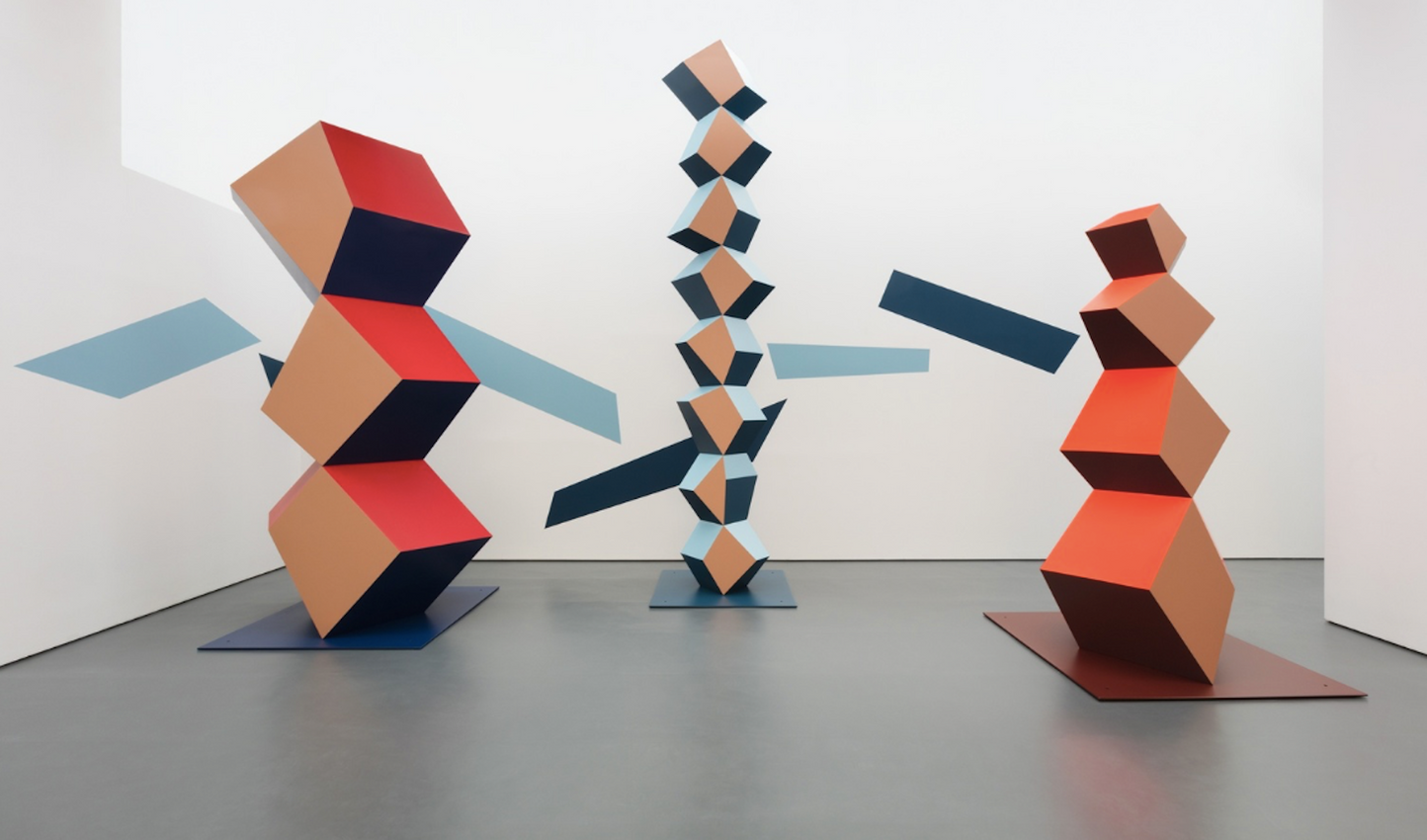
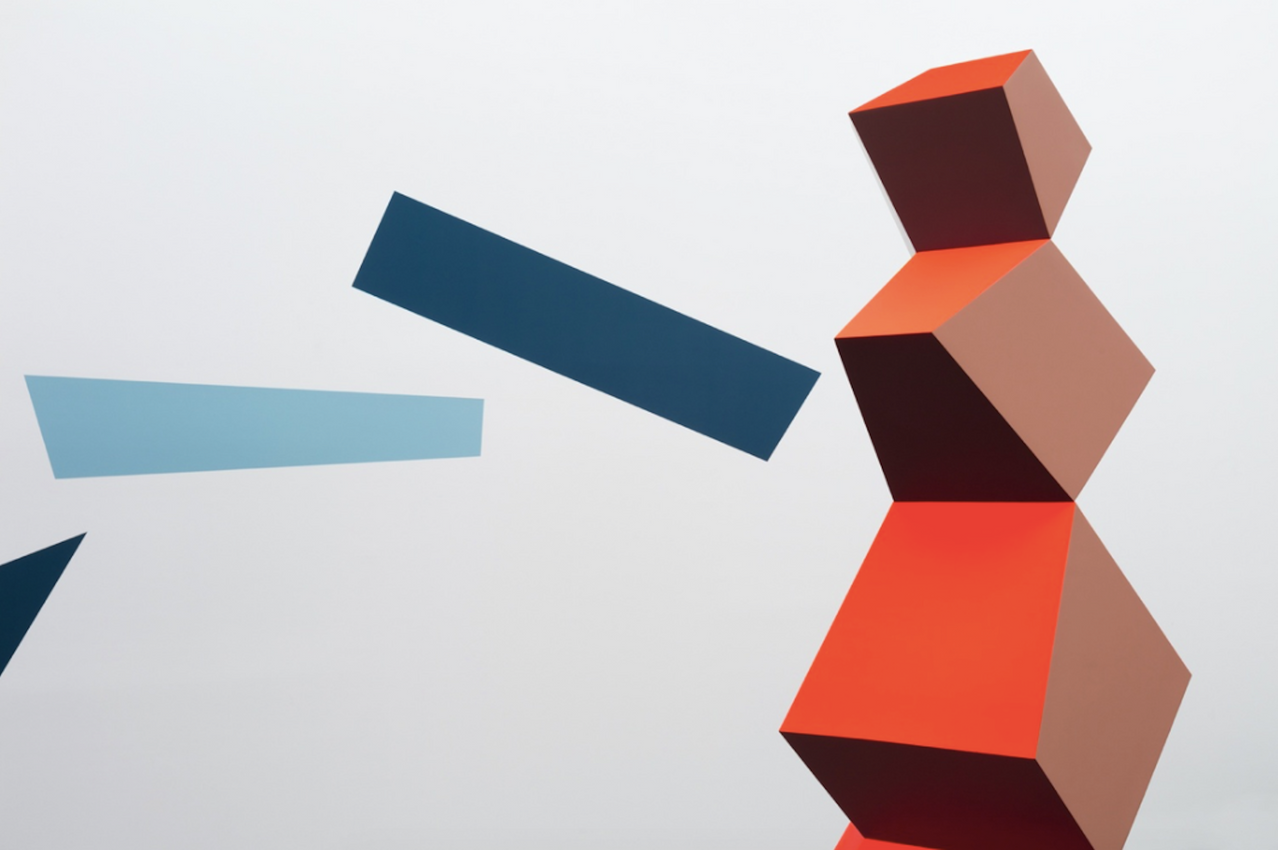
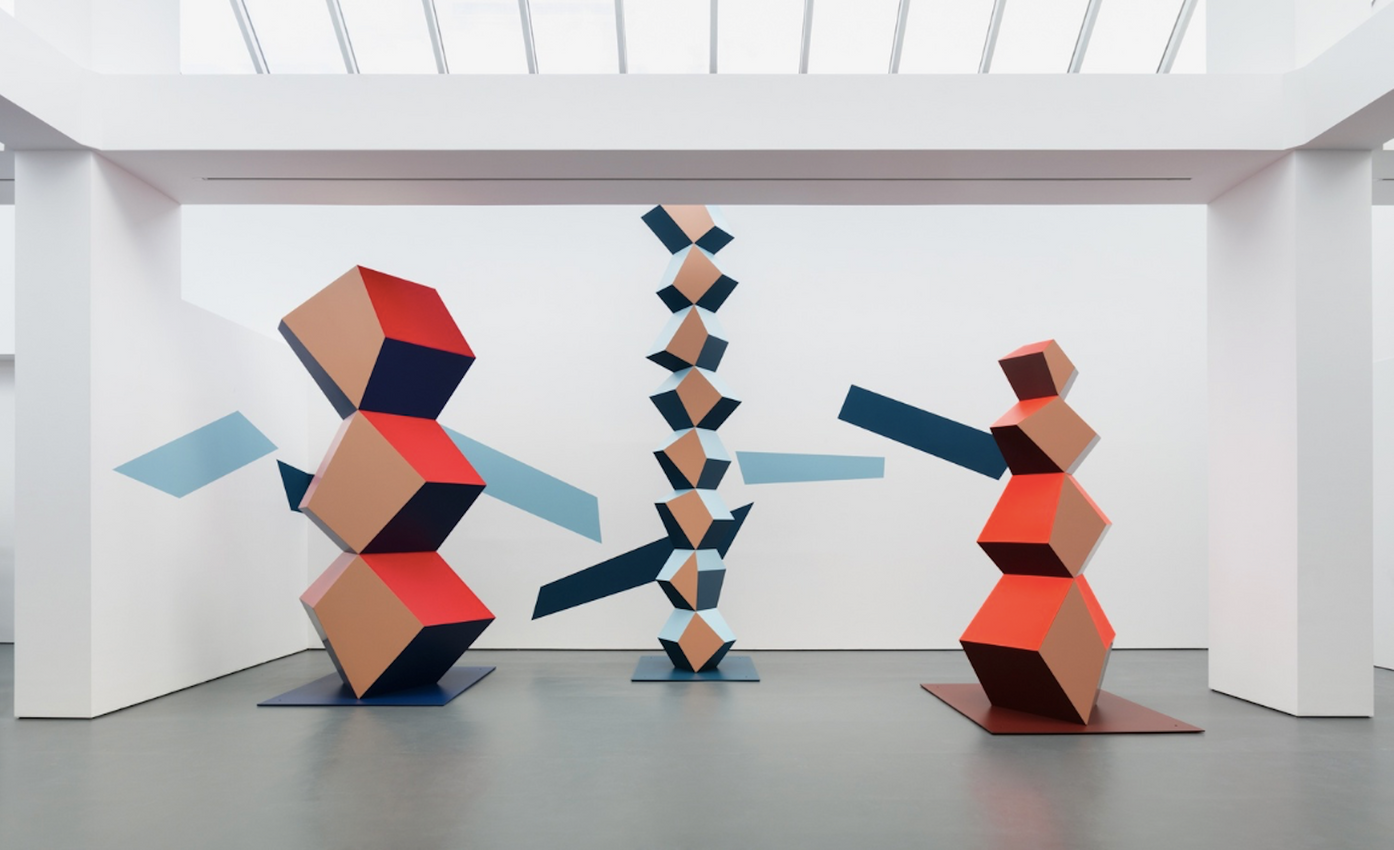
Three new sculptures which expand the body of work that Angela Bulloch has been developing since 2014, will be presented in a flexible-use space adjacent to the main exhibition area. Each of the Stacks offers a distinct rhythm created by the variations in shape, size and color of its elements. The surface of the vertically assembled rhomboid shapes, painted in a combination of light, bright or dark colours, creates an optical illusion of pushing and pulling planes. Designed within a digital imaging program, each stacked rhombus appears distinct while at the same time relating to the others. From one side the irregular aspect dominates, while from another the impression of a certain totemic regularity prevails. By using contemporary technology to transpose Euclidian geometry into a three-dimensional sphere, the artist conjures up sculptures in a weightless space, allowing virtuality and reality to coexist.
Drawing on her previous experiments with geometrical distortion, these new works expand in form and size. If the stylised geometry of Heavy Metal Tall Stack: Beige and Blues, which stands at more than three meters tall, recalls the formal aesthetics of Constantin Brâncuși’s sculptures, something about the appearance of Heavy Metal Stack: Fat Beige Three and Heavy Metal Stack of Four: Red Monster—three massive rhomboid elements for the former and a pyramid-like shape for the latter—associated with their title, invokes the idea of an anthropomorphic presence. By changing the appearance of each column in accordance to one’s point of view, Bulloch plays with our perception of sculptures while orchestrating our experience as gallery visitors. To envision the work in its entirety the viewer must circulate around the sculpture, which at times seems graphic—almost abstract—shifting between two and three dimensions. Here, the artist transfers major themes of Minimalism into the present, and more specifically, the aesthetic exploration of objects’ influence on spatial perception.
If each sculpture exists for itself, they also function as an ensemble, and form a dialogue with other categories of Bulloch’s works. Never Eat Cress—which refers to the mnemonic ‘Never Eat Cress, Eat Salmon Sandwiches and Remain Young’ reminding us how to spell ‘necessary’— is a wall painting that echoes and adapts the rhomboid shapes of the sculptures in a two-dimensional plane. The artist confronts contemporary technology, used for the conception and realisation of the work, to the long tradition of wall painting, addressing artists’ preoccupations linked to representation, form, and colour.
Angela Bulloch’s sculptures and wall paintings, like the rest of her oeuvre, manifest her interest in systems, patterns and rules, as well as the creative territory between mathematics and aesthetics.
Angela Bulloch’s work spans many media, manifesting her interest in systems, patterns and rules, as well as her preoccupation with the history of shapes and human interaction. The Pixel Boxes have become her most familiar work: Initially fabricated in beech wood with a glass front screen, their softly changing and pulsing colours distill and abstract complex visual patterns into simple shifting monochromes.


Esther Schipper founded the gallery in 1989 in Cologne. In 1997 the gallery relocated to Berlin. Through more than three decades of continuous exhibition practice, the gallery has established itself as a major force not only in Germany but in an international context, with offices in Paris and Seoul and representatives in France, Spain, the United States, Latin America, South Korea, Taiwan and China. The gallery holds up to ten gallery exhibitions as well as multiple off-site projects each year and participates in leading art fairs across the globe.

A respected voice in contemporary art discourse.
Focusing on ambitious storytelling and insightful art-world commentary. Ocula Magazine publishes in-depth interviews, critical essays and timely analysis on the artists, exhibitions and ideas driving the global art world.
Learn more about Ocula Magazine
Showcasing the best of the art world.
Ocula partners with galleries from around the world to highlight their artists, artworks and exhibitions. Gallery membership is by application and invitation, with each member vetted by an independent panel.
Learn more about Ocula Membership

Specialises in the sale of major artworks.
Led by a team with deep ties to the world’s leading auction houses, galleries and collectors. Ocula’s advisory team offers bespoke services to high-net-worth clients from around the world who are looking to acquire the best of contemporary and modern art.
Learn more about our team and services