




ARSHILE GORKY
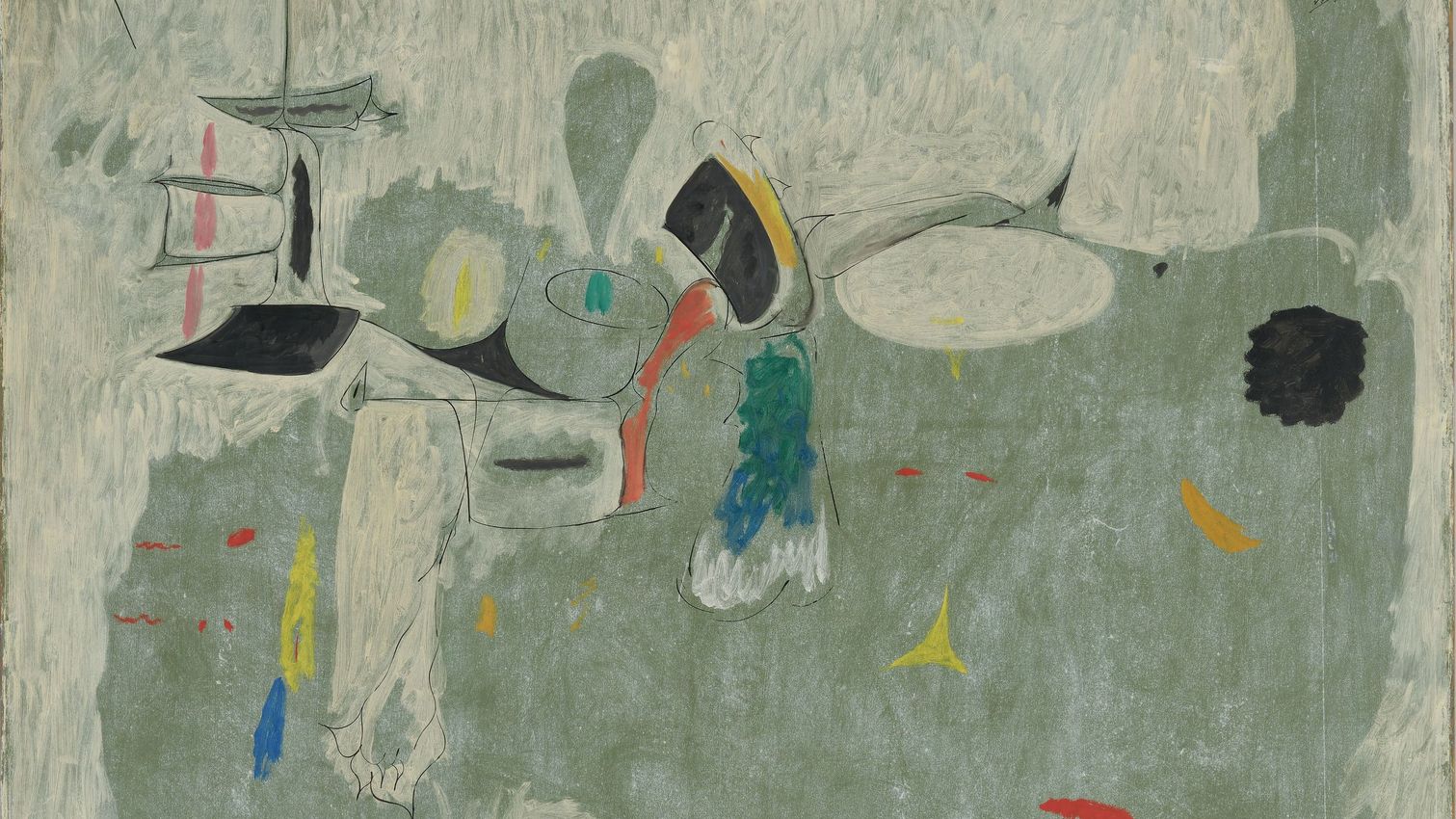
1904-1948, ArmeniaArshile Gorky (1904–1948) was an Armenian American painter whose biomorphic abstractions forged a crucial bridge between European Surrealism and the emerging Abstract Expressionist movement in the United States. Working primarily in painting and drawing, he developed a fluid, lyrical visual language in which floating organic forms, calligraphic lines and layered colour translate memory, trauma and desire into complex abstract compositions.
Gorky is best known for mature works from the 1940s such as The Liver Is the Cock’s Comb (1944), How My Mother’s Embroidered Apron Unfolds in My Life (1944), One Year the Milkweed (1944) and The Betrothal II (1947), in which thin washes of pigment, drips and spiky contours coalesce into indeterminate landscapes charged with psychological intensity. His work has been the subject of major exhibitions at institutions including the National Gallery of Art in Washington, D.C., and features in collections such as the Museum of Modern Art, New York; Tate Modern, London; and the Centre Pompidou, Paris, sustaining his reputation as a foundational figure in modern art.
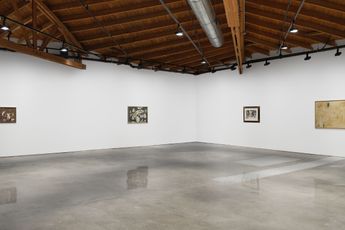
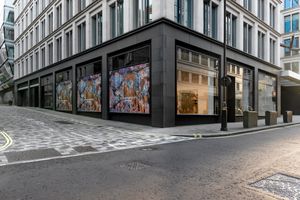
In 2026, Hauser & Wirth West Hollywood presents Arshile Gorky. Horizon West (21 February–25 April 2026), a major Los Angeles exhibition timed for Frieze LA week that focuses on his evolving approach to landscape before and after a pivotal 1941 cross-country road trip.
Early life and Career
Born Vosdanig (Vostanik) Adoian in Khorkom, in the Van region of Ottoman Turkey, Gorky survived the Armenian genocide and fled with his family, experiences that later surfaced obliquely in his paintings’ motifs and titles. After the death of his mother from starvation in 1919, he emigrated to the United States in 1920, settling first in New England before moving to New York, where he restyled himself as Arshile Gorky, adopting a new name and biography that aligned him with European modernism.
In New York he studied briefly at the New School of Design in Boston and at the National Academy of Design, before teaching at the Grand Central School of Art from 1926 to 1931, a position that gave him financial stability and time to refine his painting. Intensive study of Cézanne, Picasso, Miró and other modernists led him through successive phases of stylistic assimilation—Post-Impressionist structure, Cubist fragmentation and Surrealist biomorphism—until he began to synthesise these influences into a personal idiom.
By the mid-1930s Gorky had become part of New York’s avant-garde network, forming close relationships with artists such as Willem de Kooning and mentoring younger painters including Mark Rothko. His participation in the Works Progress Administration’s Federal Art Project allowed him to work on murals and large-scale paintings, expanding his scale and ambition while consolidating his reputation in the city’s shifting modernist milieu.
Works, Series and Methods
Gorky’s early mature work often takes the form of dense, architectonic compositions in which interlocking planes and angular forms betray his close engagement with Cubism. Series such as Nighttime, Enigma and Nostalgia (c. 1930–36) and Organization (c. 1933–37) translate personal recollection and emotional states into semi-abstract structures, combining geometric scaffolds with hand-drawn contours that already lean towards the more open biomorphic vocabulary of the 1940s.
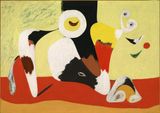
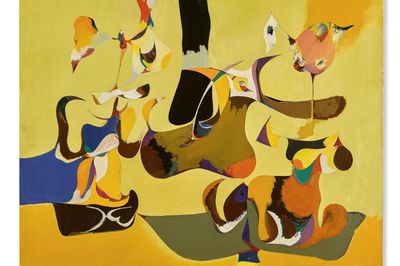
In the late 1930s and early 1940s, contact with émigré Surrealists, including André Breton and Roberto Matta, catalysed a shift towards more fluid, automatic methods. Gorky began thinning his oil paint with turpentine, allowing it to drip and pool across the canvas, and developed a language of looping, curvilinear forms and delicate black lines that seem to float over luminous, indeterminate grounds. Works such as The Liver Is the Cock’s Comb (1944) and One Year the Milkweed (1944) combine these techniques with titles that hint at bodily organs, plant life and inner states, encouraging viewers to read the paintings as oscillating between landscape, anatomy and memory.
A second key strand of Gorky’s practice centres on the reworking of personal imagery, most notably the painting The Artist and His Mother (c. 1926–36), based on a 1912 photograph taken in Armenia. Across multiple versions, he distils the photographic source into simplified forms, mask-like faces and unfinished passages, transforming a specific family portrait into a haunting meditation on loss, displacement and the partial nature of recollection. These works demonstrate how his formal experimentation is inseparable from autobiographical content, a relationship that would become a defining feature of Abstract Expressionism.
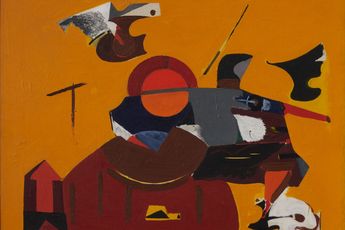
In his final years, Gorky’s paintings often register a heightened responsiveness to the rural landscapes of Connecticut and Virginia, where he spent extended periods away from New York. Paintings such as The Betrothal II (1947) integrate sulphurous yellows, acid greens and earthy reds into airy compositions in which forms seem to expand and dissolve, suggesting vegetation, insects or human figures without settling into clear representation. Across these series, viewers encounter a consistent interplay between meticulous drawing and improvisatory gesture, with Gorky repeatedly reworking surfaces, scraping back and repainting until images arrived at a precarious balance between structure and spontaneity.
Themes, Landscape and Context
Gorky’s work is frequently described as a hinge between Surrealism and Abstract Expressionism, uniting the former’s investment in the subconscious and automatism with the latter’s emphasis on large-scale, gestural abstraction. His paintings are often read as visual translations of personal history—genocide, migration, reinvention—yet they avoid literal narrative, instead staging these experiences as shifting constellations of signs, fragments and atmospheres.
Landscape became an increasingly important site for this exploration, especially after a 1941 road trip from New York to Los Angeles with his future wife, Agnes ‘Mougouch’ Magruder, and the sculptor Isamu Noguchi. Drawn to the American West yet famously ‘turning his back’ on the Grand Canyon, Gorky translated the expansiveness and strangeness of these terrains into abstracted fields of colour and line that later crystallised in the Virginia farm paintings. The recurrence of motifs linked to Armenian childhood—aprons, fields, village names—alongside titles that reference diaries, betrothals and domestic objects underscores how his abstraction remains tethered to specific cultural memories and family histories. Within the broader history of modern art, his practice is often situated as an early instance of ‘lyrical abstraction’, in which colour, line and form work less as autonomous formal elements than as carriers of affect, memory and psychological complexity.
Exhibitions, Collections and Recognition
During his lifetime, Gorky exhibited in key New York venues associated with the city’s modernist vanguard, including Julien Levy Gallery and Peggy Guggenheim’s Art of This Century. Posthumously, his significance has been cemented by major retrospectives and focused exhibitions, such as the National Gallery of Art’s survey of his 1940s work, which emphasised his role as a pioneer of Abstract Expressionism. His paintings and drawings are now held in leading public collections worldwide, among them the Museum of Modern Art in New York, the Whitney Museum of American Art, the National Gallery of Art in Washington, D.C., Tate Modern in London and the Centre Pompidou in Paris, reflecting his ongoing international impact.
In early 2026, Arshile Gorky. Horizon West at Hauser & Wirth West Hollywood brings renewed attention to his legacy on the West Coast, coinciding with Frieze Los Angeles and its surrounding programme of gallery exhibitions. Focusing on landscapes created before and after the 1941 cross-country trip, the show juxtaposes rarely seen works with paintings first shown in his 1941 solo museum exhibition in San Francisco, offering audiences a concentrated view of how travel reshaped his understanding of place and perception. Gorky’s influence continues through the work of artists associated with the New York School, including Jackson Pollock, Willem de Kooning and Mark Rothko, many of whom acknowledged his example in merging personal experience with experimental abstraction.
Arshile Gorky FAQs
What is Arshile Gorky best known for?
Arshile Gorky is best known for his role as a bridge between European Surrealism and American Abstract Expressionism, and for large-scale biomorphic paintings that fuse memory, emotion and abstraction. Key works such as The Liver Is the Cock’s Comb (1944), How My Mother’s Embroidered Apron Unfolds in My Life (1944) and The Betrothal II (1947) are frequently cited as defining examples of his mature style.
What themes does Arshile Gorky explore in his work?
Gorky’s work explores themes of displacement, trauma, desire and the persistence of childhood memory, often rooted in his experiences of the Armenian genocide and migration to the United States. Rather than depicting events directly, he transforms these histories into ambiguous organic forms and atmospheric colour fields that invite viewers to navigate between landscape, body and dream.
How did Surrealism influence Arshile Gorky?
Surrealism introduced Gorky to automatic drawing and the idea of accessing the subconscious through improvisatory mark-making, leading him to loosen his compositions and embrace chance effects such as drips and stains. His friendships with André Breton and Roberto Matta encouraged him to merge Surrealist biomorphism with his own memories and sensations, paving the way for Abstract Expressionism’s gestural abstraction.
Where can I see Arshile Gorky’s work?
Gorky’s paintings and drawings can be seen in major museum collections, including the Museum of Modern Art and the Whitney Museum of American Art in New York, the National Gallery of Art in Washington, D.C., and Tate Modern in London. Additional significant holdings are found at the Centre Pompidou in Paris and museums across North America, Europe and Asia, reflecting the breadth of institutional interest in his work. Commercial galleries such as Hauser & Wirth have also dedicated major exhibitions to the artist’s work, for example as seen in the 2026 show Arshile Gorky. Horizon West at Hauser & Wirth at West Hollywood in Los Angeles.
What is ‘Arshile Gorky. Horizon West’ about, and how does it relate to Frieze LA?
Arshile Gorky. Horizon West at Hauser & Wirth West Hollywood focuses on the artist’s evolving approach to landscape, presenting works made before, during and after his 1941 journey from New York to California. Timed to coincide with Frieze Los Angeles and its associated gallery programme, the exhibition offers visitors in the city during the fair a rare opportunity to examine how Gorky’s firsthand encounters with American terrain informed some of his most important abstract landscapes.
Ocula | 2026




Explore Arshile Gorky's Exhibitions





Explore and Follow Artists Shaping Contemporary Art
A respected voice in contemporary art discourse.
Focusing on ambitious storytelling and insightful art-world commentary. Ocula Magazine publishes in-depth interviews, critical essays and timely analysis on the artists, exhibitions and ideas driving the global art world.
Learn more about Ocula Magazine
Showcasing the best of the art world.
Ocula partners with galleries from around the world to highlight their artists, artworks and exhibitions. Gallery membership is by application and invitation, with each member vetted by an independent panel.
Learn more about Ocula Membership
Specialises in the sale of major artworks.
Led by a team with deep ties to the world’s leading auction houses, galleries and collectors. Ocula’s advisory team offers bespoke services to high-net-worth clients from around the world who are looking to acquire the best of contemporary and modern art.
Learn more about our team and services