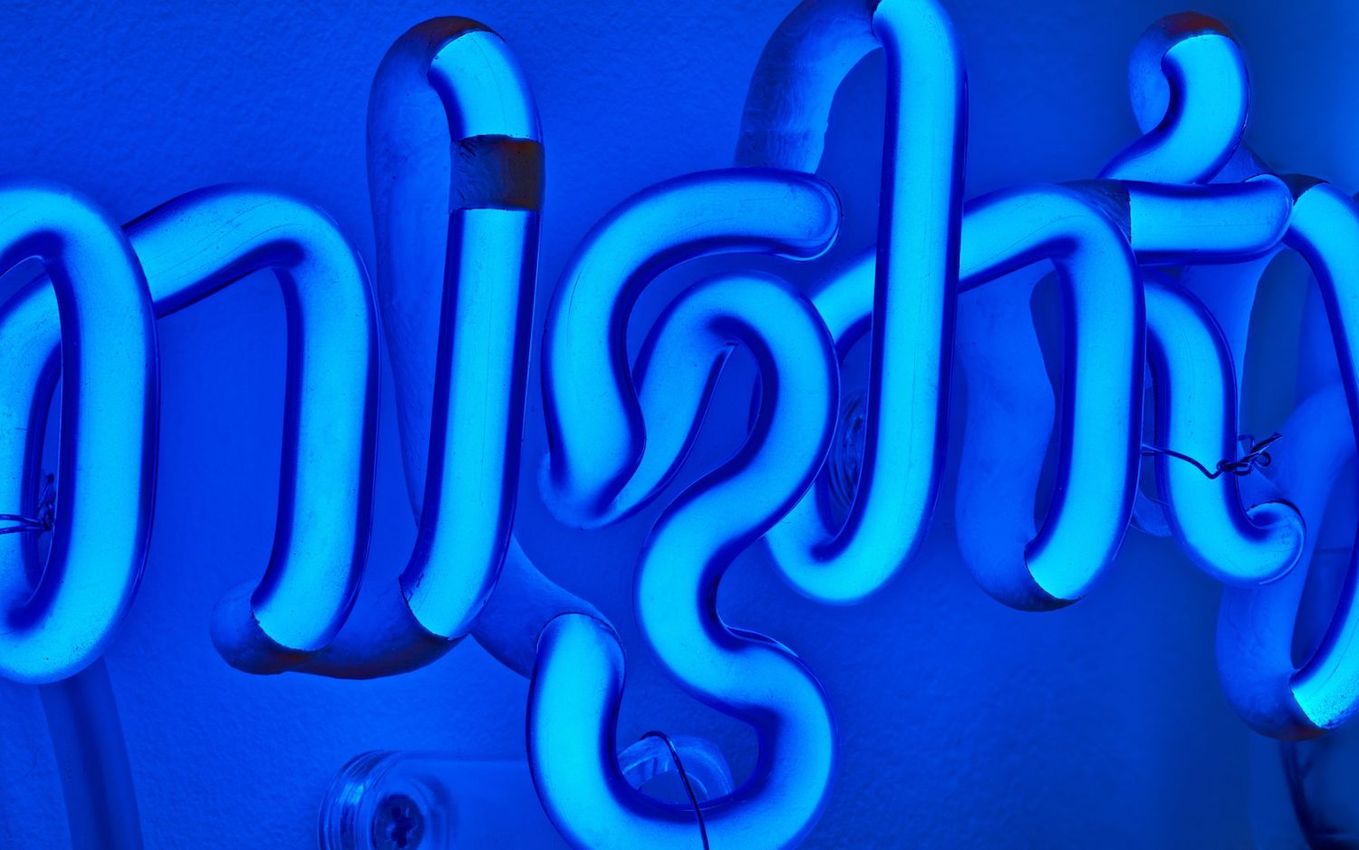
Maybe some words read better in neon—maybe some people look better under neon_._—Douglas Gordon
Gagosian is pleased to present a selection of neon works by Douglas Gordon. The works were produced by the on-site workshop that Gordon established in his exhibition at the gallery’s Davies Street, London, location in 2022, in which artisans worked to shape Murano glass tubing into short texts.
In his films, projections, installations, photographs, performances, and works in other mediums, Gordon investigates collective memory and our sense of psychological security through extreme distortions of time and space, often using his own work and that of other artists and filmmakers as raw material. He has made text-based works since the 1990s; most of these have taken the form of vinyl transfers applied to walls, but a few—the first being Empire, installed in 1998 in an alleyway outside a Glasgow pub—have employed neon light.
Gordon’s new neon works are autobiographical, but also spark nostalgia in the minds of many viewers raised in the same milieu; further, they resonate with the ways in which ideas and techniques are born, grow, and interconnect: “Because it’s a gas,” he has stated of neon itself, “and because it was discovered, not invented, it quickly became a byword or symbol for the very essence of discovery.” From seeing illuminated signs in old movies to observing the real thing in London’s Soho, Gordon was seduced by neon’s fusion of novelty and illicit glamour.
Each of the neon works in the exhibition has a “partner” (not on view) that completes a well-known line from a film or a lyric from a popular song. I second that emotion is taken from a 1968 song by Smokey Robinson that was covered in 1980 by English new wave band Japan, and that was popular when Gordon was at school. I dont care I dont care has a dual reference, reproducing a line common to There Is a Light That Never Goes Out (1986) by the Smiths and Pavement’s Cut Your Hair (1994).
Finally, the exhibition acknowledges neon’s change in status from a common platform for commercial signage toward a rarified technology superseded by digital display. The gnomic verbal content of Gordon’s texts chimes with the alchemical nature of neon and its place in the history of modernism; the medium has a long and distinguished creative heritage, having been used by numerous artists, including Dan Flavin, Joseph Kosuth, and Bruce Nauman.
Douglas Gordon is a conjurer of collective memory and perceptual surprise whose tools include commodities and mechanisms of everyday life. Into a diverse body of work—spanning narrative video and film, sound, photographic objects, and texts both as site-specific installation and printed media—he infuses a combination of humor and trepidation to recalibrate reactions to the familiar.


A respected voice in contemporary art discourse.
Focusing on ambitious storytelling and insightful art-world commentary. Ocula Magazine publishes in-depth interviews, critical essays and timely analysis on the artists, exhibitions and ideas driving the global art world.
Learn more about Ocula Magazine
Showcasing the best of the art world.
Ocula partners with galleries from around the world to highlight their artists, artworks and exhibitions. Gallery membership is by application and invitation, with each member vetted by an independent panel.
Learn more about Ocula Membership

Specialises in the sale of major artworks.
Led by a team with deep ties to the world’s leading auction houses, galleries and collectors. Ocula’s advisory team offers bespoke services to high-net-worth clients from around the world who are looking to acquire the best of contemporary and modern art.
Learn more about our team and services