Press Release

A sheet of paper, a wooden board, a piece of metal, a white cook’s apron, a white wall... according to Deleuze/Guattari’s ideas on ‘capitalism and schizophrenia’ these are all ‘bodies without organs’, surfaces for inscription, possibilities for coding and the production of meaning. The body without organs is in itself unproductive, it is ‘constantly injected into production’ in order to effect its union with anti-production.1 In the realm of art they are often assigned the role of the found, the inchoate, the unarticulated. As such, these materials, morphologies, but also loci, generate in their interaction with art, an economy of the auratic, a currency of critique.

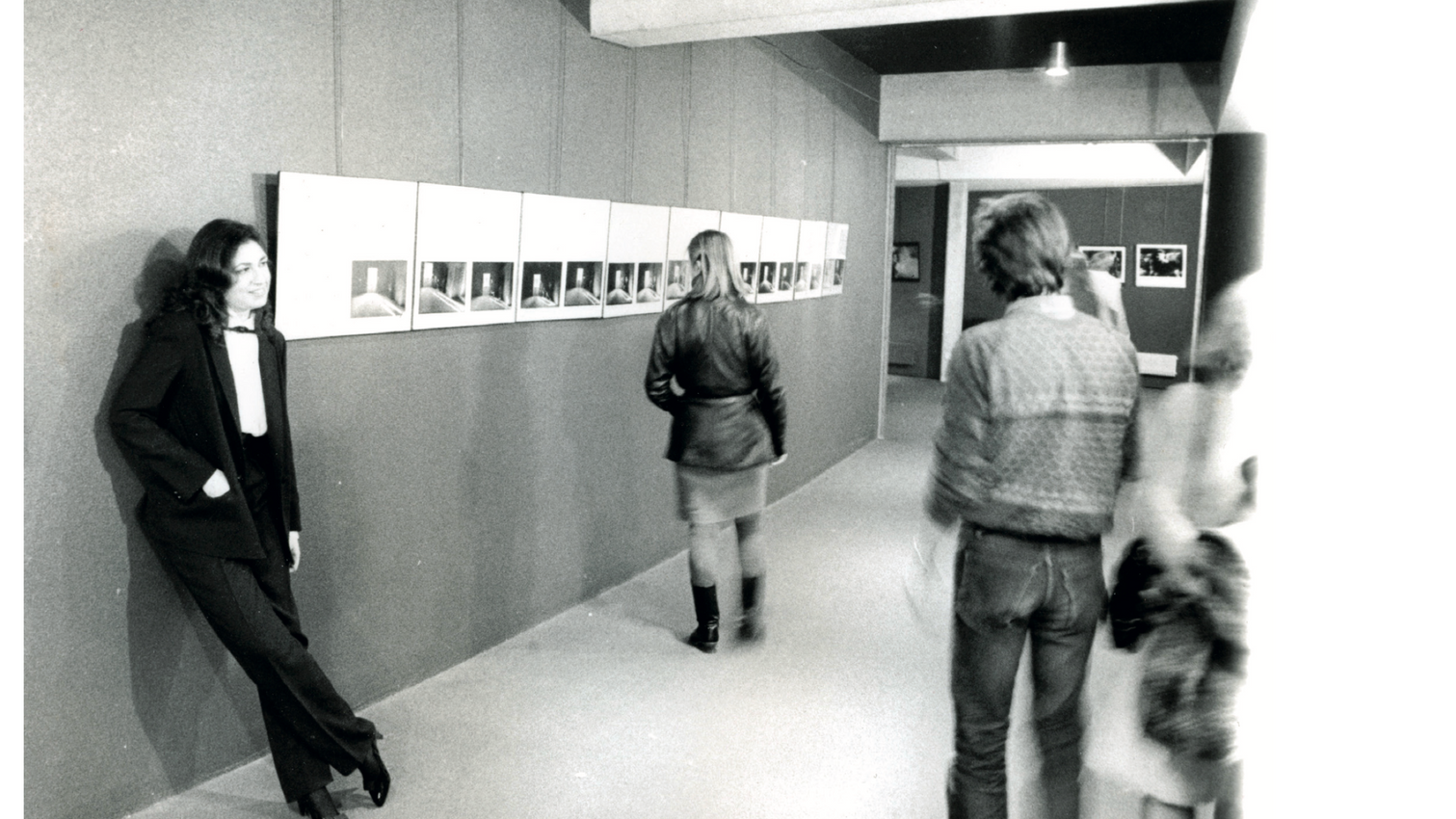
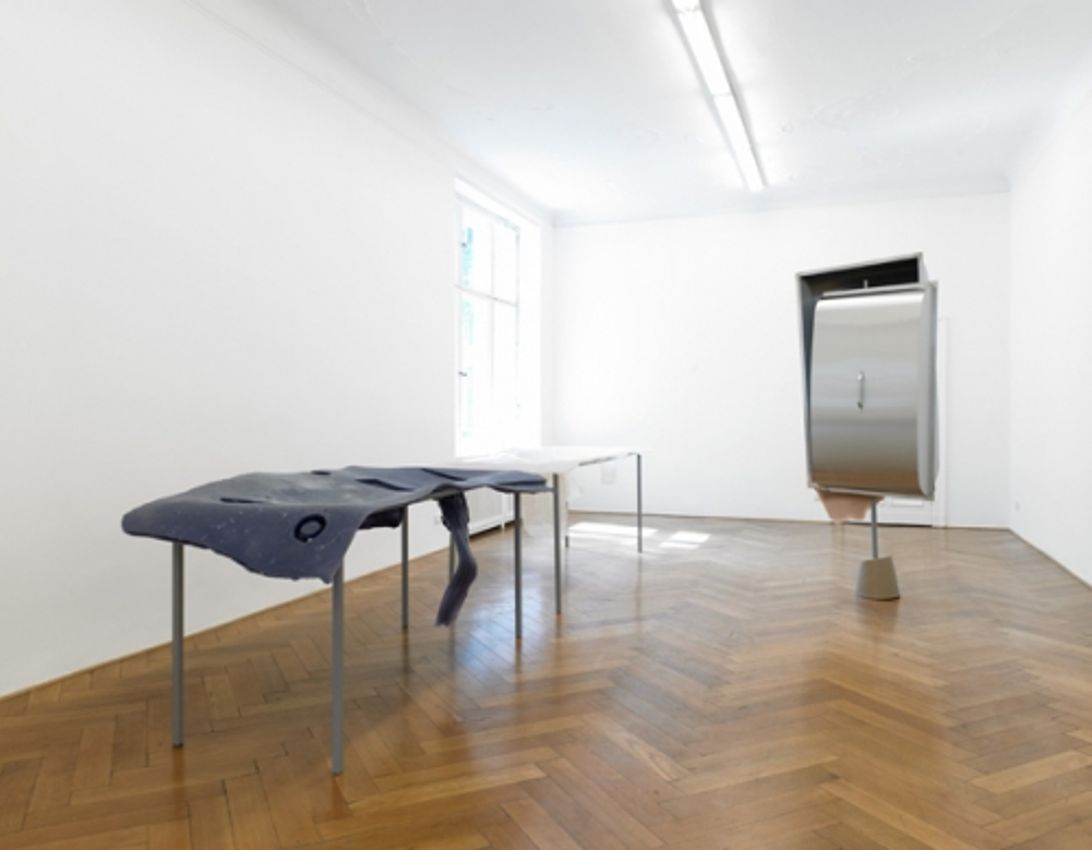
Deleuze and Guattari exposed bodies without organs to the desiring-machines and vice versa. One desiring-machine that stands in conflict with a body without organs is, for example, the schizophrenic table as postulated by Henri Michaux. ‘A dehumanized table, nothing cozy about it, nothing middle-class, nothing rustic, nothing countrified (...). A table which lent itself to no function. Self-protective, denying itself to service and communi-cation alike. There was something stunned about it, something petrified.’2 In such a piece of furniture production and its cessation coincide: ‘The table continues to ‘go about it’s business.’ The surface of the table, however, is eaten up by the supporting framework. The nondetermination of the table is a necessary consequence of its mode of production.’3 ‘Bodies’ made of rubber hang over simple stands. The matrix is made from reversed casts, an assemblage of heaped up material. When the cast is removed from the mould, negative forms are left. While every impression makes a secret of its object and the reason for it, the listing of them in an accompanying sign robs the potentially cast materials and morphologies of any mysticism. These traces are to be regarded like the ingredients of the dish potted head laid out on a Rechaud. Lids or covers also belong to them. Several are hung up in the gallery on a kind of stand so that you can see the residue from the material sauce running out like over boiled jelly. The fragmented photographic portraits of a false cook don’t stand in for the artist.

Rather this figure counterbalances the auratic moment of encounter entailed in production. Tables such as these are dysfunctional and the question remains: ‘What is a form? So as not to startle anyone with the philosophical weight of this all-too-sudden question, I would like to answer it with an etymological pun which the French language has to offer. Form (forme) is a fourme, that is a cheese (fromage)–something formed (formage) if you will.’4 So no metaphysics of the form. No Platonic idea, and no ‘professional deformation’ either. Forming of the head, formation and models of thinking. The poured casting of thoughts. Rather like beating your head again and again against the organless body of the white walls–pour déformer la tête!

Gardemanger, 2011

1 Gilles Deleuze and Félix Guattari, Anti-Oedipus, Capitalism and Schizophrenia, trans. Robert Hurley, Mark Seem, Helen R. Lane, London: Athlone Press, 1984, p. 9f.

2 Ibid. p. 6.

3 Henri Michaux, Les grandes épreuves de l’esprit, Paris: Gallimard, 1966, p. 156, quoted in Gilles Deleuze and Felix Guattari, Anti-Oedipus, Capitalism and Schizophrenia, p. 7.

4 George Didi-Huberman, Ähnlichkeit und Berührung, Cologne: Dumont, 1999, p. 31.

Read More
About the Artist

Based in Berlin since 1984, Iranian-born artist Nairy Baghramian creates perplexing sculptures and installations out of silicon, resin, and steel, among others, that examine the relationships between the human body and architecture. In her incessant questioning of the traditional medium of sculpture, Baghramian provokes an examination of form and content.

View Artist Profile

Also Exhibiting at Galerie Buchholz

About the Gallery

Galerie Buchholz is an art gallery specializing in international contemporary art, with exhibition spaces in Cologne, Berlin and New York City. The gallery was founded in Cologne in 1986 by Daniel Buchholz, and today is run jointly with Christopher Müller.

View Gallery Profile
Address
Fasanenstraße 30
Berlin
Germany
Opening Hours
Tuesday – Saturday
10am – 6pm
(1)
Berlin Fasanenstraße 30
Galerie Buchholz
Fasanenstraße 30, Berlin, Germany

Opening hours
Tuesday – Saturday
10am – 6pm
The art world in focus