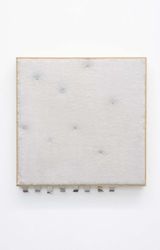
Fondazione Marconi and Gió Marconi are pleased to announce Vocale con accento, the first solo exhibition dedicated entirely to Gianni Colombo’s ceramic work. Curated by Marco Scotini, the exhibition brings more than twenty clay works to the public for the first time, ranging from terracottas to engobed and glazed surfaces. This largely unpublished body of work dates from the early years of the artist’s practice, from 1953 to the founding of Gruppo T. Although the selected works represent only part of Colombo’s ceramic production, Vocale con accento offers the first comprehensive exhibition survey of this formative and significant period in his research.
There is always a blind spot in the work of an artist who resists being classified and subsumed into their known and recognised oeuvre. Something that, despite being undeniable, remains overlooked. It is like a secret room that remains hidden and invisible despite being exposed to view. Much like the letter in Edgar Allan Poe’s “The Purloined Letter”, which remains undetected precisely because it is hidden in plain sight. Such is the case with Gianni Colombo’s ceramic production: a radical beginning that set the course for all his subsequent work, yet has never received adequate critical attention.
Although, since 1995, scarcely an exhibition or publication on Gianni Colombo has appeared without including three or four significant examples of his ceramic work, this production seems to have been regarded as a separate chapter, never fully integrated into the broader investigation of his oeuvre. While it is true that terracotta would never again feature in his work, just as polychromy would give way to white monochromes and evocative titles to technical designations, it is equally true that Colombo’s choice of ceramics marked a departure from both painting and sculpture, while also offering Colombo an initial encounter with a material that was plastic, elastic and fluid. It is no coincidence that aspects of ceramic modelling would continue to emerge in the tactility, corporeality and performativity that characterise his subsequent work.
Colombo began experimenting with clay in the 1950s, at a time when post-war Italian ceramic culture was reaching its peak. These were the years in which clay emerged as a leading medium of artistic expression, embodying the creative and avant-garde impetus of the immediate post-war period. In 1954, the Incontro Internazionale della Ceramica (International Meeting of Ceramics) took place in Albisola, bringing together a decidedly heterogeneous group of international artists, heirs to Surrealism, in the name of new forms of experimentation with ceramics. They included members of the recently disbanded CoBrA group (Asger Jorn, Karel Appel and Corneille), artists associated with the Nuclear Art Movement (Enrico Baj and Sergio Dangelo), Spatialism (Lucio Fontana), Surrealism (from which Roberto Matta had been expelled in 1948), and the Informel movement (Emilio Scanavino). Shortly afterwards, Joe Colombo, Gianni’s brother, designed the display for the works by these artists, all active in Albisola, presented at the 10th Milan Triennale.
All of Colombo’s earliest exhibitions, between 1955 and 1959, took place within the framework of the Concorsi Nazionali della Ceramica in Faenza or various editions of the Mostra Nazionale della Ceramica of the Premio Gubbio. However, 1958 also saw a kind of incunabulum of what would later become Gruppo T, with an exhibition in Bellinzona, followed by one in Lugano, in which Colombo exhibited numerous ceramic works alongside Gabriele Devecchi, Davide Boriani and Carlo Berta. Precisely because of their search for a dialogue with the historical avant-garde, Colombo’s ceramics at this point seem to depart from the traditional and manual references usually associated with the medium. Their divergence from contemporary ceramic production made them the object of critical scrutiny. In fact, recalling a certain period of Fontana’s work, Colombo’s ceramics take the form of mutable dials or overlapping toothed discs that can be rotated around their own axis. Contemporary with his kinetic works, if not actually anticipating them, these pieces can be manipulated by viewers, who are thus able to take part in the transformation of the work. Works such as Superficie variabile (1959), in which terracotta bricks are assembled in a sort of abacus, and Colonna Intermutabile (1960) clearly point towards the celebrated Strutturazioni Pulsanti in polystyrene and the rotating honeycomb structures in Plexiglas, Strutturazioni Acentriche (1962). These later works represented an undisputed milestone in the kinetic art of the 1960s.
In this sense, Vocale con accento does more than bring a neglected chapter to light: it invites us to reconsider Gianni Colombo’s entire artistic trajectory through a material that anticipates some of his most fundamental insights. In Colombo’s ceramic work, form is never entirely complete or fixed once and for all; rather, it lends itself to manipulation, opens itself up to variation and draws the viewer into a direct and participatory experience.
The exhibition is in collaboration with Archivio Gianni Colombo and with the curatorial assistance from Alberto Navilli, and is accompanied by a catalogue published by Dario Cimorelli Editore, which examines Colombo’s entire ceramic production through contributions by Marcella Beccaria, Lisa Hockemeyer and Marco Scotini, alongside previously unpublished material and archival photographs.


Considered one of the greatest international exponents of kinetic and environmental art, Gianni Colombo made the link between space and body the catalyst for all his three-dimensional investigations. Using flashes of light, moving objects, immersive environments and isolated architectural elements, the artist created disturbing spatial devices capable of disorienting acquired perceptual forms and deconstructing ordinary behavioural codes.
Gió Marconi Gallery started in 1990 under the initiative of Gió Marconi who had previously created Studio Marconi 17, an experimental space for young artists and curators that he ran from 1987 to 1990. At the beginning, the new gallery was directed by Gió and his gallerist father Giorgio, who in turn had founded the gallery Studio Marconi (1965-1992). In its opening year, the gallery had showcased exhibitions by Martin Kippenberger, Mario Schifano as well as Richard Hamilton. In the 30 years to follow, Gió Marconi Gallery has developed an ongoing vibrant program and its own consistent approach to exhibiting and combining brave choices well ahead of their time. Throughout the decades, the gallery continued to support the careers of its artists, promoting their diverse practices to audiences and institutions at home and abroad. While the focus of the gallery has always been on contemporary positions, it gradually started to include also historical artists of the Studio Marconi.

A respected voice in contemporary art discourse.
Focusing on ambitious storytelling and insightful art-world commentary. Ocula Magazine publishes in-depth interviews, critical essays and timely analysis on the artists, exhibitions and ideas driving the global art world.
Learn more about Ocula Magazine
Showcasing the best of the art world.
Ocula partners with galleries from around the world to highlight their artists, artworks and exhibitions. Gallery membership is by application and invitation, with each member vetted by an independent panel.
Learn more about Ocula Membership
Specialises in the sale of major artworks.
Led by a team with deep ties to the world’s leading auction houses, galleries and collectors. Ocula’s advisory team offers bespoke services to high-net-worth clients from around the world who are looking to acquire the best of contemporary and modern art.
Learn more about our team and services