Press Release

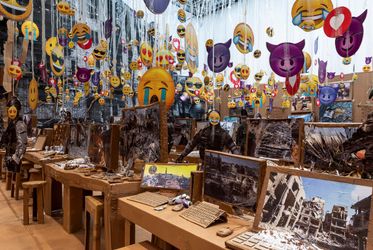
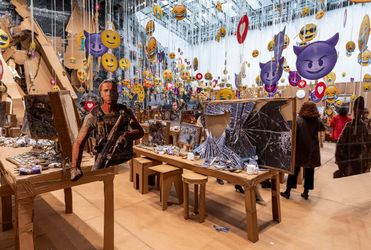
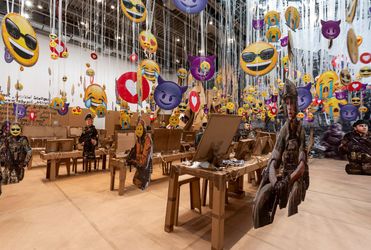
How to do art in times of war, destruction, violence, anger, hate, resentment? What kind of art should be done in moments of darkness and desperation? Can art be a tool for understanding history’s changes? Can a work of art draw alternative forms of understanding the world? How to continue working - as an artist - and in doing so, avoid falling into the traps of facts, journalism, and comments? I want to ask myself these questions and above all, I want to create, with my work, a surface of reflection. I don’t pretend to resolve or offer solutions, but I want my work Fake it, Fake it - till you Fake it to contribute to this problematic, as a form cutting a break-through in the analog into the digital.

To work in ‘the real world’ and for ‘the real world’ is the commitment. I want to make a plastic affirmation which poses the problematic of how an analog, real exhibition space can be combined with the digital and virtual world. I want to keep my work in its ‘analog’ mode, in conflict with the ‘digital,’ therefore reflecting the friction and clash of the real into the virtual. Of course it’s never about ignoring the digital or the virtual because their enormous transformation and far-reaching consequences have created on our coexistence and communicational behavior a kind of ‘fake-utopian’-turning point. I am trying to challenge - throughout my work - this ‘fake-utopian’ idea. I call it ‘fake-utopian’ and not dystopian. A dystopian idea is an idea originally utopian, that was unintentionally transformed by mistake or default, into dystopia. But here, the ‘fake-utopian’ idea is an idea that deliberately doesn’t admit its fakeness and never believes in its utopian dimension. This is what I want to work out, in ‘faking’ myself with self-irony, modesty, silliness, and headlessness.

I have been following with much interest the Silicon Valley cliché-credo “Fake it, till you make it!” and I include myself in this cliché-credo, because am I not - are we not all trying to do so? I too, want to fake it, fake it so much, so long and far, that things don’t lie any more. Because ‘fake’ is not the problem, lying is the problem. I do not want to lie, I do not want things to lie. When someone in the subway is asking for money and making signs as a deaf person - perhaps the signs are fake, but the person is not faking his or her need of money, so - there is no lie.

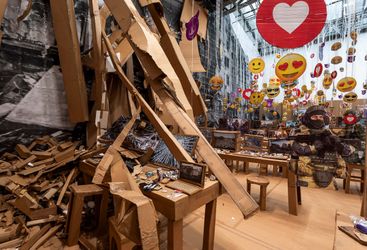
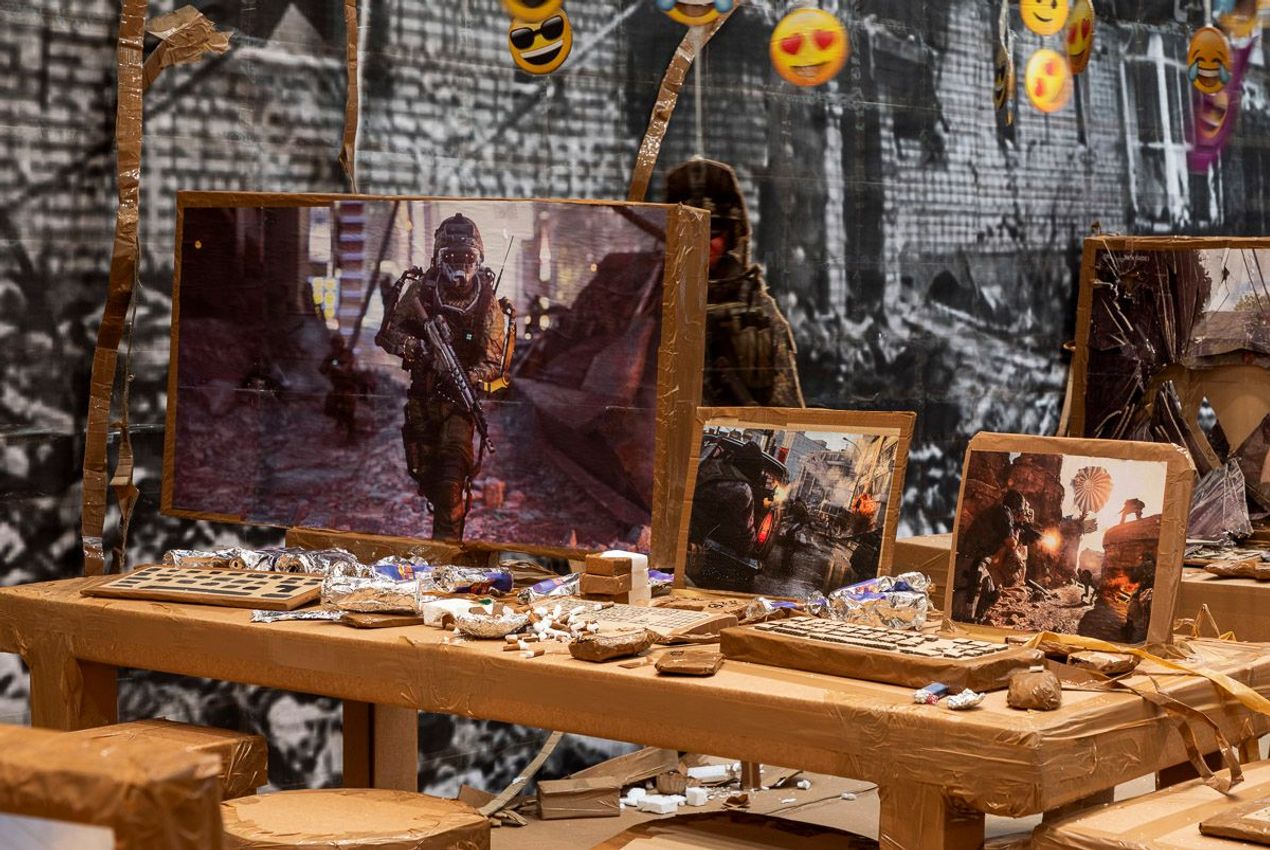
The form of the work Fake it, Fake it - till you Fake it is precarious, it’s a Precarious Sculpture. In working the form out only in cardboard, from ‘fake’ computers to ‘fake’ credit cards, I want to insist on the importance of the material-decision in its plastic dimension, and on the artist’s agreement to pay the price for a decision which always is an artistic one. The question is: How can a precarious-form be offered through an enveloping, quickly done, poorly worked-out sculpture? And how can a form that interrogates the influence and compliance of digital-consumerism and questions ‘fake-utopian’ results, be asserted?

Read More

Installation Views

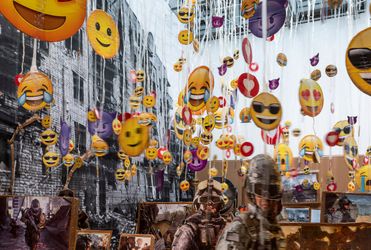
Exhibition view: Thomas Hirschhorn, Fake it, Fake it – till you Fake it, Gladstone Gallery 530 West 21st Street, New York 2024 . © Thomas Hirschhorn / Artists Rights Society (ARS), NY. Courtesy of the artist and Gladstone Gallery.
About the Artist

The Swiss artist Thomas Hirschhorn rose to prominence in the 1990s for his sculptural installations that combined philosophical theories and mundane, recycled materials to raise questions about consumerism, social responsibility, political discontent, and reality. His huge, immersive, site-specific environments often entail interacting with the local community in both production and enactment.

View Artist Profile

Also Exhibiting at Gladstone

About the Gallery
Gladstone is known for its commitment to artists whose prescient approaches and experimental practices have defined the contours of contemporary art. The gallery has long been an active partner in the cultivation of iconoclastic careers, fostering a roster of artists recognized for their ground-breaking contributions. Headquartered in New York and including outposts in both Brussels and Seoul, Gladstone’s impact extends globally, enabling both the presentation of new bodies of work, and an amplification of the international reach of its artists. Alongside its work with contemporary artists, the gallery is steward to the legacies of pivotal historical artists and serves as an advocate for the enduring power of art. Gladstone is led by a team of partners who spearhead its long-term vision and program, building on the values of its founder Barbara Gladstone.
View Gallery Profile
Address
530 West 21st Street, New York
New York
United States
Opening Hours
Tuesday - Saturday
10am - 6pm
(1)
New York 530 West 21st Street, New York
Gladstone
530 West 21st Street, New York, New York, United States
+1 212 206 7606
http://gladstonegallery.com

Opening hours
Tuesday - Saturday
10am - 6pm
The art world in focus