Press Release
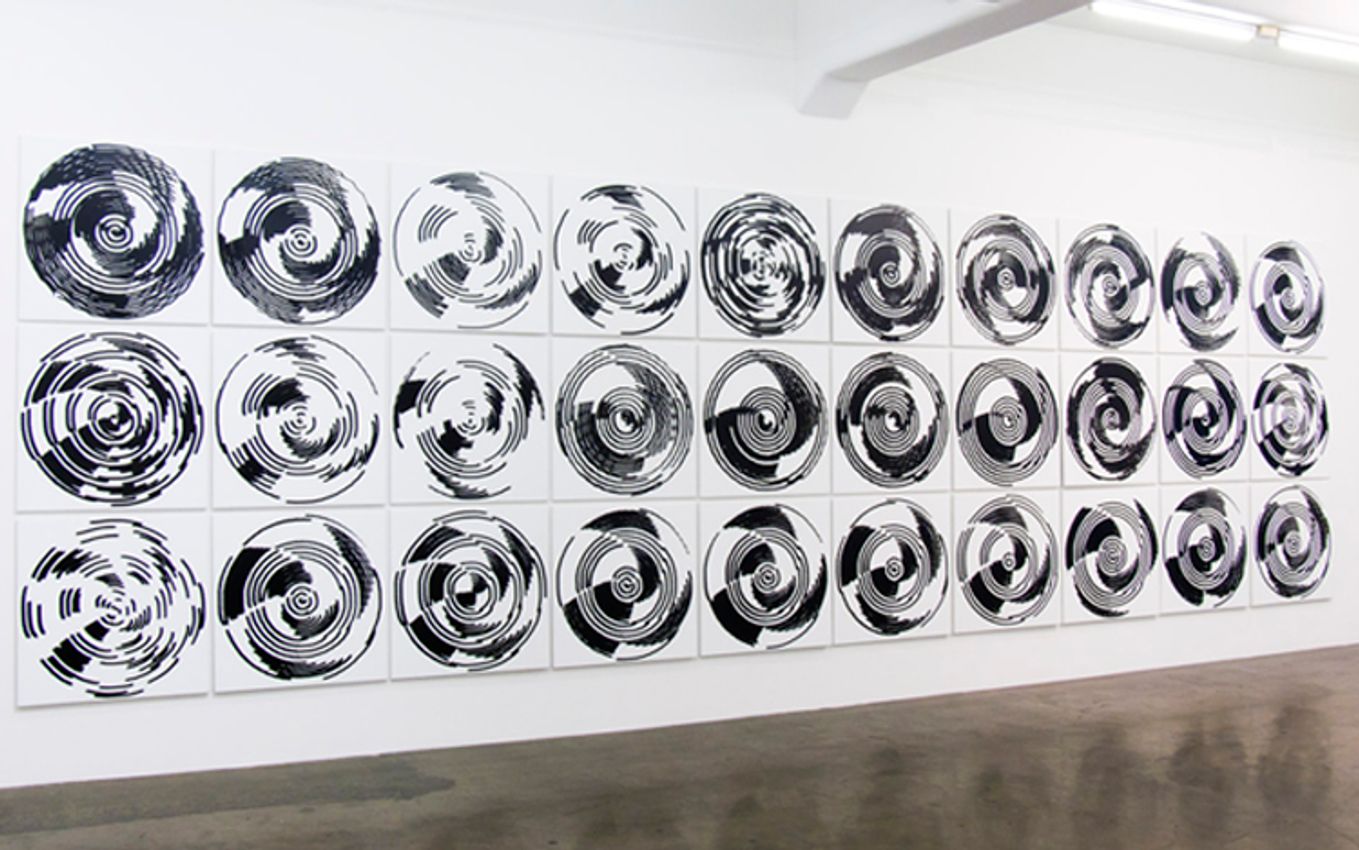
For over a year Simon Ingram’s Radio Painting Station has been collecting energy emitted from hydrogen atoms undergoing “spin-flips” in space. The visual representation of this collection is a series of thirty concentrically circular compositions that materialise energy from the sun, and the interstellar medium, in a cartoon-like and painterly way. It is these that the artist chooses to present for his fourth solo exhibition Paintings of the Sun at Gow Langsford Gallery.

Radio Painting Station, set up at JAR in Kingsland, is one part amateur radio astronomer's lab, one part painting studio and one part gallery space. The entrance to the space is mostly glass and at street level, with passers-by able to see the progress of the project as a series of paintings multiplies. Local people see the project as their own - parents with children in prams, bar flies en route home late at night from Kingsland bars, dog walkers; all stop to talk with the artist about what is happening in the space.

The artist uses techniques and equipment of a painter turned amateur radio astronomer. Rather than looking for visible light with a telescope, he constructed a pyramid-like form and pointed it through a skylight to collect energy at the frequency of 1420 megahertz, then couples this to a special radio receiver and this to his machine. Radio Painting Station’s operation encompasses the period from the 4th of November 2013 to the 28th of April 2015. It was commissioned by Wystan Curnow and Susan Davis for JAR and supported generously by the Chartwell Trust. As well as temporarily turning JAR into an amateur radio astronomer’s painting studio, the artist installed a solar power system, electrifying it, as an off-the-grid project space.

In addition to Paintings of the Sun, a 152 page monograph published in 2014 by Kerber Verlag will be launched at the exhibition.

(Anna Jackson, March 2015 )

“The place and act of painting in Ingram’s work is hosted in the public sphere. The actual painting of the canvas is a spectacle outside the studio, dislocated from the subjectivity of the artist and the romantic atelier. Adding to the intertextualities in the project’s mode of address, the translation of radio waves into steady, albeit ham-fisted marks problematises abstraction rather than aesthetising it. And at a time when contemporary painting relies so heavily on haptic qualities to affect viewers, Ingram removes his hand and locates materiality, not in the thingness of the painting but in the motorised apparatus that moves over its surface.”

Michelle Grabner, Painting Machines, Bielefeld: Kerber Verlag 2014, p. 128.

“By deferring to the machinic, by tuning his antennae towards the ether, by translating sound waves into computer code, Ingram allows that he (and we) are enmeshed within a much larger system. His works demonstrate, in both their mode of making and as finished products, the subtle, irrevocable connections between organic and manmade, technological and human, abstract and animate, visible and invisible, coded and real. He lets things show us something about themselves and reminds us that our minds and bodies are closer to nature and to machines than we might like to imagine.”

Christina Barton, Painting Machines, Bielefeld: Kerber Verlag 2014, p.6.

“The hydrogen line (1420.40575 MHz) is the precession frequency of neutral hydrogen atoms, the most abundant substance in space. It happens to fall in the quietest part of the radio spectrum, what's known as the Microwave Window. Although there may not seem to be a lot of loose hydrogen atoms about (there's perhaps one per cubic centimeter of interstellar space), the interstellar medium contains a lot of cubic centimeters. So these individual atoms chirping away at 1420 MHz make a powerful chorus, which is readily detected by even small radio telescopes.”

Dr. SETI, (2002, December 28). What is the Hydrogen Line? Retrieved from http://www.setileague.org/askdr/hydrogen.htm

For a full selection of works please refer to our website: http://www.gowlangsfordgallery.co.nz/exhibitions/paintings-of-the-sun?id=8157&eid=8156

For more information and a full range of work, please refer to our website: http://www.gowlangsfordgallery.co.nz/exhibitions/paintings-of-the-sun?id=8157&eid=8156
About the Artist

Simon Ingram’s work interprets the modernist practice of the autonomous, self-made artwork in relation to painting as a constructional and computationally based self-organising system. His practice articulates itself in three distinct lines of work: machines made from Lego robotics and generic constructional materials that paint autonomously in oil paint with a brush; paintings made by the artist that use artificial life systems as a method to govern composition and decision making; and video work related to the production of self-making painting machines. Drawing on divergent strands of knowledge (artificial life, painting, critical theory, software), Ingram’s work re-stages and reinvents painting as a critical, contemporary project that explores painting’s conceptual signification while remaining resolutely fabricational.

View Artist Profile Simon Ingram contemporary artist
About the Gallery

Gow Langsford is a commercial art space committed to fostering and promoting the best contemporary art from New Zealand and abroad. Located directly opposite the Auckland Art Gallery, Gow Langsford Gallery represents over thirty established New Zealand and international artists. Gow Langsford is one of the country’s most established galleries and is widely regarded as its most influential dealer gallery. Alongside a regular and varied exhibition schedule, Gow Langsford is a market leader in works on the secondary market.

View Gallery Profile
Address
28-36 Wellesley Street East
Auckland
New Zealand
Opening Hours
Monday – Friday, 10 am–5 pm
Saturday, 10 am – 4 pm
Closed Sunday
(1)
Auckland 28-36 Wellesley Street East
Gow Langsford Gallery
28-36 Wellesley Street East, Auckland, New Zealand

Opening hours
Monday – Friday, 10 am–5 pm
Saturday, 10 am – 4 pm
Closed Sunday
The art world in focus