Water features are an integral component of Iranian architecture. Homes and gardens traditionally featured a shallow pool or howz, which was variously used to cool and humidify the dry air, for washing and other household activities, or simply to create beauty. During the prosperous 1960s, swimming pools were added into the mix. Yet looking at Tehran from above reveals a curious phenomenon. Empty pools pock wealthier areas of the city like air bubbles or little icepick scars. Surprisingly for a dense city where space is at a premium, these pools are rarely leveled, filled in or repurposed. Instead they seem to remain as receptacles of memory, waiting for an absent future that might never arrive.
Nazgol Ansarinia’s practice is intimately concerned with the built environment of her city, the effects of unfettered development, and demarcations between public and private space. What is left behind—the scars, the traces, what is sutured back together—is as important as what gets demolished and destroyed. In the linked bodies of work on view the artist focuses on the northern Tehran district of Jordan, taking a municipality map as her starting point. Its area is just 3km2 but features over 1100 such pools, which occupy close to 5000m2 and are labeled as “private waters.” She views these empty pools, untiled and almost always painted blue, as liminal spaces that represent a collective desire to keep water and perhaps even come together fluidly, as water. In turn, Ansarinia channels this collective longing to imagine a neighbourhood where the pools are full again.
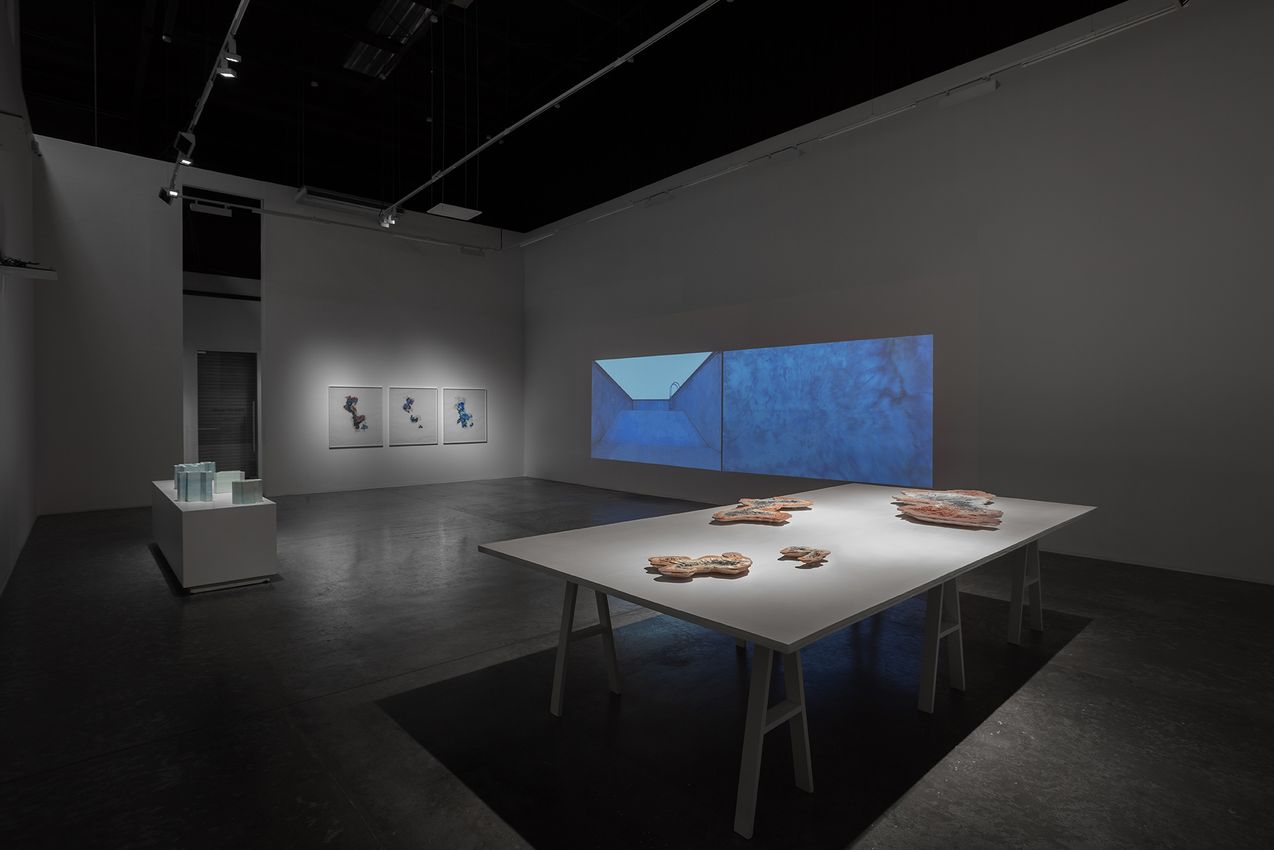
The series of sculptures Connected Pools (2020) brings five or six pools together at a time, their dimensions faithfully reproduced from the municipality document. Washed in blue, they suggest rooftop water features on the kinds of stacked, multi-floor buildings that now crowd Tehran. The mushrooming of such high rises and an attendant lack of privacy, along with widespread water shortages as a result of both climate change and resource diversion and mismanagement, mean that these open-air spaces have largely remained unused since the Islamic Revolution. This passage of time is indexed in the diptych video Dissolving Substances (2020). One channel shows an empty swimming pool, a “blue room” like the ones that the artist used to play football in as a child. The paint fades then it cracks, with branching fissures that suggest the estuaries of a flood plain that is fast-disappearing into the sea. It becomes a saturated blue again. In the second channel, we get a macro view of the same process, but here the footage has been manipulated to woozily ripple and undulate in a way that resembles moving water. Darker patches bloom like mould or an oil spill.
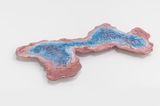
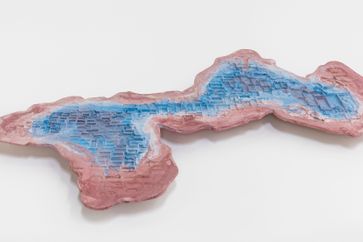
This chromatic effect is extended in her newest series of large sculptures and accompanying drawings from the series Lakes drying tides rising (2022), which assemble greater numbers of the Jordan neighbourhood’s watery voids into composite, irregularly honeycombed lakes. Like the pools in Tehran and perhaps the country as a whole, these lakes exist at a precarious interstice between wetness and dryness. During the past few years of drought and acute power shortages in Iran, water has morphed from being an amorphous vehicle of nostalgia to a resource crisis that is actively causing economic hardship. In shape and palette, these newest works especially recall Lake Urmia in the northeast of Iran, which famously shrunk to a tenth of its size before recently being rehabilitated.
Ink wells from the center of each drawing, and different colours run into and displace each other like a meeting of currents to create mellifluous, organic forms. Working in layers, the process mirrors the way a landscape might be formed and transformed over time by wind and by rain. In the rust and ochre edges of the sculptures, the walls and divisions of the pools equally suggest a sensitively excavated desert settlement. Yet as with Lake Urmia, it’s hard to tell whether these recombined water bodies are drying, or whether water—and by extension, hope—springs from their centres.
Nazgol Ansarinia’s work examines the systems and networks that underpin her daily life such as everyday objects, routines, events and experiences, and the relationship they form to a larger social context. Born and raised in Tehran, Ansarinia’s practice reflects upon tensions between private worlds and the wider socioeconomic realm, and how local iterations of a culture might act as a site for the hopes and fears of those living in a(faltering) globalised word.

Green Art Gallery is a contemporary art space featuring a multi-generational mix of artists whose practices are rigorously researched, idea-led, and representative of our current moment. The gallery now represents a multi-generational mix of artists from the Middle East, North Africa, South Asia and beyond, including Turkish artists Hale Tenger and Hera Büyüktaşcıyan; Iranian artists Kamrooz Aram and Nazgol Ansarinia; and Shadi Habib Allah, Seher Shah, and Alessandro Balteo-Yazbeck, who are Palestinian, Pakistani and Venezuelan respectively. In this geographic mix, the gallery reflects Dubai’s position as a cosmopolitan—as well as artistic—entrepôt, even as it boasts of a strong parallel Arab Modernist program.

A respected voice in contemporary art discourse.
Focusing on ambitious storytelling and insightful art-world commentary. Ocula Magazine publishes in-depth interviews, critical essays and timely analysis on the artists, exhibitions and ideas driving the global art world.
Learn more about Ocula Magazine
Showcasing the best of the art world.
Ocula partners with galleries from around the world to highlight their artists, artworks and exhibitions. Gallery membership is by application and invitation, with each member vetted by an independent panel.
Learn more about Ocula Membership

Specialises in the sale of major artworks.
Led by a team with deep ties to the world’s leading auction houses, galleries and collectors. Ocula’s advisory team offers bespoke services to high-net-worth clients from around the world who are looking to acquire the best of contemporary and modern art.
Learn more about our team and services