



Bertrand Lavier likes to confront us with unqualifiable situations.His artworks often seem to hover between different possibleidentities as well as different temporalities.
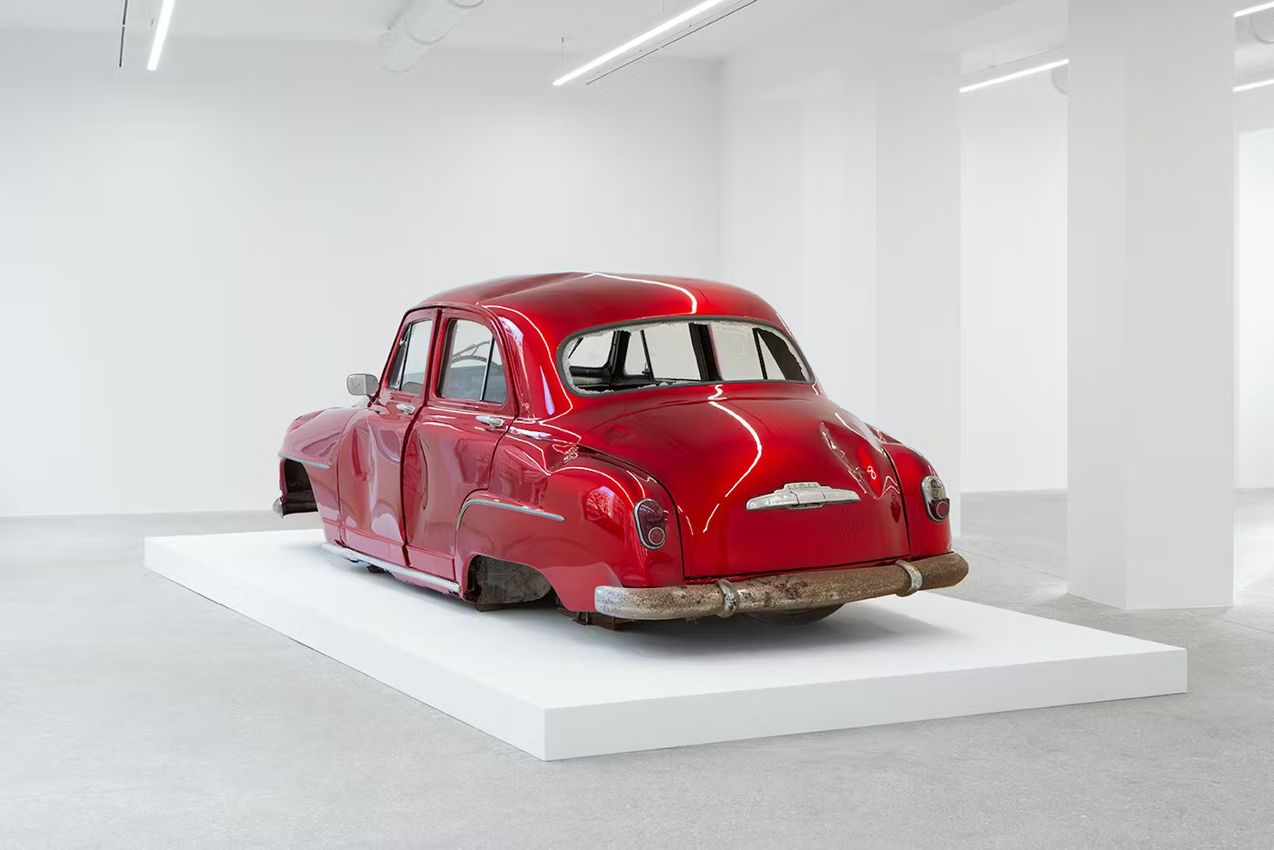
This is again the case with his two new ‘worksites’, as he likes tocall these bodies of work that he’s never entirely finished with,returning to them over the decades whenever he feels like it.One of these ‘worksites’ consists of paintings encased in blocksof clear resin, the other a car carcass covered in a thoroughlycontemporary coat of gleaming paint.
The encased paintings present us with a paradox. To begin with,there is the iconoclastic, almost sacrilegious gesture of makingthe paintings permanently inaccessible. Then, the nature of theobject is changed: exhibited in this way, the paintings lose theirtwo-dimensionality and almost appear like sculptures. And yet,a consequence of this new way of showing the paintings is thatthey can now be better seen: on the one hand, because we nowsee sides of them that until now were not visible, and because thebrilliance of the resin heightens their visual presence; on the otherhand—and this is the most crucial point—because this essentiallydestructive gesture lifts these artworks out of the anonymity inwhich they were otherwise doomed to remain forever. Thesemiddling artworks belong to their time in the way they encapsulatea certain artistic programme: just as the artists of the nineteenthcentury painted still-lives, those closer to us have produced lyricalabstractions. Returning to a recurrent theme in his work, BertrandLavier questions the status of the author and originality. Thisremoved repurposing is potentially more ‘artistic’ than the initialpainterly gesture, which never seems to interrogate the nature ofpainting itself. There is a distant echo of Duchamp’s _Pharmacie_here, as well as some of Lavier’s earlier works: in LandscapePainting and Beyond and Nature Morte and Still-Life, he wasalready ‘augmenting’ rather middling images. It is this _middling_quality that gives the gesture of encasement its full significance.Another of Lavier’s themes emerges at this point: the relationshipbetween high and low culture. What are we to make of thesehonest paintings—essentially artistic but worthless—oncethey have been elevated and emphasised through a processas popular and tacky as that of resin encasing? Like with theHarcourt/Grévin series, this new worksite reveals the utterlyrelative nature of cultural hierarchies.
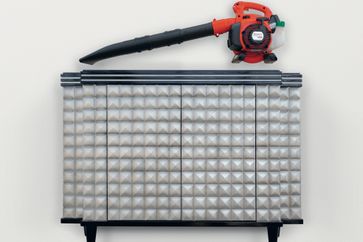
Good and bad taste are also set one into the other with therepainted car carcass. A 1955 Simca Aronde—once the mostpopular car in France—now nothing but a heap of scrap metal, hasbeen given a coat of bright, candy-coloured paint reminiscent ofthe ultramodern racing cars driving the streets in the capitals ofthe Gulf countries. Are we looking at a new object—as the shinytint seems to indicate—or a wreck—as the rust of the bumper barreminds us we are? Is this a luxury good or a ruin? The Aronde’snature crackles with these interfering possibilities, just as itstretches between the 50s and our 20s. In this, it is like Lavier’spainted refrigerator, whose 50s curves, made however in 1997and repainted in 2023 with thick layers of his ‘Van Gogh touch’,scrambles our habitual frameworks.
With these two new ‘worksites’, Bertrand Lavier continues hispursuit of an investigation he first began a long time ago, oneequal parts jovial and serious, interrogating a reality that isprofoundly paradoxical, always shifting, always ambiguous, andthat can never be grasped in a single dimension.
Bertrand Lavier came to international attention in the 1976 Venice Biennale. With his large scale assemblages, or “building sites,” Lavier explored ideas of appropriation and simulacrum, diverting images of contemporary mass culture into works of art. Influenced by the works of Duchamp and the Nouveaux Realists, as well as conceptual artist such as Joseph Kosuth and Dennis Oppenheim, Lavier attempted to expose underlying tensions between fine art and its representation, reality and simulation. His most well known work subvert the paradoxical relationship between painting and sculpture, by coating ready-made objects, such as refrigerators, pianos and tables, with thick layers of impasto. Unlike his contemporaries who emphasised the dematerialisation of the art object, Lavier’s works strike a balance between powerful visual image and conceptual gesture. Characteristic of his practice is the translation of motifs between media, an aesthetic grafting that is also a tongue in statement.

A respected voice in contemporary art discourse.
Focusing on ambitious storytelling and insightful art-world commentary. Ocula Magazine publishes in-depth interviews, critical essays and timely analysis on the artists, exhibitions and ideas driving the global art world.
Learn more about Ocula Magazine
Showcasing the best of the art world.
Ocula partners with galleries from around the world to highlight their artists, artworks and exhibitions. Gallery membership is by application and invitation, with each member vetted by an independent panel.
Learn more about Ocula Membership

Specialises in the sale of major artworks.
Led by a team with deep ties to the world’s leading auction houses, galleries and collectors. Ocula’s advisory team offers bespoke services to high-net-worth clients from around the world who are looking to acquire the best of contemporary and modern art.
Learn more about our team and services