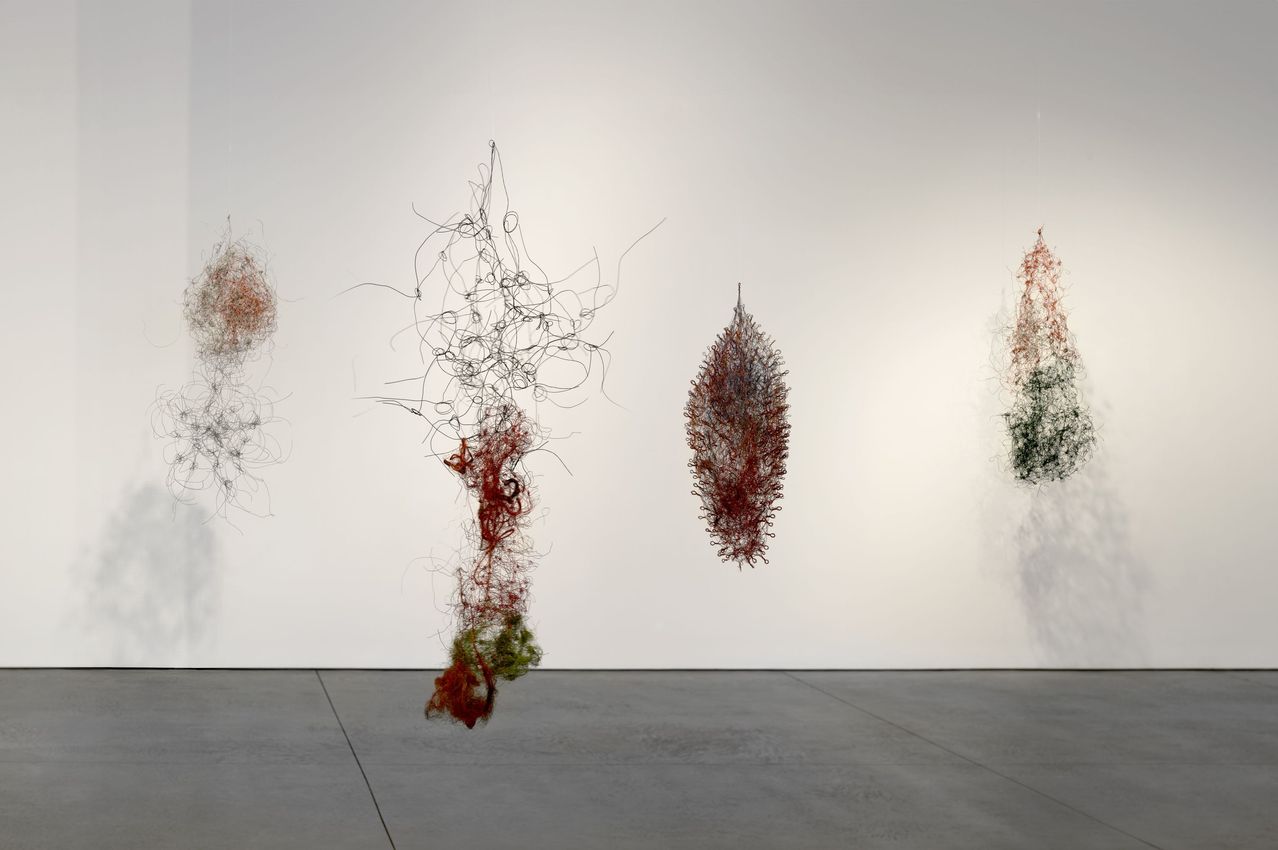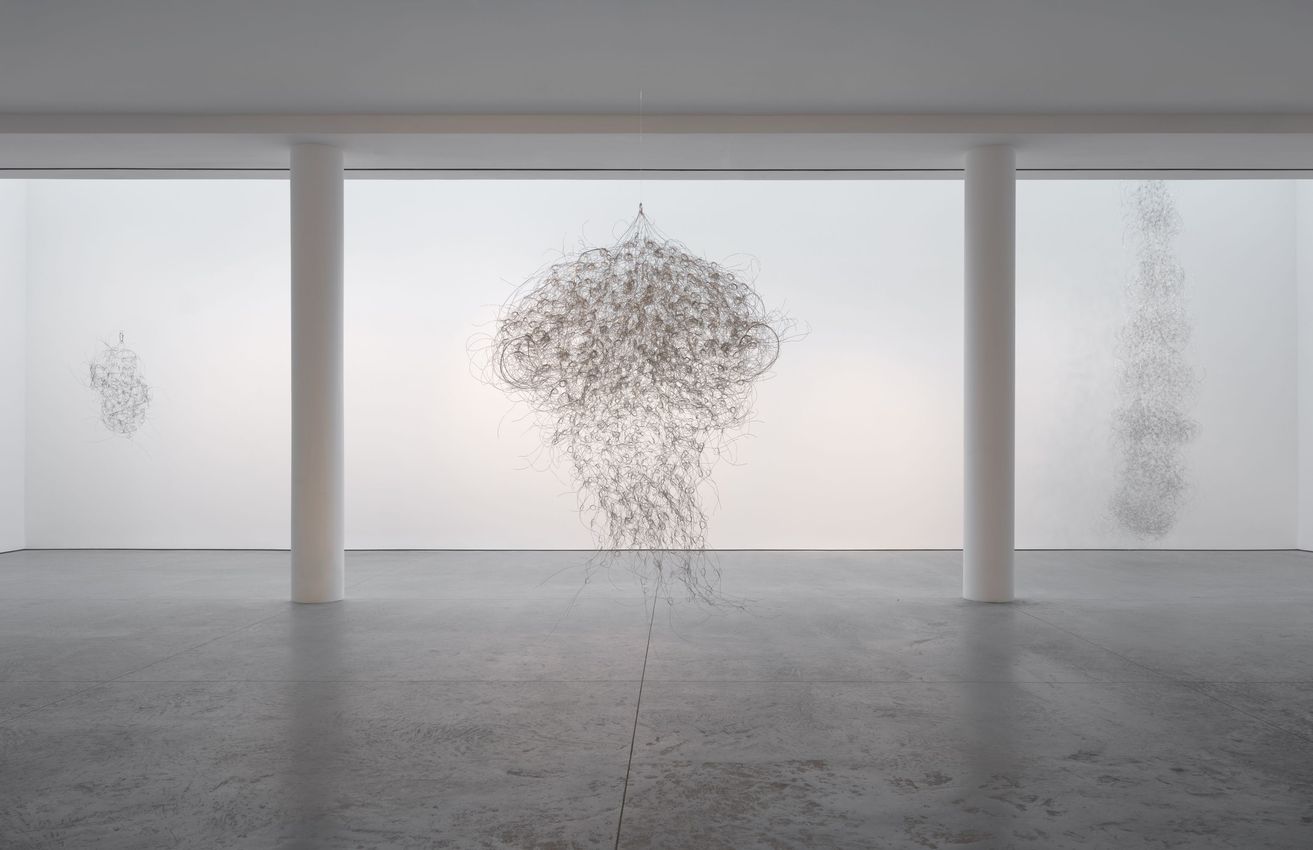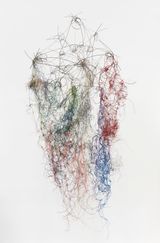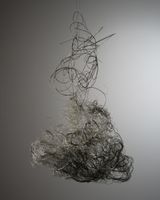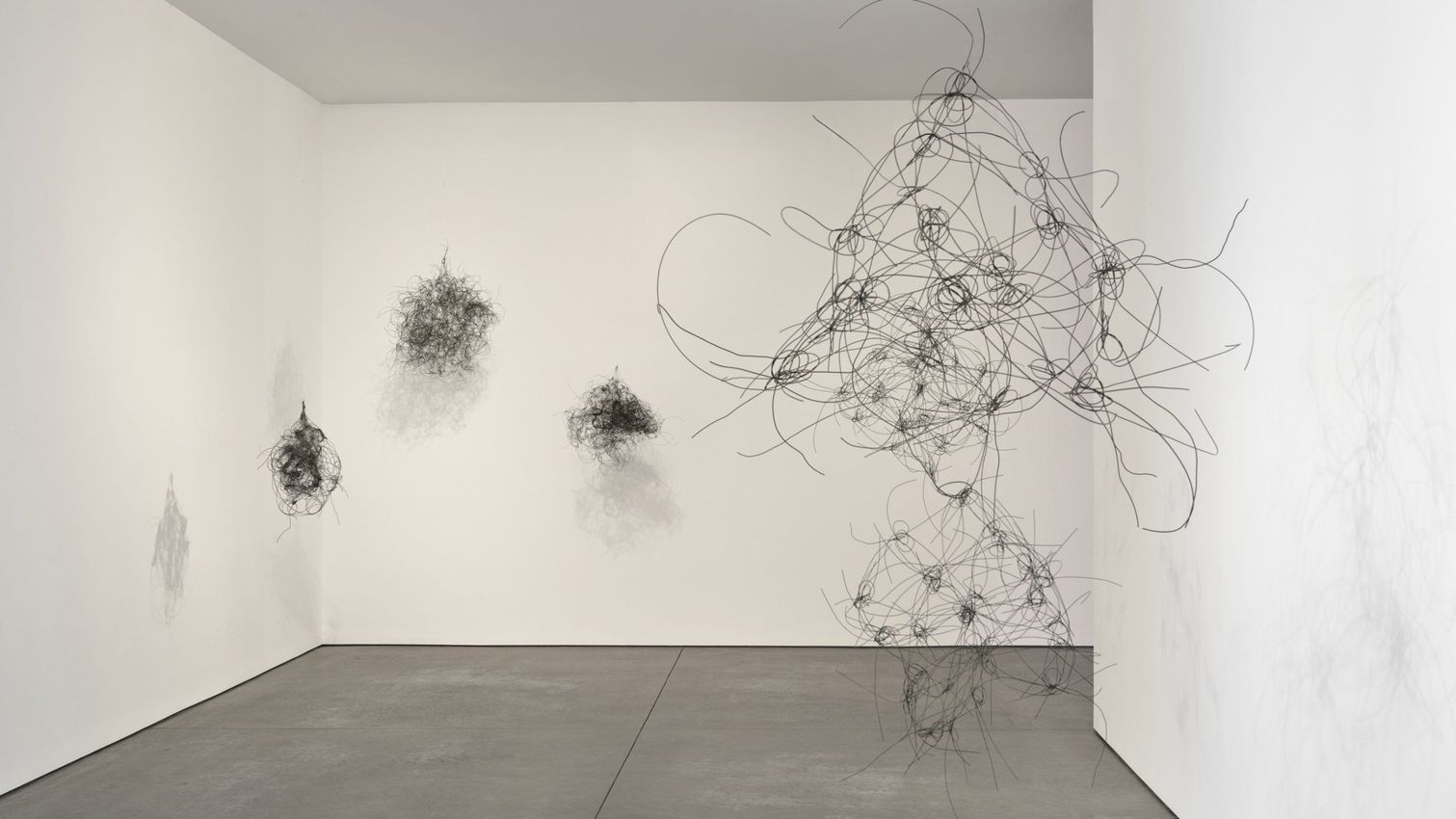
The endless sculptural potential of wire has captivated Alan Saret for nearly sixty years. Galacticonexus, the first exhibition to focus exclusively on his hanging sculptures, comprises ethereal works from 1975 to the present day. Each one illuminates Saret’s central artistic concern: networks in space—their mutability, their organic resonance, their mathematical correlations. Whether entropic or rigidly algorithmic in their construction, every floating matrix is more air than material, at once object and absence. This emptiness mimics the physical makeup of everything from atoms to galaxies. Saret’s hanging wire works move and, per the artist, “breathe”; he describes them as “like spirits, the most rarified form of matter.” Hung from the ceiling of the gallery, this constellation of abstract sculptures conjures visions of the natural world.
Composed of intertwined filaments of stainless-steel wire, the structure of the gargantuan Two To Ten Rising (2025) proceeds from bundles of ten and five strands down to masses constructed from two and three wires per node. Saret’s preoccupation with visualizing numerical relations has resulted in a system he calls “Number Stuff,” in which integers become as tangible as material; in his words, “Number Stuff gives a visible voice to number.” Cubic Electric (1997), for instance, explores how groups of four intersecting wires can become three-dimensional structures. Writing about Saret in 1970, Emily Wasserman noted that “disorder, dispersion, and disintegration are as much properties of his art as are allusions to structure, armature, architecture, and situation.” The non-geometric compositional logic of Multi-Material Network: Grand Sythagon (1975) demonstrates the foundational importance of the former attributes to Saret’s practice. When he began working with wire in 1967, critics and curators identified him as part of the “anti-form” movement. Unlike peers associated with this sculptural mode like Eva Hesse, Lynda Benglis, Richard Serra, who responded to the inherent properties of industrial materials, Saret emphasized the relationship between his creations and the organic world.
Saret’s titles often highlight what he terms “the illusory” elements of his sculptures. Swan (2002) alludes to its primary form’s swooping protrusion, as elegant as the bird’s neck; Regnum Urania (1983) references the cosmic associations prompted by the sculpture’s central yellow mass, its wispy tail evoking those of comets or shooting stars. Biology, like wire, is responsive; Embryo Spark (c. 2010) acknowledges that it is through this adaptivity that species proliferate. The structure of Living Waters (1999), built up from twisting threads of steel, copper, and bronze, swells and surges. Other morphological connections echo across his own oeuvre. The multihued tangles of coated wire that make up First Colors Form (1995–2015) evoke Saret’s series of Gang Drawings (1967– ), abstract compositions rendered using fistfuls of colored pencils to create parallel contours. Drawing in space with flexible materials, Saret proves, through sculpture, a claim he made in 1979: “Nature, therefore, draws the final line in art.”


Alan Saret’s practice includes sculpture, drawing, painting, architecture, geometry study, writing, language study, and music. He is best known for creating sculptures with flexible materials, composed of wire and other ‘non-art’ mediums. After a three-year sojourn in India in early 1970s where he focused on the spiritual and metaphysical, Saret’s approach to spatiality shifted to three-dimensional wire networks that explore the domain between order and disorder—leading to penetrated constructions that seem to come alive.


A respected voice in contemporary art discourse.
Focusing on ambitious storytelling and insightful art-world commentary. Ocula Magazine publishes in-depth interviews, critical essays and timely analysis on the artists, exhibitions and ideas driving the global art world.
Learn more about Ocula Magazine
Showcasing the best of the art world.
Ocula partners with galleries from around the world to highlight their artists, artworks and exhibitions. Gallery membership is by application and invitation, with each member vetted by an independent panel.
Learn more about Ocula Membership

Specialises in the sale of major artworks.
Led by a team with deep ties to the world’s leading auction houses, galleries and collectors. Ocula’s advisory team offers bespoke services to high-net-worth clients from around the world who are looking to acquire the best of contemporary and modern art.
Learn more about our team and services