





ROBERT INDIANA
1928-2018, United StatesRobert Indiana created his Pop Art pieces by adapting the American Dream iconography of adverts, logos and neon signs. Inspired by poetry as well as this commercial landscape, his bold-coloured works bordered hard-edge painting yet were also highly accessible.
Early Years
Robert Indiana was born Robert Clark in New Castle, Indiana, in 1928. The Depression and his father’s job for oil company Philips 66 shaped his early life, although he once said that his mother “couldn’t bear to live in one house longer than a year”. His parents divorced when he was not yet a teenager. Following three years in the US Air Force, the GI Bill supported him to study at the School of the Art Institute of Chicago, then the Skowhegan School of Sculpture and Painting in Maine, and the Edinburgh College of Art—he moved to New York City in 1954 and changed his name to avoid confusion with two other artists called Robert Clark. Elsworth Kelly helped Indiana to find a studio in Lower Manhattan; they later became lovers. In 1961, MoMA included Indiana in its seminal Art of Assemblage exhibition.
Robert Indiana: Artworks
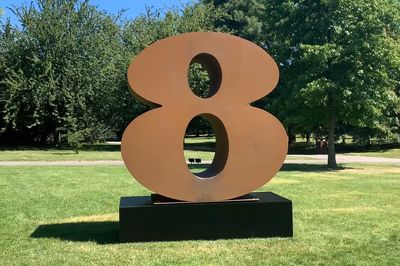
Robert Indiana’s artwork is more complex that it perhaps initially appears—his energetic, bold pieces explore American identity and the power of language, using single words, numbers and imagery drawn from the vocabulary of advertising and roadside architecture.
- His early sculptures were influenced by the seaport location of his studio bordering New York City’s Financial District, featuring found items including wooden beams and stencils. These pieces were often taller than 1.5 metres—examples include Jeanne d’Arc (1960—1962) and Four (1959—1962).
- When Indiana discovered a set of brass stencils he began to incorporate short words into his paintings and sculptures. Eat/Die (1962), the first of the Eat series, perhaps marked his status as a member of the Pop Art movement. The word “eat” was not merely comment on consumer culture; it was also the last word Indiana’s mother said before she died]2. A large-scale sign saying Eat was commissioned for the New York State Pavilion at the 1964 World’s Fair.
- Indiana featured his parents in the dark 1963 diptych Mother and Father, with the couple pictured in front of their Model T Ford, his mother bare-breasted and his father barefoot.
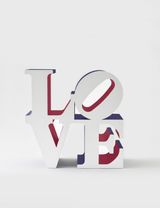
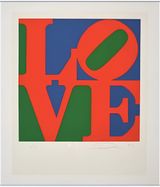
- Robert Indiana is arguably best known for his Love series of works, initially created for a Christmas card for MoMA in 1965, but evolving through paintings and screenprints and then eventually into the sculptural works, the first of which was made for the Indianapolis Museum of Art in 1970. There are many theories about the initial idea: perhaps it was inspired by art at the churches Indiana attended as a child; it may have been a result of Indiana helping with the conversion of a Christian Science church into a gallery, or possibly the design originally featured a different four-letter word, prompted by his break-up with Ellsworth Kelly. The four letters of Love, with the O angled, remain one of the world’s most reproduced (and plagiarised) artworks. Sculptures of Love exist across the globe.
Robert Indiana: Select Exhibitions
Select Solo Exhibitions
- Robert Indiana: The American Dream, Pace Gallery, New York City (2025)
- Robert Indiana: Sculpture 1958—2018, Yorkshire Sculpture Park (2022)
- Robert Indiana: A Sculpture Retrospective, Buffalo AKG Art Museum (2018)
- Robert Indiana: To Russia With Love, State Russian Museum, St Petersburg (2016)
- Robert Indiana: Beyond Love, Whitney Museum of American Art, New York City (2013)
- Robert Indiana a Milano, around Milan (2008)
- Robert Indiana: a Living Legend, Seoul Museum of Art (2006)
- Robert Indiana: Peace Paintings, Paul Kasmin Gallery, New York City (2004)
- Robert Indiana, Shanghai Art Museum (2002)
- Love and the American Dream: the Art of Robert Indiana, Portland Museum of Art (1999)
- Robert Indiana: Early Sculpture 1960—1962, Salama-Caro Gallery, London (1991)
- Robert Indiana, Galerie Natalie Seroussi, Paris (1989)
- Indiana’s Indiana’s: a 20-Year Retrospective of Painting and Sculpture from the Collection of Robert Indiana, Farnsworth Art Museum, Rockland (1982)
- Robert Indiana: New Paintings and Sculpture, Galerie Denise René, New York City (1972)
- Robert Indiana: Number Paintings, on tour in Germany (1966)
- Robert Indiana, Stable Gallery, New York City (1962)
Select Group Exhibitions
- Hard Edge(d), Kunstmuseum Schloss Derneburg, Holle (2026)
- Dear America: Artists Explore the American Experience, National Gallery of Art, Washington DC (2026)
- Painted Pop, Acquavella Galleries, Palm Beach (2023)
- Frieze Sculpture, Regent’s Park, London (2019)
- Witness: Art and Civil Rights in the 1960s, Brooklyn Museum, New York City (2014)
- Sculpture in the City, around London (2013)
- Hand-Painted Pop: American Art in Transition, Museum of Contemporary Art, Los Angeles (1992)
- Pop Art 1955—1970, Art Gallery of New South Wales, Sydney (1985)
- American Pop Art, Whitney Museum of American Art, New York City (1974)
- documenta 4, Kassel (1968)
- New York World’s Fair, Queens, New York City (1964)
- Stock Up for the Holidays: an Anthology of Pop Art, Pace Gallery, Boston (1962)
- The Art of Assemblage, MoMA, New York City (1961)
Further Reading
- Robert Indiana’s Instagram
- Robert Indiana obituary in The New York Times
- Robert Indiana obituary in the Guardian
- The Robert Indiana Legacy Initiative
- Artist profile page at Pace Gallery
Robert Indiana FAQs
Was Robert Indiana friends with Andy Warhol?
Yes, Robert Indiana and Andy Warhol were friends; they met in New York City during the 1950s. They both grew up in poor backgrounds and were sensitive to the homophobic attitudes of the period. Indiana took part in some of Warhol’s avant-garde anti-films, notably 1964’s Eat, in which he slowly ate a mushroom for 45 minutes.
What was the lawsuit over Robert Indiana’s artworks?
One day before Indiana died in 2018, Morgan Art Foundation sued art publisher Michael McKenzie, claiming: “They have isolated Indiana from his friends and supporters, forged some of Indiana’s most recognizable works, exhibited the fraudulent works in museums, and sold the fraudulent works to unsuspecting collectors.” These works included silk-screen prints featuring Bob Dylan lyrics. In April 2026, a jury at the Manhattan Federal Court found McKenzie guilty of making and selling unauthorised Indiana artworks and awarded Morgan Art Foundation more than $102 million USD.
Where did Robert Indiana move to when he left New York City?
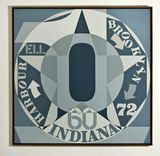
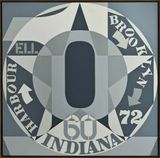
In 1978, Robert Indiana took the decision to remove himself from the art world in New York City and moved to the remote island of Vinalhaven in Maine. He moved into a Victorian building called the Star of Hope, where he built a new studio. The move to Vinalhaven prompted him to switch the focus of his artistic practice: he created 18 large-scale works called The Hartley Elegies (1989—1994), inspired by Marsden Hartley’s German Officer paintings (Hartley lived on Vinalhaven in 1938). Indiana also added to his American Dream series.
Ocula








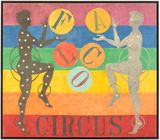


Explore Robert Indiana's Exhibitions







Explore and Follow Artists Shaping Contemporary Art
A respected voice in contemporary art discourse.
Focusing on ambitious storytelling and insightful art-world commentary. Ocula Magazine publishes in-depth interviews, critical essays and timely analysis on the artists, exhibitions and ideas driving the global art world.
Learn more about Ocula Magazine
Showcasing the best of the art world.
Ocula partners with galleries from around the world to highlight their artists, artworks and exhibitions. Gallery membership is by application and invitation, with each member vetted by an independent panel.
Learn more about Ocula Membership
Specialises in the sale of major artworks.
Led by a team with deep ties to the world’s leading auction houses, galleries and collectors. Ocula’s advisory team offers bespoke services to high-net-worth clients from around the world who are looking to acquire the best of contemporary and modern art.
Learn more about our team and services