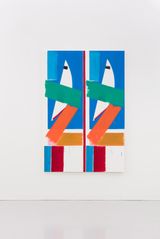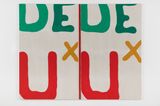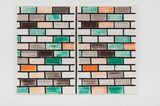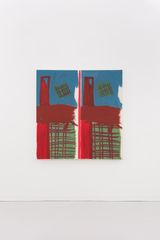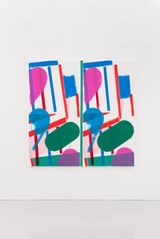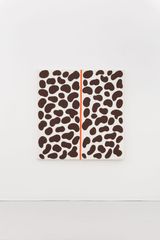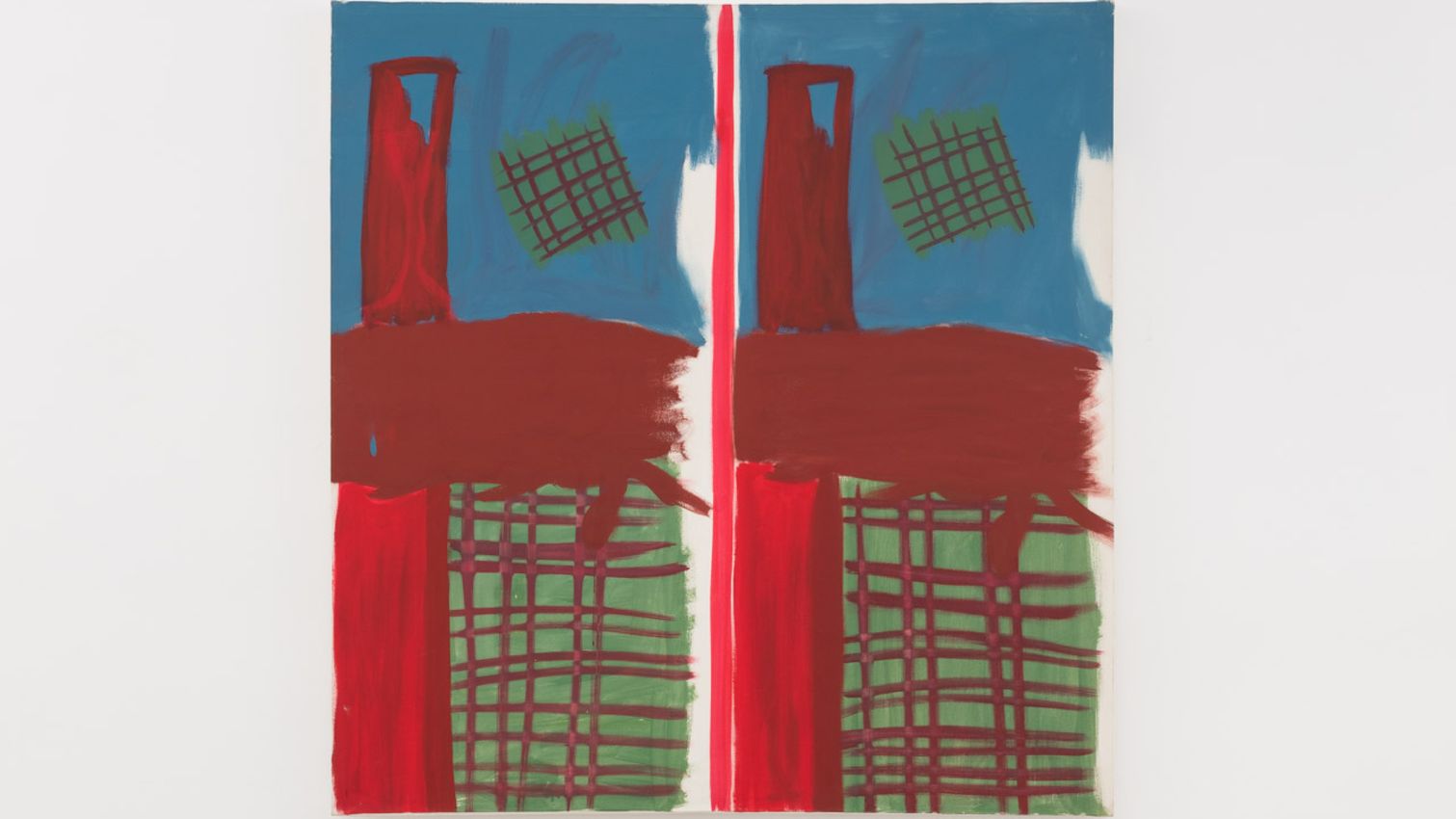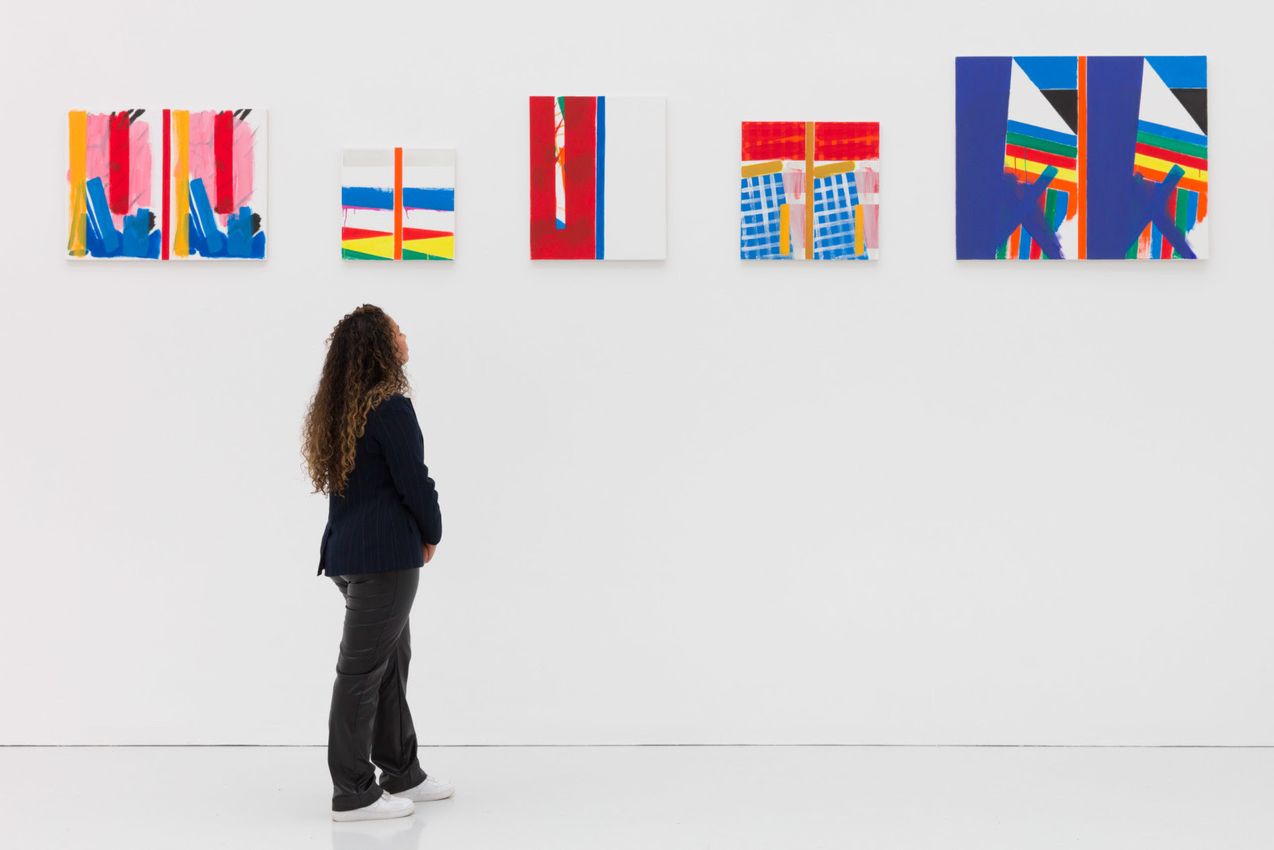
Bernard Piffaretti’s paintings are characterised by the vertical division of a central brushstroke, a technique which creates distinctly individual compositions all the while bonding each and every painting in his oeuvre. However, for his second solo exhibition at Kate MacGarry, Ridgeline, Piffaretti presents a series of paintings which are aligned on not just one but two axes, vertically and horizontally, conceptually and physically.
The aligned lower edge of each painting forms a continuous contour around the gallery, reminding the viewer to consider each of Piffaretti’s works as part of a whole. His dedication to the consistency of a format gives his practice in its entirety a discernible identity, total connection and the boundaries to explore the nuances of a visual language. The paintings cannot be perceived without the awareness that there are others. This method of display however gives emphasis to the displacement of visual authenticity within the images–the central border does not unite the works in the uniformity of their appearance, ‘it is mainly in the differences, in the divergence, that an image will displace its model, and it is that displacement that will make it effective’ (Bernard Piffaretti, 2007). The viewer is encouraged to scrutinise each half of a painting without verifying the resemblance – it is not a mirror image he executes but a partner, recited from memory once the first half is complete.
Language intervenes sporadically in Piffaretti’s paintings. Each work begins spontaneously, without a study, an aim or a plan, however the rare presence of words in his paintings are purposeful and aim to emphasise an aspect of his work. Ridgeline immediately indicates the horizontal alignment of paintings around the gallery space, ‘the pictures follow on from one another through their obvious oppositions,’ says Piffaretti, “thus, formats and pictorial situations leave each picture with its own analysis”. However, the exhibition title also refers to the idea of a split view–looking down upon two divided landscapes. At once focussing and dividing our attention, the vertical ‘ridge’ in the centre of each canvas urges us to identify the differences and similarities in what we observe and become an active agent in the process of seeing.
Ridgeline is an agent for connection and dissociation. The paintings reveal no distinguishable trace of recurring motifs apart from the one visual and conceptual trigger which binds them all, allowing Piffaretti limitless creativity in his exploration of painting.
Bernard Piffaretti was born in 1955 in Saint-Etienne, France. This year, he will participate in The Double: Identity and Difference in Art Since 1900, an exhibition at the National Gallery, Washington DC. Principal solo exhibitions since 2017 include Blanc International Art Space, Beijing, China, 2021; Surplus Space, Wuhan, China, 2021; Lisson Gallery, Shanghai, China, 2021; Galerie Frank Elbaz, Paris, France, 2020; Galerie Klemm’s, Berlin, Germany, 2019; Lisson Gallery New York, USA, 2019; Philip Martin Gallery, Los Angeles, USA, 2018; and Kate MacGarry, London, 2017.
Bernard Piffaretti is known for duplicate panel paintings that show abstract images alongside their identical reproduction reflecting on notions of originality, copy, and completion.

The gallery was founded by Kate MacGarry in 2002 on Redchurch Street, London, where some of its represented artists, including Goshka Macuga (Poland), Francis Upritchard (New Zealand), Ben Rivers (UK) and Dr Lakra (Mexico) had their first commercial gallery exhibition. The current gallery space, originally designed by architect Tony Fretton, is on Old Nichol Street where they present six exhibitions a year. The gallery participates in international art fairs including Art Basel and Frieze London where they have presented solo projects since 2010. The gallery represents 25 emerging and established artists; most recently adding Dawn Ng, Rio Kobayashi and Mark Corfield-Moore to the roster.

A respected voice in contemporary art discourse.
Focusing on ambitious storytelling and insightful art-world commentary. Ocula Magazine publishes in-depth interviews, critical essays and timely analysis on the artists, exhibitions and ideas driving the global art world.
Learn more about Ocula Magazine
Showcasing the best of the art world.
Ocula partners with galleries from around the world to highlight their artists, artworks and exhibitions. Gallery membership is by application and invitation, with each member vetted by an independent panel.
Learn more about Ocula Membership

Specialises in the sale of major artworks.
Led by a team with deep ties to the world’s leading auction houses, galleries and collectors. Ocula’s advisory team offers bespoke services to high-net-worth clients from around the world who are looking to acquire the best of contemporary and modern art.
Learn more about our team and services