




OSGEMEOS
b. 1974, BrazilOSGEMEOS is the collaborative project of Brazilian identical twin brothers Otavio and Gustavo Pandolfo (both born 1974, São Paulo), whose name comes from the Portuguese ‘os gêmeos’, meaning ‘the twins’. Their large-scale murals and studio work blend Brazilian popular culture, folk imagery, and hip hop with a distinctive, dreamlike visual language, making them key figures in contemporary street art and institutional exhibitions.
Early years and formation of OSGEMEOS
Otavio and Gustavo grew up in the working-class São Paulo neighbourhood of Cambuci, where drawing became an early way of communicating with each other and with their family, as well as a form of play. In the 1980s they became immersed in Brazil’s emerging hip hop culture, first through breakdancing and music, then through graffiti, which they began painting on city walls in 1987. Over time, the twins’ close collaboration, shared sketchbooks, and dialogue with São Paulo’s streets coalesced into the joint practice now known as OSGEMEOS.
Visual Language and OSGEMEOS Artworks
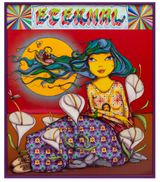
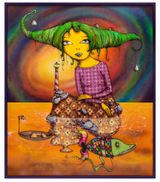
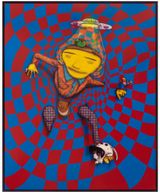
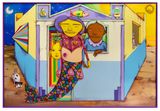
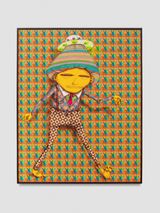
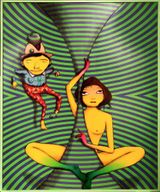
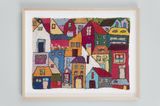
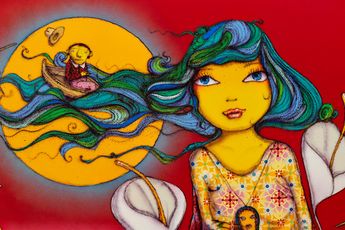
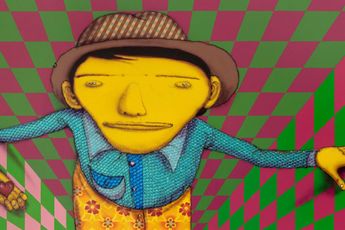
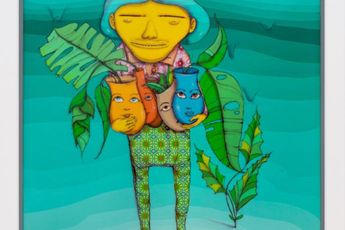
OSGEMEOS are known for vibrant, densely patterned scenes populated by long-limbed, yellow-skinned figures with thin outlines, enlarged heads, and simplified, mask-like features. The yellow tone is conceived as a universal skin colour that resists specific racial categorisation while also echoing the diversity and warmth of Brazilian society. Within these worlds, characters drift between everyday urban settings and fantastical spaces filled with musical instruments, floating houses, and surreal architectures.
Working across painting, drawing, sculpture, installation, and video, OSGEMEOS often incorporate found objects, fabrics, sound, and kinetic elements into immersive environments. Their works range from intimate family portraits and scenes of São Paulo street life to larger allegories that reflect on inequality, memory, dreams, and the power of imagination. Drawing remains central: sketchbooks and wall drawings form the basis for canvases, installations, and large-scale public murals that open their inner universe to a broad public.
Major Commissions and Public Projects
OSGEMEOS have realised some of the most recognisable large-scale murals of the past two decades. In 2008 they were commissioned to paint the riverside façade of Tate Modern in London as part of the museum’s exhibition Street Art, widely noted as one of the first major museum presentations of the genre. For the 2014 FIFA World Cup in Brazil, they transformed the Brazilian national football team’s Boeing 737 into a flying mural using more than a thousand aerosol cans, covering the plane with a crowd of characters representing the country’s ethnic and cultural diversity; the work remained on the aircraft for two years after the tournament, giving travellers the experience of ‘flying with a painting’.
Also in 2014, for the Vancouver Biennale, the artists created Giants, a 360-degree, approximately 21-metre-tall mural that wrapped six concrete silos on Granville Island. Each silo was turned into a monumental figure, together forming six gigantic characters that tower over the waterfront and reframe the industrial site as a sculptural artwork. Other notable public projects include murals for Wynwood Walls in Miami, the Houston Street and Bowery Wall and Creative Time’s Coney Island projects in New York, the Parallel Connection midnight-moment animation in Times Square, and site-specific interventions at HangarBicocca in Milan.
Institutional Exhibitions and Recent Projects
Alongside their street-based practice, OSGEMEOS have developed an extensive exhibition history with museums and galleries. The immersive installation Lyrical (2018, Mattress Factory, Pittsburgh) combined wall paintings, sculptural elements, and objects from the brothers’ collection to form a multisensory environment of colour, sound, and movement. The large-scale exhibition Segredos (Secrets) (2020–2021, Pinacoteca de São Paulo) gathered more than a thousand works and objects, from teenage notebooks and early drawings to large canvases, installations, and sound pieces, tracing the evolution of their imagery over several decades.
In recent years their work has been the subject of major international presentations. In 2024–2025 the museum-scale survey OSGEMEOS: Endless Story at the Hirshhorn Museum and Sculpture Garden, Washington, D.C., brought together paintings, sculptures, installations, and archival material to explore their ongoing creation of a dream world populated by yellow-skinned characters and musical, floating architectures. Gallery exhibitions such as Portal of Dreams (2024, Lehmann Maupin, Seoul) and Cultivating Dreams (2024, Lehmann Maupin, New York) have focused on new paintings and immersive installations set within an imagined landscape that extends their long-running interest in the porous border between everyday reality and fantasy.
Earlier solo shows of OSGEMEOS’ work have been organised by the following institutions:
- OSGEMEOS no Museu do Pontal – O bunker (31 January 2015–31 December 2019, Museu Casa do Pontal, Rio de Janeiro), a site-specific outdoor installation created especially for the museum’s gardens.
- OSGEMEOS (1 August–25 November 2012, Institute of Contemporary Art, Boston), the duo’s first solo museum exhibition in the United States, accompanied by the temporary mural The Giant of Boston on Dewey Square.
- Pra quem mora lá, o céu é lá (2010, Museu Coleção Berardo, Lisbon), a museum show that brought their dreamlike painted and sculptural works to a Portuguese audience.
- OS GEMEOS (16 November 2007–6 January 2008, Museum Het Domein, Sittard, Netherlands), an early European institutional exhibition documented in a dedicated catalogue.
Their works are represented in public collections such as the Museum of Contemporary Art Tokyo; Museu de Arte Moderna de São Paulo; Museu de Arte Brasileira, São Paulo; Museo de Arte de Puerto Rico, San Juan; Pinacoteca do Estado de São Paulo; and the Franks-Suss Collection, London.
Website and Instagram
OSGEMEOS maintain an active online presence that documents new murals, studio works, and exhibitions. Their official website, osgemeos.com.br, and Instagram account @osgemeos provide ongoing insight into the development of their characters, installations, and large-scale urban interventions across Brazil and around the world.
Osgemeos FAQs
What does ‘OSGEMEOS’ mean?
‘OSGEMEOS’ comes from the Portuguese ‘os gêmeos’, meaning ‘the twins’, and refers to Brazilian identical twin artists Otavio and Gustavo Pandolfo.
Why are OSGEMEOS important in contemporary art?
OSGEMEOS helped bring Brazilian graffiti and mural painting onto the global stage, bridging street art and museum exhibitions with large-scale murals, immersive installations, and paintings that draw on São Paulo street culture, music, and folklore.
Why do OSGEMEOS paint yellow characters?
OSGEMEOS long-limbed, yellow-skinned figures are intended as universal characters that do not correspond to a single race or ethnicity while also echoing the warmth and diversity of Brazil’s population.
Where can I see major OSGEMEOS murals?
Key public works by OSGEMEOS include Giants (2014) on the silos at Granville Island in Vancouver, large murals in São Paulo, New York (Houston/Bowery Wall and Coney Island projects), Miami (Wynwood Walls), Milan (HangarBicocca), and the Boeing 737 painted for Brazil’s national football team during the 2014 World Cup.
What is ‘Giants’ (2014) by OSGEMEOS?
Giants is a 360-degree mural created for the 2014 Vancouver Biennale, where the artists transformed six 21-metre-tall concrete silos into towering yellow-skinned characters, turning an industrial site into a monumental artwork.
What is ‘OSGEMEOS: Endless Story’?
OSGEMEOS: Endless Story (2024–2025) is a museum-scale survey at the Hirshhorn Museum and Sculpture Garden in Washington, D.C., that brought together paintings, sculptures, installations, and archival materials to present their dreamlike universe across an entire floor.
How did OSGEMEOS start working with museums like Tate Modern?
Their reputation in São Paulo’s graffiti scene and collaborations with international artists led to invitations from major institutions; in 2008 they painted the riverside façade of Tate Modern in London for the exhibition Street Art, one of the first major museum shows devoted to the genre.
Ocula | 2026










Explore Osgemeos' Exhibitions






Explore and Follow Artists Shaping Contemporary Art
A respected voice in contemporary art discourse.
Focusing on ambitious storytelling and insightful art-world commentary. Ocula Magazine publishes in-depth interviews, critical essays and timely analysis on the artists, exhibitions and ideas driving the global art world.
Learn more about Ocula Magazine
Showcasing the best of the art world.
Ocula partners with galleries from around the world to highlight their artists, artworks and exhibitions. Gallery membership is by application and invitation, with each member vetted by an independent panel.
Learn more about Ocula Membership
Specialises in the sale of major artworks.
Led by a team with deep ties to the world’s leading auction houses, galleries and collectors. Ocula’s advisory team offers bespoke services to high-net-worth clients from around the world who are looking to acquire the best of contemporary and modern art.
Learn more about our team and services