





MARINA ABRAMOVIĆ
b. 1946, SerbiaPioneering performance artist Marina Abramović places her body at the centre of her artistic practice, achieving heightened consciousness by interacting with pain, stillness, time and endurance. Her work not only explores her own limits but also asks the audience to question their participation and their relationship with the artist.
Early Years
Marina Abramović was born in Belgrade in 1946 and her disciplinarian parents were loyal to the post-war Communist regime. In Gillian Zoe Segal’s 2015 collection Getting There: A Book of Mentors, Abramović said: “My childhood was very unhappy. I grew up with incredible control, discipline, and violence at home. Everything was extreme.” Hospitalised with suspected haemophilia, she recalled: “That was the happiest, most wonderful time of my life.” Robert Wilson’s 2011 film The Life and Death of Marina Abramović explored some of this period.
Her mother wouldn’t let her play with other children, and Abramović used drawing as a way of understanding the world. She studied at the Academy of Fine Arts in Belgrade (1965–1970) and the Academy of Fine Arts in Zagreb (1970–1972). She originally painted, but then moved into performance art.
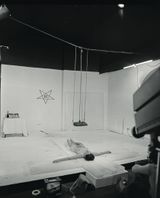
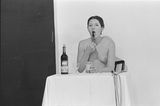
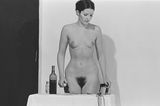
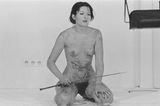
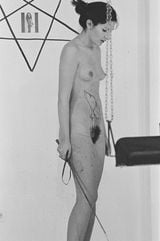
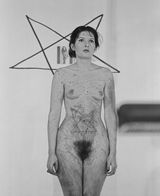
Even as her performance practice began to take shape—notably in 1975’s Thomas Lips, in which she carved a five-pointed Communist star into her abdomen—Abramović remained with her abusive parents until she was 29, when she received an invitation to perform on Dutch television. At this point she met German artist Ulay; Abramović escaped from her parents and Ulay became both her professional and romantic partner between 1975 and 1988.
Marina Abramović: Artworks
Abramović pushes her physical and mental limits while exploring the role of rituals and customs. Her performances often feature pain, but she sees this as an entry point into the subconscious mind; by focusing, she can achieve endurance. Perhaps as a consequence of her childhood, discipline is a key tenet of her practice: she sets out to achieve specific, self-defined instructions in her performances.
- The Rhythm series of the 1970s is perhaps best known for 1974’s _Rhythm 0, a controversial performance piece in which Abramović stood still for six hours in a Naples Gallery, next to a table with 72 items—ranging from a feather and a grape to a whip and a gun—that the audience used on her however they chose. “It was six hours of real horror,” she later recalled: the audience became bolder in their choice of object, cutting away her clothes and pointing the gun at her head.
- Between 1975 and 1988 Abramović regularly collaborated with Ulay, notably in the Relation series. 1977’s Relation in Time features the pair connected by their tied-together ponytails. 1977’s Imponderabilia invited visitors to squeeze through a doorway on either side of which were the naked Abramović and Ulay. Their final piece, The Lovers, had been planned as a marriage, but by the time the Chinese authorities granted permission for them to walk towards each other from opposite ends of the Great Wall, their meeting in the middle was to say goodbye.
- Post-Ulay she entered a contemplative phase, with works including Balkan Baroque, a performance in which she washed 1,500 bloodied cow bones by hand, which won her the Golden Lion at the Venice Biennale.
- For 2010’s The Artist is Present at MoMA in New York City, Abramović trained 30 performance artists in her consciousness-altering method, but the most popular element of the exhibit was where the artist herself sat at a table and invited visitors to sit opposite her. When she opened her eyes she and the visitor would connect without speaking, but being watched by other visitors. One of the participants was Ulay, which surprised Abramović and moved her to tears.
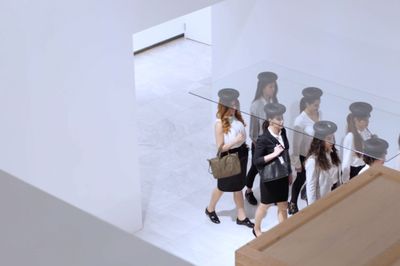
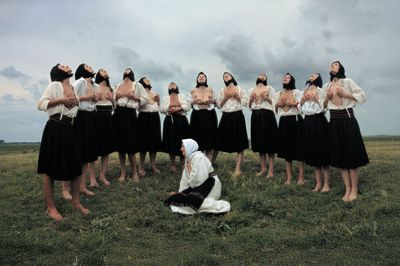
- 2025’s Balkan Erotic Epic featured more than 70 performance artists, dancers, musicians and singers who appeared in 13 scenes drawn from Balkan folklore and ritual. Each scene was inspired by the conception of the erotic as a source of power and fertility, including Scaring the Gods to Stop the Rain in which women bared their vaginas to the heavens.
- At the 2026 Venice Biennale, Marina Abramović became the first living woman to exhibit at the Gallerie dell’ Accademia. Transforming Energy brought together more than five decades of her work, including Rhythm.
Marina Abramović: Select Awards
- Honoris Causa Diploma Award, Albertina Academy of Fine Arts of Turin (2024)
- Princess of Asturias Award, Arts, Oviedo (2021)
- Honorary Doctorate of Arts, Instituto Superior de Arte, Havana (2015)
- Cultural Leadership Award, American Federation of Arts, New York City (2011)
- Lorenzo il Magnifico Career Award, Florence Biennale (2009)
- Honorary Doctorate, Art Institute of Chicago, Chicago (2004)
- Golden Lion, 47th Venice Biennale (1997)
Marina Abramović: Select Exhibitions
Select Solo Exhibitions
- Marina Abramović: Transforming Energy, Gallerie dell’Accademia, Venice (2026)
- Marina Abramović: Seven Deaths, Frederiksbergmuseerne, Copenhagen (2026)
- Marina Abramović: Thomas Lips 1975, Galerie Krinzinger, Vienna (2025)
- Balkan Erotic Epic, Factory International, Manchester (2025)
- Between Breath and Fire, Gres Art, Bergamo (2024)
- Marina Abramović, Kunsthaus Zürich (2024)
- Energy Clothes, Galerie Krinzinger, Vienna (2023)
- Marina Abramović, Royal Academy of Arts, London (2023)
- Marina Abramovic: Portrait as Biography, Bernal Espacio Galeria, Madrid (2022)
- Seven Deaths of Maria Callas, Palais Garnier, Opéra National de Paris (and touring) (2021)
- The Life, Serpentine Gallery, London (2019)
- White Space, Lisson Gallery, London (2014)
- The Artist is Present, MoMA, New York City (2010)
- Seven Easy Pieces, Solomon R Guggenheim Museum, New York City (2005)
- Soul Operations Room, Kappatos Gallery, Athens (2000)
- Spirit Cooking, Galerie de Lege Ruimte, Ghent (1996)
- Sur la Voie, Pompidou Centre, Paris (1990)
- Modus Vivendi: Works 1980–1985, Van Abbemuseum, Eindhoven (1985)
- Positive Zero, Holland Festival, Carre Theatre, Amsterdam (1983)
- AAA–AAA, RTB television studio, Liege (1978)
- Thomas Lips, Galerie Krinzinger, Innsbruck (1975)
Select Group Exhibitions
- The Spirits of Maritime Crossing 2026, Palazzo Rocca Contarini Corfù, Venice (2026)
- What a Wonderful World: An Audiovisual Poem, The Julia Stoschek Foundation, Variety Arts Theatre, Los Angeles (2026)
- 12 Years of Ulay / Marina Abramović, Cukrarna Gallery, Ljubljana (2025)
- Artists and Athletes: The Hill They Climb, WARP Coup de Ville, Sint-Niklaas (2024)
- Humble Works, Colnaghi, London (2021)
- Rising, Phi Centre, Venice (2019)
- Summer Exhibition, Royal Academy of Arts, London (2016)
- Unconditional Love, Arsenale, Venice Biennale (2009)
- Cleaning the House, Kiasma, Helsinki (1999)
- The Lovers, Museum of Contemporary Art, Montreal (1991)
- The Brink, European Dialogue, Sydney Biennale (1979)
Further Reading
- 2024 interview in the Guardian
- Artist profile page at Lisson Gallery
- Interview with the Royal Academy of Arts (2023
- The Marina Abramovic Institute
Marina Abramović FAQs
What is the Abramović Method?
Maria Abramović created the Abramović method after spending time with Aboriginal tribes in Australia if 1980. She and then-partner Ulay lived with the Pitjantjatjara people and, being away from the distractions of city life, she “felt overwhelming lightness and happiness and her senses were heightened”. She also engaged with repetitive, meditative tasks (something she had already explored while living in a Tibetan community in India).
Did Marina Abramović work with Lady Gaga?
Yes, in 2013, a few months before she released her third studio album, Artpop, Lady Gaga stayed at Marina Abramović’s home and completed a four-day consciousness-altering course. With no phone or other means of communication, Gaga undertook tasks including Abramović’s well-known exercise in separating and counting grains of rice. Abramović said: “It felt like she was my daughter.”
Has Marina Abramović ever performed other artists’ work?
Yes—in Seven Easy Pieces, at the Solomon R Guggenheim Museum in New York City in 2005, Abramović re-enacted both her controversial 1975 piece Thomas Lips, but also five works by Vito Acconci, Valie Export, Gina Pane, Joseph Beuys and Bruce Nauman.
Ocula
View Marina Abramović's Artworks






















Explore Marina Abramović's Exhibitions







Marina Abramović in Ocula Magazine









Explore and Follow Artists Shaping Contemporary Art
A respected voice in contemporary art discourse.
Focusing on ambitious storytelling and insightful art-world commentary. Ocula Magazine publishes in-depth interviews, critical essays and timely analysis on the artists, exhibitions and ideas driving the global art world.
Learn more about Ocula Magazine
Showcasing the best of the art world.
Ocula partners with galleries from around the world to highlight their artists, artworks and exhibitions. Gallery membership is by application and invitation, with each member vetted by an independent panel.
Learn more about Ocula Membership
Specialises in the sale of major artworks.
Led by a team with deep ties to the world’s leading auction houses, galleries and collectors. Ocula’s advisory team offers bespoke services to high-net-worth clients from around the world who are looking to acquire the best of contemporary and modern art.
Learn more about our team and services