Our struggle is also a struggle of memory against forgetting...
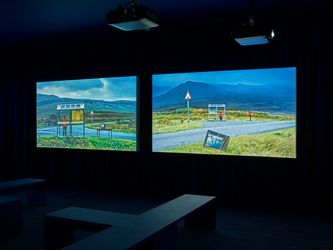
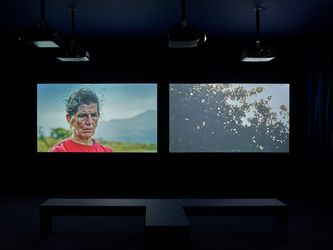
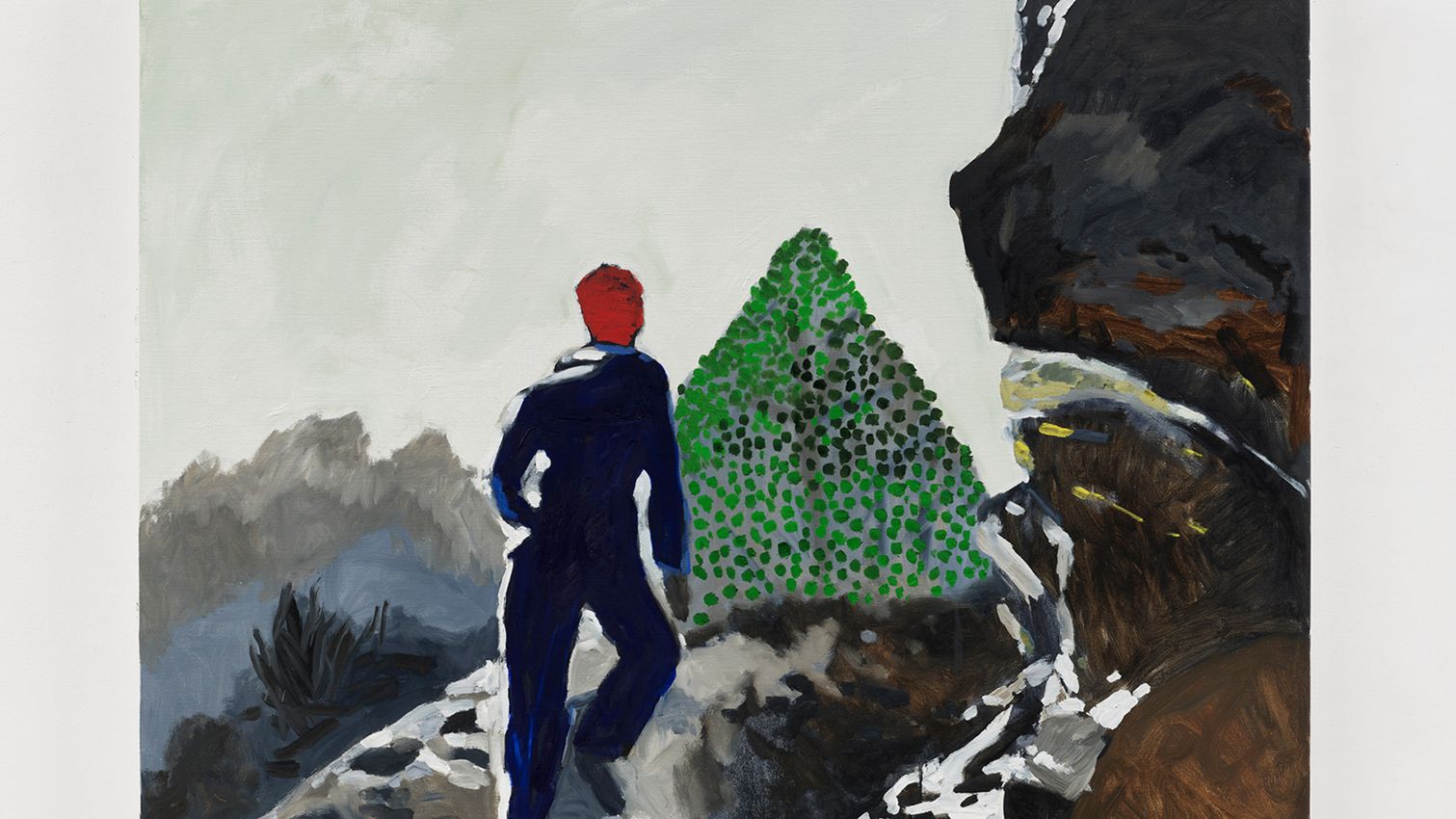
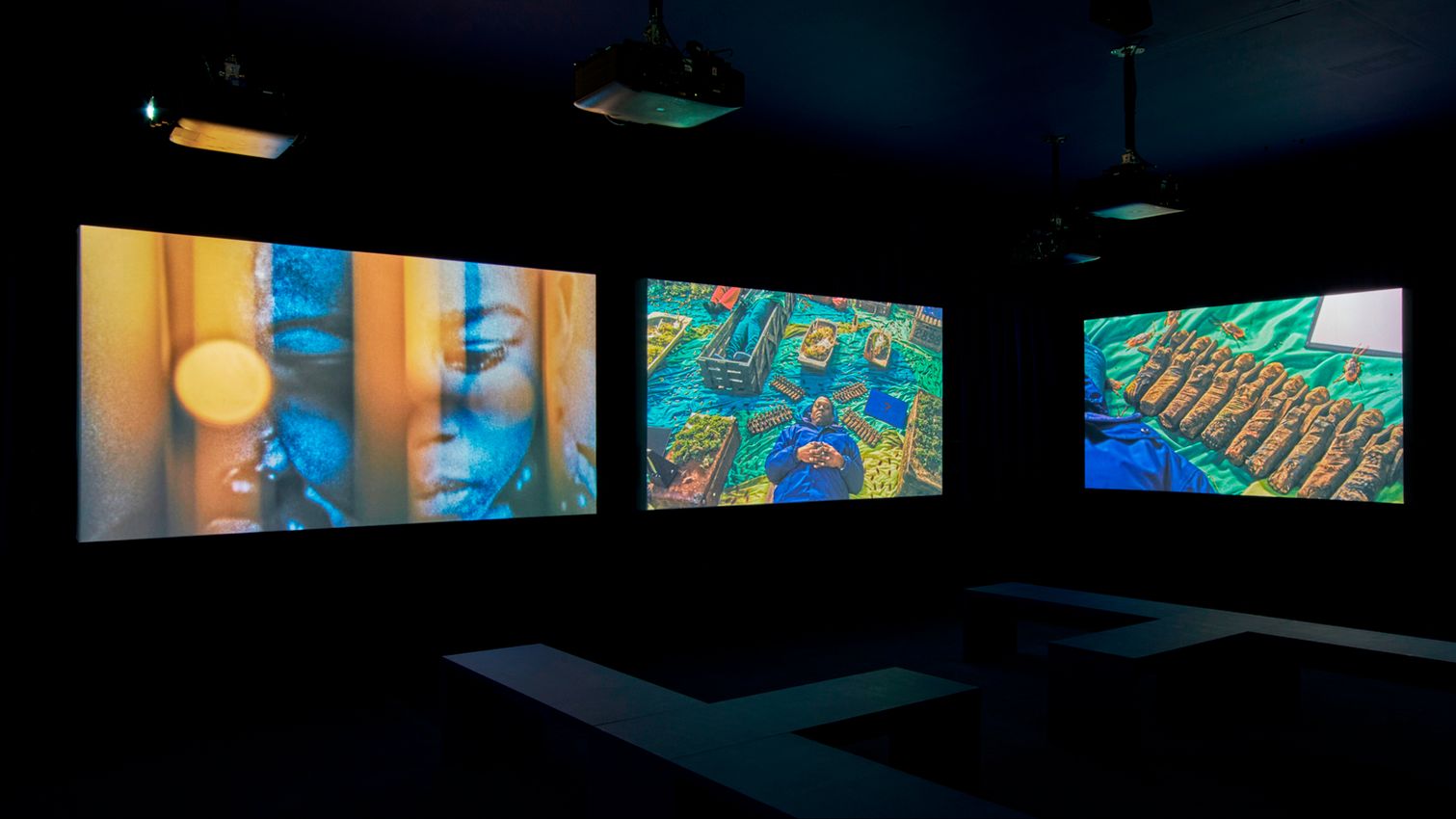
British artist John Akomfrah opens the U.S. premiere of Listening All Night To The Rain, the critically acclaimed work first commissioned for the British Pavilion at La Biennale di Venezia in 2024. Akomfrah brings a focused iteration to New York, debuting the central multi-channel film, Canto VI, which traces pivotal moments in the histories of colonised nations, focusing on the independence movements and uprisings that swept Africa and Asia from the 1940s to the 1970s, as well as the parallel history of women’s struggle for liberation. The presentation at Lisson Gallery coincides with Akomfrah’s continued engagement with histories of resistance in the United States; alongside this exhibition, The Baltimore Museum of Art and the Menil Collection have co-commissioned John Akomfrah: The Hour Of The Dog, an immersive multi-channel film installation exploring non-violent civil rights protests of the 1960s, including the work of young activists from the Student Non-Violent Coordinating Committee (SNCC). The project premiered at the BMA in November 2025 and travels to the Menil Collection from April 2026.
Described as “utterly captivating” by The Guardian, Listening All Night to the Rain continues Akomfrah’s abiding interest in memory, post-colonialism, ecology and the politics of aesthetics with a renewed focus on the sonic. Drawing its title from Chinese writer and artist Su Dongpo’s (1037 – 1101) poetry that meditates upon the transitory nature of life during a period of political exile, the exhibition is seen as a manifesto that encourages the act of listening as a form of activism. The exhibition weaves together newly filmed material with found still images, video footage, audio clips and texts from international archive collections and libraries. Akomfrah juxtaposes these documented geopolitical narratives with imagined tableaux – often surreal or dreamlike in nature – in order to reposition the role of art in its ability to write history in unexpected ways, forming critical and poetic connections between different geographies and time periods. Through methods of bricolage (the reuse of diverse materials in order to produce new meanings), non-linearity and repetition, the artist tells stories from the five continents through the ‘memories’ of multiple filmed characters who represent the migrant community in Britain.
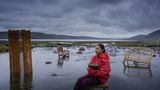
Originally conceived for the British Pavilion, the exhibition transformed the space into a vessel for a series of sculptural film installations titled ‘cantos’ or ‘movements’, each addressing different aspects of twentieth- and twenty-first-century global histories. At Lisson Gallery New York, Akomfrah presents Canto VI, the central multi-channel film of Listening All Night to the Rain which specifically examines pivotal moments in the histories of colonized nations, focusing on the independence movements that swept Africa and Asia from the 1940s to the 1970s. Drawing on archival footage, the work reflects on the Mau Mau rebellion in Kenya, the Congo’s struggle for independence from Belgian rule, Nigeria’s path to nationhood and the catastrophic aftermath of colonial amalgamation, and the 1947 Partition of India, seen through figures such as Jawaharlal Nehru. These narratives are framed through the diasporic experience in Britain, where personal memory is entwined with the enduring legacies of empire.
Analogous to these narratives of anti-colonial struggle, Canto VI foregrounds another, interconnected history of liberation: the women’s rights movement. Akomfrah highlights pivotal yet often forgotten figures whose identities were shaped by migration and dispersed communities, acknowledging their profound influence on the cultural and political development of gender equality movements. By placing these stories in dialogue, the work underscores the entanglement of struggles for national independence, civil rights, and social justice.
”John Akomfrah: Listening All Night to the Rain” was commissioned by the British Council for the 60th International Art Exhibition – La Biennale di Venezia, 2024. Co-commissioners: Lisson Gallery, TBA21 Thyssen-Bornemisza Art Contemporary and Smoking Dogs Films.
Courtesy Lisson Gallery.


John Akomfrah is a hugely respected artist and filmmaker, whose works are characterised by their investigations into memory, post-colonialism, temporality and aesthetics and often explores the experiences of migrant diasporas globally. Akomfrah was a founding member of the influential Black Audio Film Collective, which started in London in 1982 alongside the artists David Lawson and Lina Gopaul, who he still collaborates with today. Their first film, Handsworth Songs (1986), explored the events surrounding the 1985 riots in Birmingham and London through a charged combination of archive footage, still photos and newsreel. The film won several international prizes and established a multi-layered visual style that has become a recognisable motif of Akomfrah’s practice. Recent works include the three-screen installation The Unfinished Conversation (2012), a moving portrait of the cultural theorist Stuart Hall’s life and work; Peripeteia (2012), an imagined drama visualising the lives of individuals included in two 16th century portraits by Albrecht Dürer and Mnemosyne (2010), which exposes the experience of migrants in the UK, questioning the notion of Britain as a promised land by revealing the realities of economic hardship and casual racism. In 2015, Akomfrah premiered his three-screen film installation Vertigo Sea (2015), that explores what Ralph Waldo Emerson calls ‘the sublime seas’. Fusing archival material, readings from classical sources and newly shot footage, Akomfrah’s piece focuses on the disorder and cruelty of the whaling industry and juxtaposes it with scenes of many generations of migrants making epic crossings of the ocean for a better life. Vertigo Sea has as its narrative spine two remarkable books: Herman Melville’s Moby-Dick (1851), and Heathcote Williams’ epic poem Whale Nation (1988), a harrowing and inspiring work which charts the history, intelligence and majesty of the largest mammal on earth.


A respected voice in contemporary art discourse.
Focusing on ambitious storytelling and insightful art-world commentary. Ocula Magazine publishes in-depth interviews, critical essays and timely analysis on the artists, exhibitions and ideas driving the global art world.
Learn more about Ocula Magazine
Showcasing the best of the art world.
Ocula partners with galleries from around the world to highlight their artists, artworks and exhibitions. Gallery membership is by application and invitation, with each member vetted by an independent panel.
Learn more about Ocula Membership

Specialises in the sale of major artworks.
Led by a team with deep ties to the world’s leading auction houses, galleries and collectors. Ocula’s advisory team offers bespoke services to high-net-worth clients from around the world who are looking to acquire the best of contemporary and modern art.
Learn more about our team and services