


Press Release

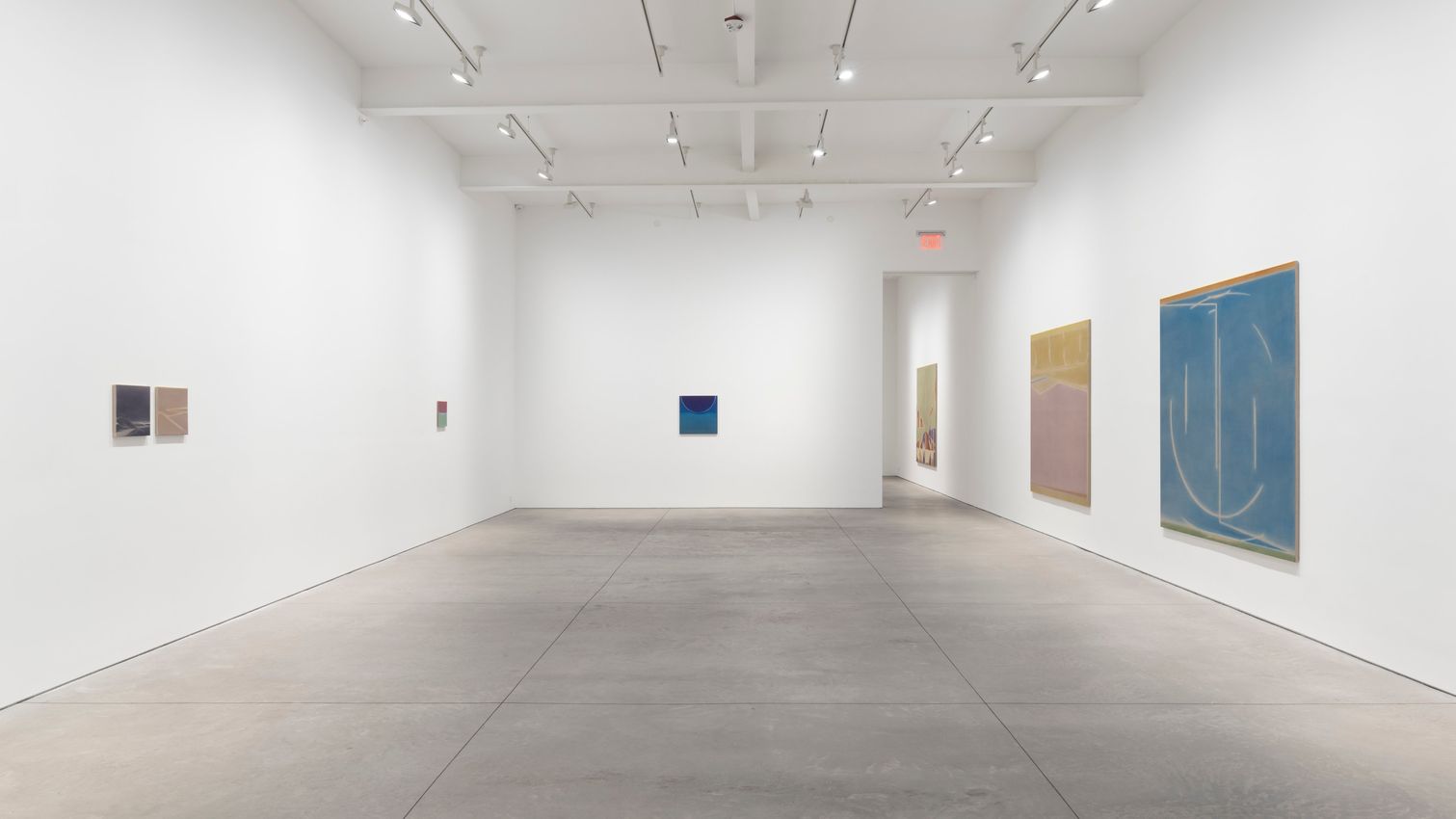
In the work of Julie Beaufils, one sees the painter relentlessly pursuing the movement of line to portray what she refers to as ‘an emotional sense of time’ rather than one that is mathematical or quantifiable. Through abstraction and colour, she creates atmospheric paintings to convey ineffable sensations of duration. And yet, the work is not entirely abstract; it draws from a range of references—from a suburban tree to a plant floating at the bottom of the sea, a prefab modernist structure in Antibes, a post-industrial wasteland, a forgotten resort, even a photo she saw of campers in Chernobyl’s forest. These images, however, remain hazy and unidentifiable, like something remembered. ‘It’s important to remember that you can do so much with very little,’ says Beaufils.

Though she has become known for her muted, earthy palette—the result of mixing natural mineral pigments reminiscent of the tonal arrangements in Michelangelo Antonioni’s films—she is, first and foremost, a disciplined draughtsman. Before touching a paintbrush to canvas or even considering colour, she sketches simple, weightless compositions and refers to her vast archive of studies. She strives to carry this economy of gesture onto canvas, translating it into colour. The resulting picture is an atmosphere reduced to its essential properties.

‘Each painting is a movement,’ says Beaufils. In works like L’Abysse and Cannonball, fluid spaces shift between flat tonal values intersected by lines of negative space. By elevating the canvas to play the role of a line, it becomes as integral as the pigment. In Underwater and Forest, ripples and lines expand outward creating a sense of continuous motion. In Dust, a trace of crimson cuts through an arid world, stripped to its foggy incarnadine essence.

‘Why is that smoke yellow?’ asks Giuliana’s (Monica Vitti’s) son toward the end of Antonioni’s Red Desert (1964). ‘Because it’s poisonous,’ replies Giuliana. “You mean if little birdies fly there, they’ll die?” he asks. ‘The little birdies know by now. They don’t fly there anymore.’

The Salton Sea is one of those conundrums people are drawn to because it is both forlorn and alluring—a non-place. Once poised to become the ‘California Riviera’ in the 1950s and ‘60s, it was gradually abandoned after the lake began to shrink, farm runoff produced bright pools of colour and a sulphuric odour, and plumes of factory emissions hung over the water.

Like Antonioni’s first color feature, Red Desert, an iconic film set in an industrial wasteland and defined by its painterly minimalism, Beaufils’ Salted Sea suggests that beauty persists in entropy. Its foreground, awash in ferric, nuclear ochre, contrasts with Egyptian blue and blush jet streaks that seem to hover at the top of the painting, evoking smoggy ozone layers. In Double Sunrise, two fields of color pin a windswept strata of air. ‘Knowing when to stop can be the hardest part,’ says Beaufils.

Read More
About the Gallery

Founded in 2019, the gallery presents ambitious projects by emerging and mid-career artists. The gallery opened its first space in 2019 with a solo exhibition of Los Angeles based artist Kenturah Davis, and opened its second Los Angeles location in 2021 with the debut solo exhibition of New York based artist Sasha Gordon.

View Gallery Profile
Address
633 North La Brea Ave
Suite 101
Los Angeles
United States
Opening Hours
Tuesday – Saturday
11am – 6pm
(1)
Los Angeles 633 North La Brea Ave, Suite 101
Matthew Brown
633 North La Brea Ave, Suite 101, Los Angeles, United States

Opening hours
Tuesday – Saturday
11am – 6pm
The art world in focus
