Press Release

In Dreaming of Spilliaert Mendes Wood DM presents several astonishing works by Léon Spilliaert (b.1881, Ostend, Belgium; d.1946, Brussels) in combination with no less than fifteen living artists. Exhibited in a 17th-century deconsecrated church in Retranchement, only a few miles away from the North Sea, this transhistorical presentation allows for a multifaceted reading of the artworks on view.

Few Belgian artists remain as ambiguous yet influential as Léon Spilliaert. Today widely recognized for his ominous sea- and landscapes, enigmatic self-portraits and sinister nocturnal scenes, the idiosyncratic artist holds a unique position in the Belgian and international art world. The accumulation of symbolist, romantic and expressionist tendencies into a single body of work resists any singular categorization and vividly highlights an existential, yet universal, reflection. The artistic attitude and themes of Spilliaert serve as a reference for the contemporary artists in Dreaming of Spilliaert and can offer a valid point of entry for the reading of their work.

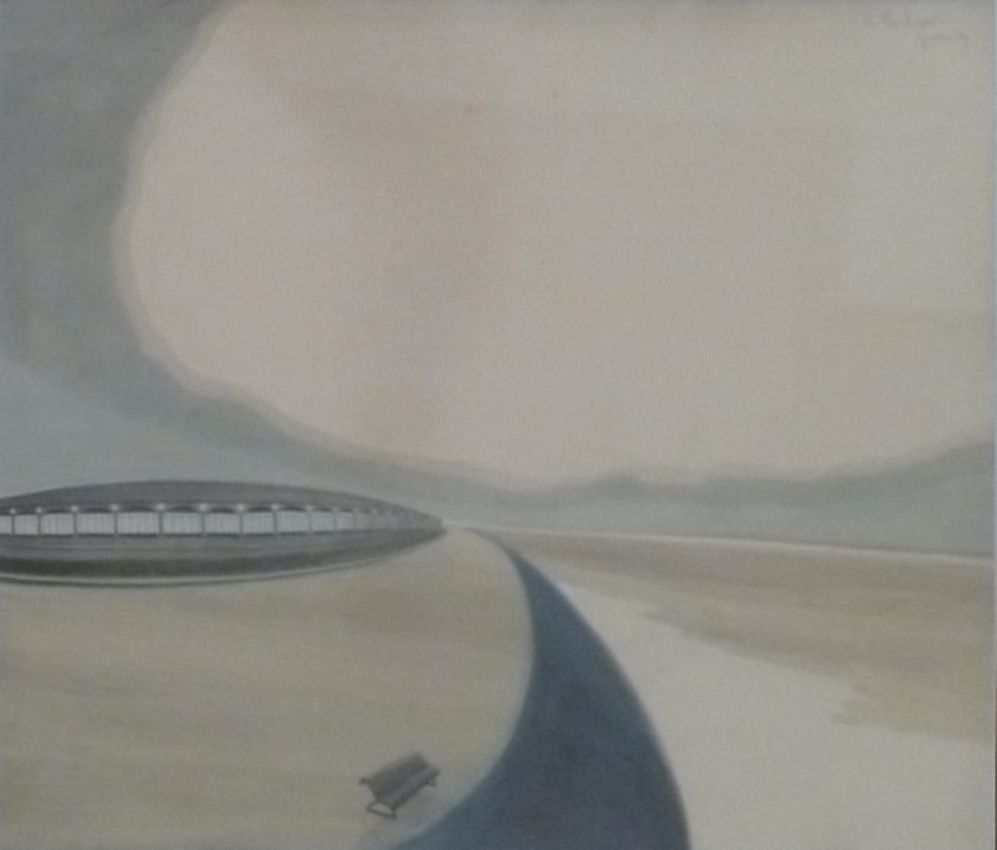
Throughout the oeuvre of Spilliaert one can discover and unravel a symbiotic relation between the depiction of seemingly banal, everyday objects and an attempt to grasp, or escape, the fragility of daily life. In Les Poupées (1931), for example, the anxious look on the dolls’ eyes transforms the lifeless puppet into a poignant reflection of human vulnerability. What becomes undoubtedly apparent in Spilliaert’s series of compositions with dolls, mainly executed in the first part of the 1930s, is the artist’s endless painted repetition of similar objects, as an excuse to examine form, colour and technique. This seriality allows for an almost automatic rendition of the subject matter, which, in turn, gives room for psychological explorations, and can also be found in Spilliaert’s sea- and landscapes. These scenes, which encompass a large majority of the artist’s oeuvre, are rightfully praised for their ability to evoke a sense of melancholy, emptiness and unease. The artist employed this subject matter in an attempt to express an existential anxiety, which stemmed from both his personal character as well as the societal characteristics of the beginning of the 20th century. His unique graphic style, with its emphasis on the horizontal line, near-monochromatic colour palette and dramatic use of light and shadow, is strikingly visible in La digue et Kursaal (Ostende) (1909).

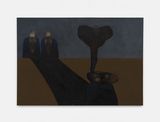
That the landscape, as a painterly genre, is often utilized by artists to express or examine a mental state and reality rather than a merely physical one remains applicable till this day. Even though the conditions of our contemporary society have changed severely since the time of Spilliaert, a variety of artists presented in this group show draw on the rich tradition of landscape painting in order to explore the complexities of the human condition. The small-scale paintings of Lucas Arruda, for example, present meditative compositions wherein the depicted scenery can be considered as a mnemonic register that evokes an emotional resonance. Although executed with different techniques and more than a hundred years apart, Arruda’s scene powerfully echoes a similar atmosphere to Spilliaert’s Marine (1900), a unique early work by the artist. Paula Siebra’s Vulto (2024) similarly offers a transient, mental mood. Her depictions of everyday life, which are created with surprisingly similar formal strategies to Spilliaert — such as the use of monochromatic colour tones — provide a profound sense of tranquility and introspection.

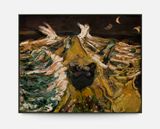
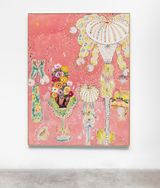
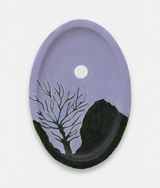
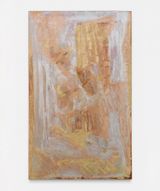
Although Spilliaert mostly worked on paper, he made roughly fifty works in oil on canvas, the majority of which were produced between 1920 and 1936. An exquisite example is the serene_Arbres au crépuscule_ (1924), in which the artist is able to translate his nightly walks into an atmospheric forest scene. This uncanny ambiance can also be found in Pol Taburet’s Karaoke (2024) or in Guglielmo Castelli’s Coarse Salt (2024), in which vague figures wander the picture plane. Patricia Leite, in contrast, offers the viewer a more pastoral imagery that she describes as “sensations of landscapes”. These intimate manifestations can be perceived as diary-like reflections of her daily life, reminiscent of Spilliaert’s idilic Bateau de pêcheur porté par les vagues (1912 — 1913). Inspired by the time spent in her own garden, Mimi Lauter presents a more abstracted, colourful and vivid image. In her approach, a landscape can represent the potential of life.

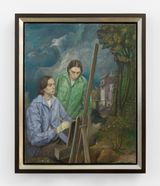
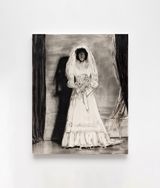
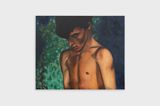
A searching for the self or, more specifically, the outer representation thereof, brought us some of the most evocative and sometimes haunting artworks produced by Spilliaert. Through these images, the artist expressed his own sense of fragility and alienation. Although not necessarily self-portraits, the images painted by Lewis Hammond often present a similarly intimate yet alienating depiction of figures. Furthermore, Antonio Obá‘s Sentinela III: A noiva (2024) comparably resembles some of Spilliaert’s powerful, unsettling portraits. (Self-)Portraiture, be it in the form of painting one’s own physical image, or in the form of the construction of a painted identity through symbolic references, preoccupies multiple artists in this exhibition. By injecting himself within historical compositions, Giangiacomo Rossetti, for example, claims ownership not only over the referenced paintings, but also over the perception of his own image. Kasper Bosmans, on the other hand, employs a vast register of symbolic references to create his artistic narrative. This ever-expanding oeuvre, which departs from the personal but has a universal resonance, offers, in return, an insight into the identity of the artist.

What becomes increasingly clear is the universal character of Léon Spilliaert’s body of work. The exploration of the human condition through landscape depictions, alongside the examination of identity and its construction through portrayal, can be seen as entryways for interpreting the diverse and unique artistic practices exhibited in Dreaming of Spilliaert.

__

Read More

Selected Works

Loading...

Also Exhibiting at Mendes Wood DM

About the Gallery
Mendes Wood DM was founded in 2010 by partners Felipe Dmab, Matthew Wood and Pedro Mendes with the intent to exhibit international and Brazilian artists in a context conducive to critical dialogue and cross-pollination. Central to the gallery’s program is a concern for regional difference and individuation while fostering cosmopolitanism and collaboration. Inspired by a belief that artistic practices broaden the scope of human agency and have the power to both touch and change the world, Mendes Wood DM cultivates a program premised on conceptualism, political resistance and intellectual rigour.

In 2017, Mendes Wood DM inaugurated its first North American exhibition space in New York with a series of two-person shows juxtaposing historical and contemporary material; including artists such as Lucas Arruda and On Kawara, Sonia Gomes and A.R. Penck.

In the same year, Mendes Wood DM expanded its European presence with a new gallery in Brussels founded in partnership with longtime friend and collaborator Carolyn Drake Kandiyoti. Located in a historic townhouse, the space lends itself to ambitious curatorial projects and monographic exhibitions, as well as welcoming artists and curators in residence. The residency is integral to the gallery project to establish a place for the active exchange, creation and reformulation of varying artistic narratives.
View Gallery Profile
Address
d'Ouwe Kerke

d'Ouwe Kerke Dorpsstraat 16 4525 AH Retranchement The Netherlands

(1)
Brussels 13 Rue des Sablons / Zavelstraat
Mendes Wood DM
13 Rue des Sablons / Zavelstraat, Brussels, Belgium

Opening hours
Tues - Sat, 11am - 7pm
The art world in focus