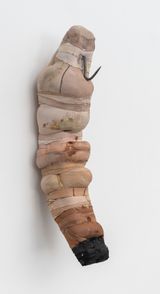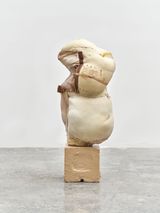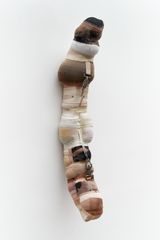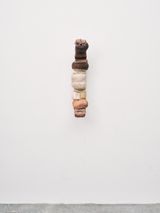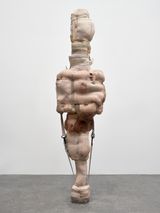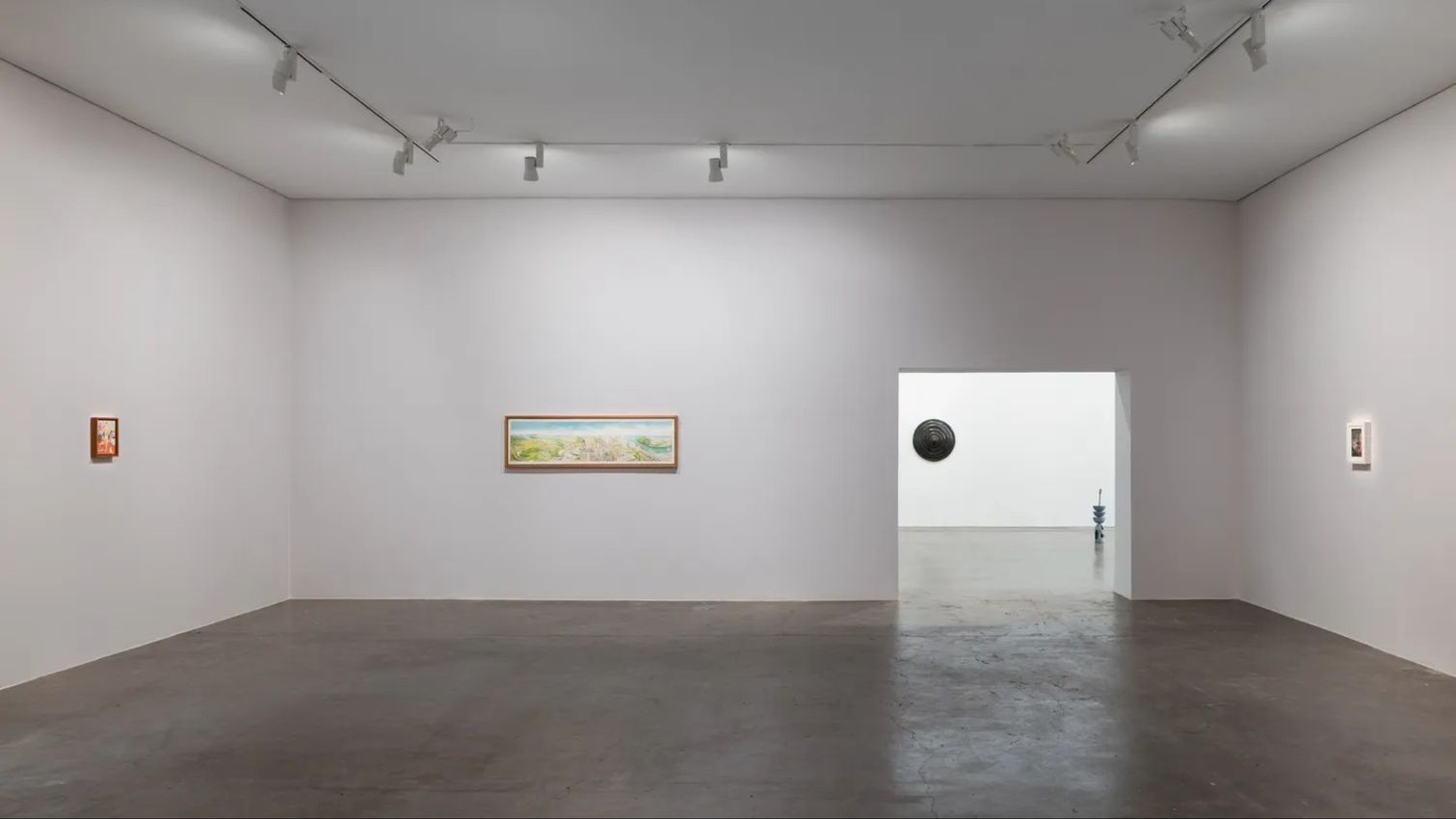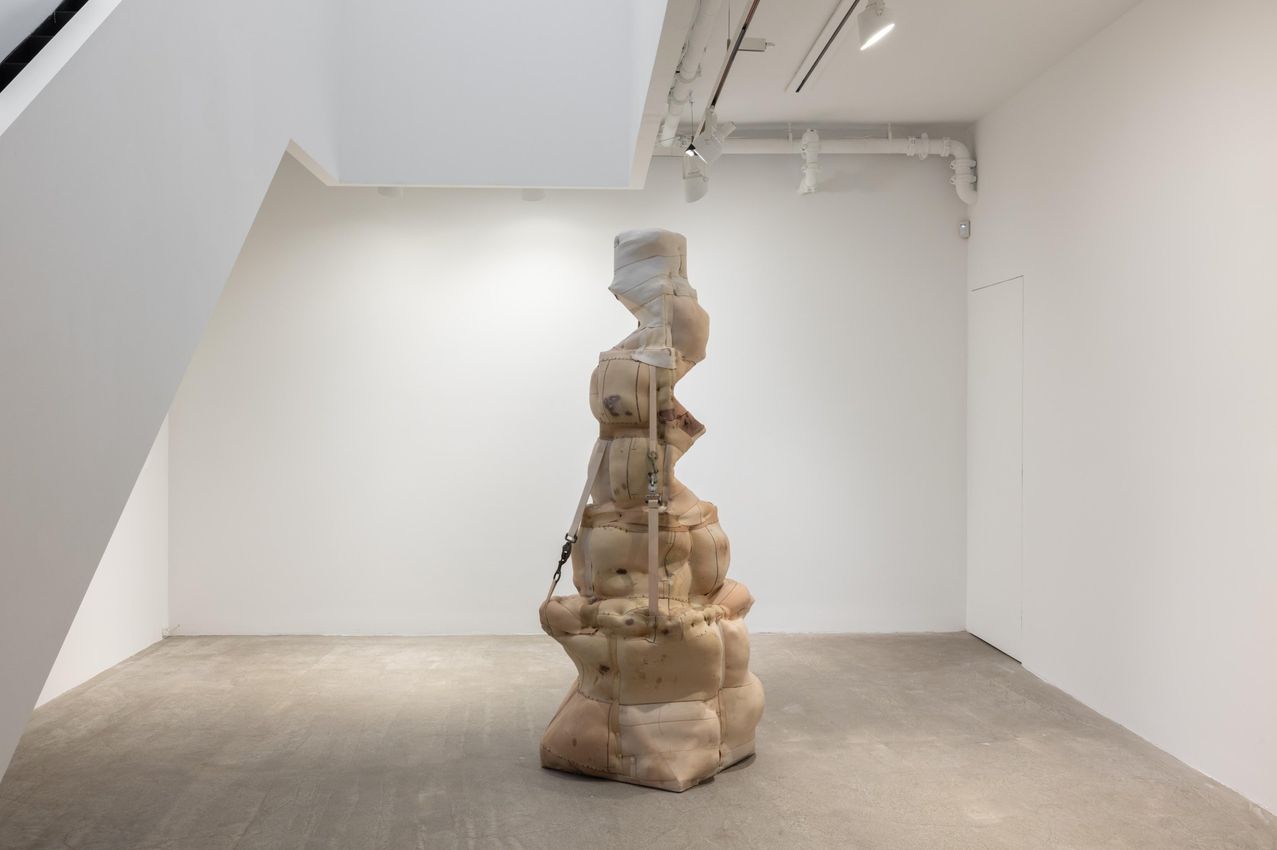
In Critical Mass, Patricia Ayres articulates Sigmund Freud’s notion of the Unheimlich.(1) Incongruity is echoed through nine pustulating sculptures, whose faceless forms distinguish themselves by their sutured topography, an amalgamation of stained United States military elastic, parachute hardware, and industrial detritus. Each vessel is riddled with ecchymosis,(2) composed of anointing oil, ashes, dye, ink, paint, gunk, and sacramental wine, an allusion to institutional coercion. Together these components harmonize the entanglement of Catholicism and the Carceral Archipelago’s pervasive impact on American society.(3)
The exhibition’s title, Critical Mass, speaks to the enigmatic sculptures’ conceptual foundation and bears the question of where these pirouetting manifestations situate themselves. Are they a requiem of familial transgressions in defiance of religious dogma? Are they indicative of a social tipping point? Or are the corset-like incarnations a meditation on the impact of incarceration? Ayres’ tethering inextricably stitches together the personal and institutional.
Whether positioned on concrete floors, placed on pedestals painted in correctional hues, or crucified on the gallery’s white walls, the dermic disruptions thematically contrast with the surrounding architecture. Ayres’ uncanny engagement with abjection is tangible in each composition’s inundated layering and meticulous idiosyncrasy, in reverence to Julia Kristeva’s feminist ideology of the abject as ‘what disturbs identity, system, order.’(4) The anthropomorphic disfigurations operate as caricatures, connotations of classical sculptural forms such as busts and totems, yet are devoid of any familiar characteristics. Every cadaver-like iteration is processed and fitted with the numerical code representing a saint’s name, further nullifying a sense of humanity.
Critical Mass is a quandary, a rumination on how panoptic structures contort their subsidiaries. An asymmetrical assemblage of martyrdom where apostles stand in disparate arrays of decomposition. What is the residue of constraint, a perpetual occupation of the soul? These protuberant reliquaries remain reticent as silent rebuttals lie twined to the integument labyrinths.
1. Unheimlich is drawn from Freud’s essay “The Uncanny” (1919) which outlines an aesthetic category outside traditional designations of beauty, related instead to the terrible, unknowable, and fearful.–
2. Ecchymosis refers to discoloration of the skin, usually caused by bruising.–
3. The Carceral Archipelago is drawn from Michel Foucault’s 1975 publication Surveiller et punir (Discipline and Punishment), referring to the mechanisms and technologies of prison systems.–
4. Julia Kristeva is a Bulgarian-French psychoanalyst and philosopher, who outlines categories of feminism centered upon resistance, woman-centered approaches to culture, and ultimately the creation of a sociopolitical order beyond gender. She also centers ideas of the abject in her psychoanalytic approach to aesthetic systems.
Press release courtesy Mendes Wood DM. Text: Tyler Christopher Brown.
Patricia Ayres’ works draw from structures of societal constraint, such as the ritual morality of Catholicism, systems of incarceration in the United States, and ideals of the body. Informed in part by her education in fashion, the sculptures are shaped by Ayres’ process, elaborating upon her conceptual sources.


A respected voice in contemporary art discourse.
Focusing on ambitious storytelling and insightful art-world commentary. Ocula Magazine publishes in-depth interviews, critical essays and timely analysis on the artists, exhibitions and ideas driving the global art world.
Learn more about Ocula Magazine
Showcasing the best of the art world.
Ocula partners with galleries from around the world to highlight their artists, artworks and exhibitions. Gallery membership is by application and invitation, with each member vetted by an independent panel.
Learn more about Ocula Membership

Specialises in the sale of major artworks.
Led by a team with deep ties to the world’s leading auction houses, galleries and collectors. Ocula’s advisory team offers bespoke services to high-net-worth clients from around the world who are looking to acquire the best of contemporary and modern art.
Learn more about our team and services