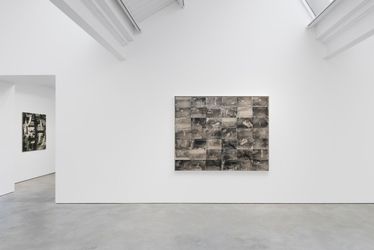
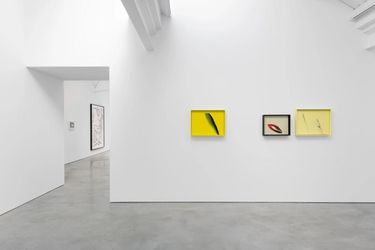
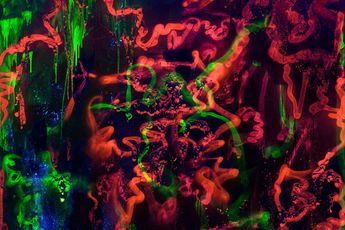
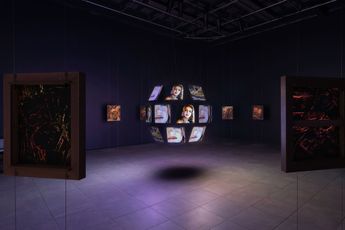
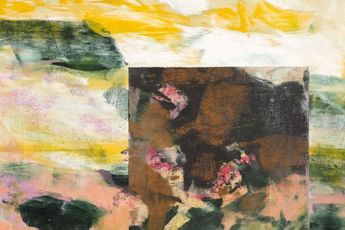
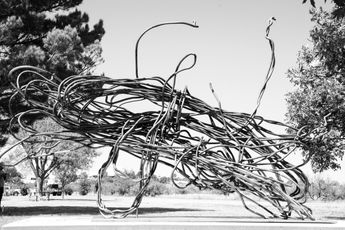
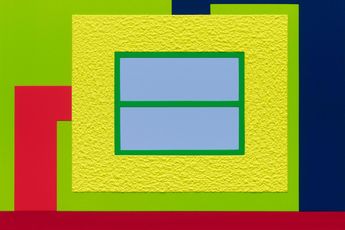
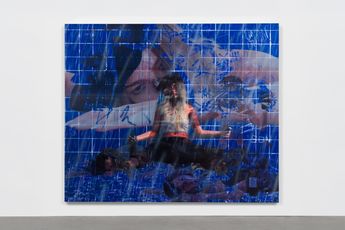
Modern Art is pleased to present Machine Painting, an intergenerational exhibition of fourteen artists who produce paintings with the assistance of machines. The exhibition brings together works by Tauba Auerbach, Matthias Groebel, Peter Halley, Jacqueline Humphries, Albert Oehlen, Seth Price, Sigmar Polke, Avery Singer, Reena Spaulings, Wolfgang Tillmans, Christopher Kulendran Thomas, Rosemarie Trockel, Jack Whitten and Christopher Wool.
A touchstone for the exhibition is Giuseppe Pinot-Gallizio’s 1958 artwork Industrial Painting. Created by a painting machine equipped with rollers, it operated freely, and applied paint on lengths of canvas laid over tables; resulting in a seventy-four-metre-long painting that was subsequently spooled onto cylinders, suspended from the ground so that it can be unfurled for the viewer to see. In making this piece, Gallizio sought to mirror and critique the ceaseless industrial production line he observed in 50s Italy. Delegating labour to machines improves productivity on an industrial scale, but the more removed the labourer, the more pronounced and performative the machine’s role becomes.
Evolving out of this example, Machine Painting includes artists who, from the 1970s to the present day, use mechanical apparatuses in the making of their work to propose a more collaborative relationship with machines. By various methods, these artists outsource their process, partially or wholly, while maintaining procedural control. Using analogue and digital methods, the painterly gesture - commonly associated with virtuosity - is incorporated into the artist’s vocabulary, and instrumentalised via multistage methods. The featured artists exploit the flat surface as a site to compress, distort, mediate and abstract images.
Machine Painting seeks to advance the discourse around machines in art, contesting the idea of machine production as cold and unthinking, and presenting the machine as a contemporary generative tool. Allowing the painted gesture to flow between digital and analogue states, Machine Painting encompasses various means of production, from the autonomous labour of machines to handmade processes that evoke machines.
The exhibition broadly examines three themes: ‘Performing as Machine’; ‘Circulating Images; and ‘Outsourced Production’. Various subjects are explored such as: mark making delegated to autonomous apparatus; postmodernist critiques of authorship; artist acting as machine with analogue tools, the translation of data; the adoption of advancing technologies, the work of other artist’s as a geo-politcal tool; artist’s ‘painting’ in digital software, which is then transposed into the physical world; work that probes the idea of the ‘degrading’ image; the critique of automation and associations with labour; and a consideration of methods such as knitting that could be considered gendered work.


A respected voice in contemporary art discourse.
Focusing on ambitious storytelling and insightful art-world commentary. Ocula Magazine publishes in-depth interviews, critical essays and timely analysis on the artists, exhibitions and ideas driving the global art world.
Learn more about Ocula Magazine
Showcasing the best of the art world.
Ocula partners with galleries from around the world to highlight their artists, artworks and exhibitions. Gallery membership is by application and invitation, with each member vetted by an independent panel.
Learn more about Ocula Membership

Specialises in the sale of major artworks.
Led by a team with deep ties to the world’s leading auction houses, galleries and collectors. Ocula’s advisory team offers bespoke services to high-net-worth clients from around the world who are looking to acquire the best of contemporary and modern art.
Learn more about our team and services