




BARBARA HEPWORTH
1903-1975, United KingdomBarbara Hepworth was a pioneering British modernist sculptor interested carving simple organic forms in marble, stone, and wood. She also made bronzes, drawings, and lithographic prints. Hepworth, with her friends, helped introduce a radical continental aesthetic to a conservative island nation.
Life
Educated at Wakefield Girls High School, Hepworth won a scholarship to go to Leeds School of Art in 1920. There she met Henry Moore, who became a life-long friend and affectionate rival. In 1921, they went to London to study at the Royal College of Art for four years, making the occasional study trip to Paris.
In 1924, she was awarded a West Riding Scholarship for a year’s travel and went to Italy to study Romanesque and early Renaissance art, nurturing her classical sensibility. In Florence, she married fellow artist, John Skeaping, and in Rome she learned to carve marble from Giovanni Ardini.
When Skeaping became ill, he and Hepworth returned to London in 1926. In 1931, she met the painter and chair of the experimental Seven and Five society, Ben Nicholson, and they became romantically involved. She separated from Skeaping in 1931 and married Nicholson in 1938.
Nicholson and Unit One Art Movement
Nicholson was passionate about abstraction, but like Hepworth, curious about Surrealism, so they went to Paris in 1933, visiting the studios of Pablo Picasso, Constantin Brancusi, and Jean Arp. Back in London, they co-founded the Unit One art movement, which aimed at uniting the two genres. In 1934, Hepworth had triplets, but managed to continue her practice as well as raise children.
In 1935, she and Nicholson met Piet Mondrian, Wassily Kandinsky, and Naum Gabo. Some of her works began to show the influence of the School of Paris, such as the Brancusi-like Two Segments and Sphere (1935—1936), in marble.
In 1939, Hepworth and Nicholson moved to the Cornish fishing village of St. Ives where they attracted other painters and sculptors, as well as some overseas artists like Gabo. It became a very highly regarded and popular art centre, for a time second only to London.
The 1940s
Due to the war, and one studio being destroyed by bombs, Hepworth and Nicholson moved to Carbis Bay at the end of 1939, where there was a studio and garden. In 1947, Hepworth began a series of drawings of surgeons operating in hospitals. She saw multiple connections between artists and hospital staff: ‘There is, it seems to me, a close affinity between the work and approach of both physicians and surgeons, and painters and sculptors.’
Key Artworks
Single Form (1961–64)
One of Barbara Hepworths most significant works, Single Form (1961–64), stands outside the United Nations headquarters in New York. Commissioned in memory of UN Secretary-General Dag Hammarskjöld, the sculpture is Hepworth’s largest and exemplifies her exploration of verticality and inner space. Its abstract form, pierced by a single oval, reflects her interest in the relationship between mass and void.
Winged Figure (1963)
Another notable piece, Winged Figure (1963), is installed on the façade of the John Lewis department store on Oxford Street, London. This aluminium sculpture, with its soaring lines and tensioned rods, conveys a sense of uplift and aspiration, embodying Hepworth’s belief in the spiritual potential of abstract art.
The Family of Man (1970)
The Family of Man (1970) is a series of nine bronze sculptures representing human figures in abstract form. Displayed at the Yorkshire Sculpture Park, the ensemble reflects Hepworth’s enduring interest in the human figure and communal relationships, rendered through simplified, monumental forms.
Meridian (1958–60)
Originally commissioned for State House in London, Meridian showcases Hepworth’s engagement with architectural spaces. The sculpture’s dynamic, spiralling form contrasts with the building’s rigid geometry, illustrating her ability to create dialogue between sculpture and environment.
Exhibitions
Barbara Hepworth’s art has been exhibited widely around the world. The Fundació Joan Miró continues to promote the artist’s work in Spain and internationally.
Solo exhibtions include:
- Barbara Hepworth: In Equilibrium, Heide Museum of Modern Art, Melbourne (2022)
- Barbara Hepworth: Art & Life, Hepworth Wakefield Gallery, Wakefield; Scottish National Gallery of Modern Art, Edinburgh; Tate St Ives; Towner, Eastbourne (2021–2023)
- Barbara Hepworth, The Musée Rodin, Paris (2019)
- Barbara Hepworth, A Matter of Form, Pace Gallery, New York (2018)
Legacy
Hepworth’s legacy is preserved at the Barbara Hepworth Museum and Sculpture Garden in St Ives, managed by Tate. The museum offers insight into her working environment and displays a significant collection of her sculptures, providing a comprehensive view of her contribution to modern art.
Barbara Hepworth FAQs
Where can I see Barbara Hepworth’s artworks?
Barbara Hepworth’s works are housed in major collections across the UK and internationally. In St Ives, Cornwall, the Barbara Hepworth Museum and Sculpture Garden, managed by Tate, offers an immersive experience of her studio and outdoor works. Other key holdings include the Tate Britain and Tate St Ives, The Hepworth Wakefield, and the Scottish National Gallery of Modern Art. Outside the UK, her works can be seen at the Kröller-Müller Museum in the Netherlands and the Museum of Modern Art in New York.
What materials did Barbara Hepworth work with?
Hepworth initially worked in stone and wood, developing her signature direct carving method. From the 1950s onwards, she increasingly used bronze, particularly for large-scale outdoor commissions. Her experimentation with texture, surface, and piercing form became a defining feature of her practice.
Did Barbara Hepworth create any public sculptures?
Yes. Hepworth was one of the first British artists to receive major public commissions. Notable examples include Winged Figure (1963) on the John Lewis building on Oxford Street, London; Meridian (1958–60) originally installed at State House, Holborn; and Single Form (1961–64) outside the United Nations headquarters in New York, a tribute to Secretary-General Dag Hammarskjöld.
Was Barbara Hepworth associated with a specific movement?
Hepworth is most closely associated with modernist abstraction and was a key figure in the development of 20th-century British sculpture. Although she exhibited with members of the Constructivist and St Ives School movements, she maintained an independent voice, drawing influence from landscape, spirituality, and human relationships.
What happened to Barbara Hepworth’s studio after her death?
After her death in 1975, Hepworth’s home and studio in St Ives were preserved as the Barbara Hepworth Museum and Sculpture Garden. The site remains as she left it, providing insight into her working methods and personal environment, and features many of her plaster and bronze works in situ.
John Hurrell | Ocula | 2021
Ocula | 2025


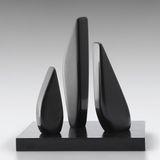

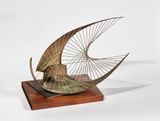
Explore Barbara Hepworth's Exhibitions

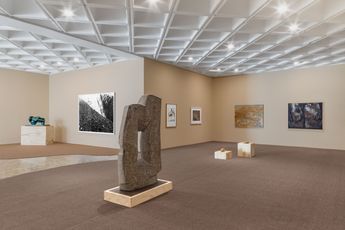




Barbara Hepworth in Ocula Magazine








Explore and Follow Artists Shaping Contemporary Art
A respected voice in contemporary art discourse.
Focusing on ambitious storytelling and insightful art-world commentary. Ocula Magazine publishes in-depth interviews, critical essays and timely analysis on the artists, exhibitions and ideas driving the global art world.
Learn more about Ocula Magazine
Showcasing the best of the art world.
Ocula partners with galleries from around the world to highlight their artists, artworks and exhibitions. Gallery membership is by application and invitation, with each member vetted by an independent panel.
Learn more about Ocula Membership
Specialises in the sale of major artworks.
Led by a team with deep ties to the world’s leading auction houses, galleries and collectors. Ocula’s advisory team offers bespoke services to high-net-worth clients from around the world who are looking to acquire the best of contemporary and modern art.
Learn more about our team and services