




HENRY MOORE
1898-1986, United KingdomHenry Moore (1898–1986) is perhaps best known for his semi-abstract sculptures, inspired by nature and human figures, but the British artist also produced tapestries, drawings and carvings. His works became synonymous with post-war modernism but he also became internationally famous as the emerging medium of television brought his art to a wider audience.
Early Years
Born in Castleford in 1898, Moore knew he wanted to be a sculptor from an early age. However, he trained as a teacher before fighting in the First World War. An ex-serviceman’s grant allowed him to pursue his ambition, enrolling at Leeds School of Art (where he met Barbara Hepworth) and then the Royal College of Art in London. Although the curriculum encouraged students to copy classical Western art, during his spare time Moore enjoyed exploring the British Museum’s ethnographic collection. In 1928, he had his first solo exhibition and in 1929 married painter Irina Radetsky; they moved to Hampstead Heath, where their neighbours included Hepworth and sculptor Naum Gabo. After graduating, Moore won a scholarship to visit Italy. Between the wars, Moore taught at the RCA and then the Chelsea School of Art, where he met historian Kenneth Clark, who championed Moore’s work among the British establishment.
Henry Moore: Artworks
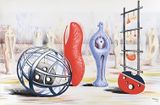
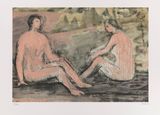
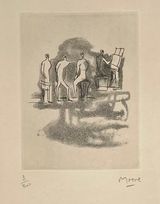
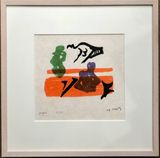
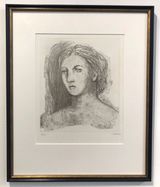
Henry Moore is perhaps best known for his abstract sculptures of the human figure—often reclining figures (for example, Draped Seated Woman (1956–1957) or mother-and-child compositions. However, he also produced drawings using crayon, chalk, watercolour and gouache. The body parts of his works were occasionally disconnected and separated to accentuate the geological as curvilinear abstraction—this can be seen in Composition (1931) and Two Large Forms (1969).
In 1933, Moore first created holes as a sculptural form in their own right—his friendship with the surrealist artist Roland Penrose prompted him to investigate bronze casting and fluid forms wrapped around holes (thoughts on this can be seen in 1939’s Ideas for Sculpture in Metal).
Moore adapted some of his ink-and-watercolour drawings into tapestries, which were woven by makers from Dovecot Studios in Scotland, Brose Patrick Studio and West Dean College in Sussex.
Henry Moore: Select Public Commissions
- West Wind (1928–1929) was one of the original reliefs of the “four winds” on the outside of London Underground’s Victoria headquarters.
- Moore created Reclining Figure: Festival for the 1951 Festival of Britain and the process was captured by the BBC in the very first programme on British television about a living artist.
- In 1955, Moore was commissioned to create a sculpture for the Unesco headquarters in Paris. Unesco Reclining Figure 1957–1958 is carved from travertine marble and measures more than 4.9m long and 2.4m high.
- Nuclear Energy 1964 - 1966 was commissioned by the University of Chicago, marking the first controlled nuclear chain reaction (which led to the atom bomb), even though Moore was a CND supporter.
- Three Forms Vertebrae 1978 stands outside Dallas City Hall in Texas.
Henry Moore: Select Posthumous Solo Exhibitions
- Moore and Malaparte: Rhythm and Form, Gagosian, Paris (2025)
- Henry Moore and Greece, Gagosian, Athens (2024)
- Georgia O’Keeffe and Henry Moore, Museum of Fine Arts, Boston (2024)
- The Sculptor’s Drawing: Henry Moore, Museo Novecento, Florence (2021)
- The Power of Nature: Henry Moore in Poland, The Centre for Polish Sculpture, Four Domes Pavilion, and National Museum, Poland (2019)
- Henry Moore: Myths and Poetry, Hauser & Wirth, Zürich (2017)
- Henry Moore, Tate Britain, London (2010)
- Henry Moore, National Gallery of Art, Washington DC (2002)
Further reading
- The Henry Moore Foundation website
- Instagram for the Henry Moore Institute in Leeds
- Research paper from Tate about Moore’s relationship with Kenneth Clark
Henry Moore FAQs
Where are Henry Moore’s works on display?
Moore’s former home in Perry Green in Hertfordshire is now owned by the Henry Moore Foundation and the 28ha site houses the world’s largest collection of his works. Visitors to London can see his sculptures in Greenwich Park, College Green (Westminster), Canary Wharf, Kensington Gardens, Battersea Park and St Paul’s Cathedral, among other places.
What were Henry Moore’s influences?
After graduation from the RCA, Henry Moore won a six-month travelling scholarship; he visited Italy and Paris where, in the Trocadéro, he saw a cast of a Mexican Chacmool reclining figure. The position and weight of the figure fascinated Moore, and he would return to the theme of reclining figures throughout his career. Moore’s sinuous abstract sculptures were influenced by the works of artists including Picasso, Constantin Brancusi, as well as the landscapes of his native Yorkshire.
What did Henry Moore do during the Second World War?
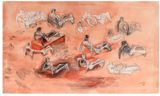
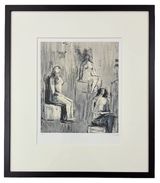
When Henry Moore’s home was bombed in 1940, he and Irina relocated to Hertfordshire—however, his ties with London were still strong. Without material to sculpt, he started drawing, including pencil-and-wax-crayon images of Londoners sheltering in Tube stations during the Blitz. These images saw him commissioned as an official war artist.
Have Henry Moore’s sculptures ever been stolen?
Yes, thieves have stolen Henry Moore’s sculptures. In December 2005, a cast of Reclining Figure 1969–1970 was removed from the Henry Moore Foundation using a crane. It was never recovered. In 2012, Sundial 1965 was stolen from the same place but the piece was recovered following an appeal.
Ocula

























Explore and Follow Artists Shaping Contemporary Art
A respected voice in contemporary art discourse.
Focusing on ambitious storytelling and insightful art-world commentary. Ocula Magazine publishes in-depth interviews, critical essays and timely analysis on the artists, exhibitions and ideas driving the global art world.
Learn more about Ocula Magazine
Showcasing the best of the art world.
Ocula partners with galleries from around the world to highlight their artists, artworks and exhibitions. Gallery membership is by application and invitation, with each member vetted by an independent panel.
Learn more about Ocula Membership
Specialises in the sale of major artworks.
Led by a team with deep ties to the world’s leading auction houses, galleries and collectors. Ocula’s advisory team offers bespoke services to high-net-worth clients from around the world who are looking to acquire the best of contemporary and modern art.
Learn more about our team and services