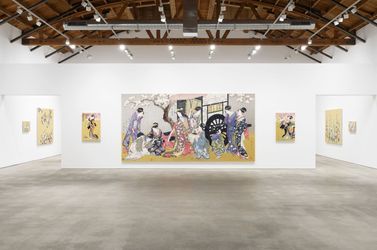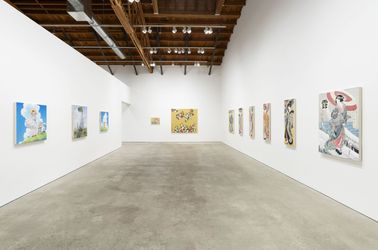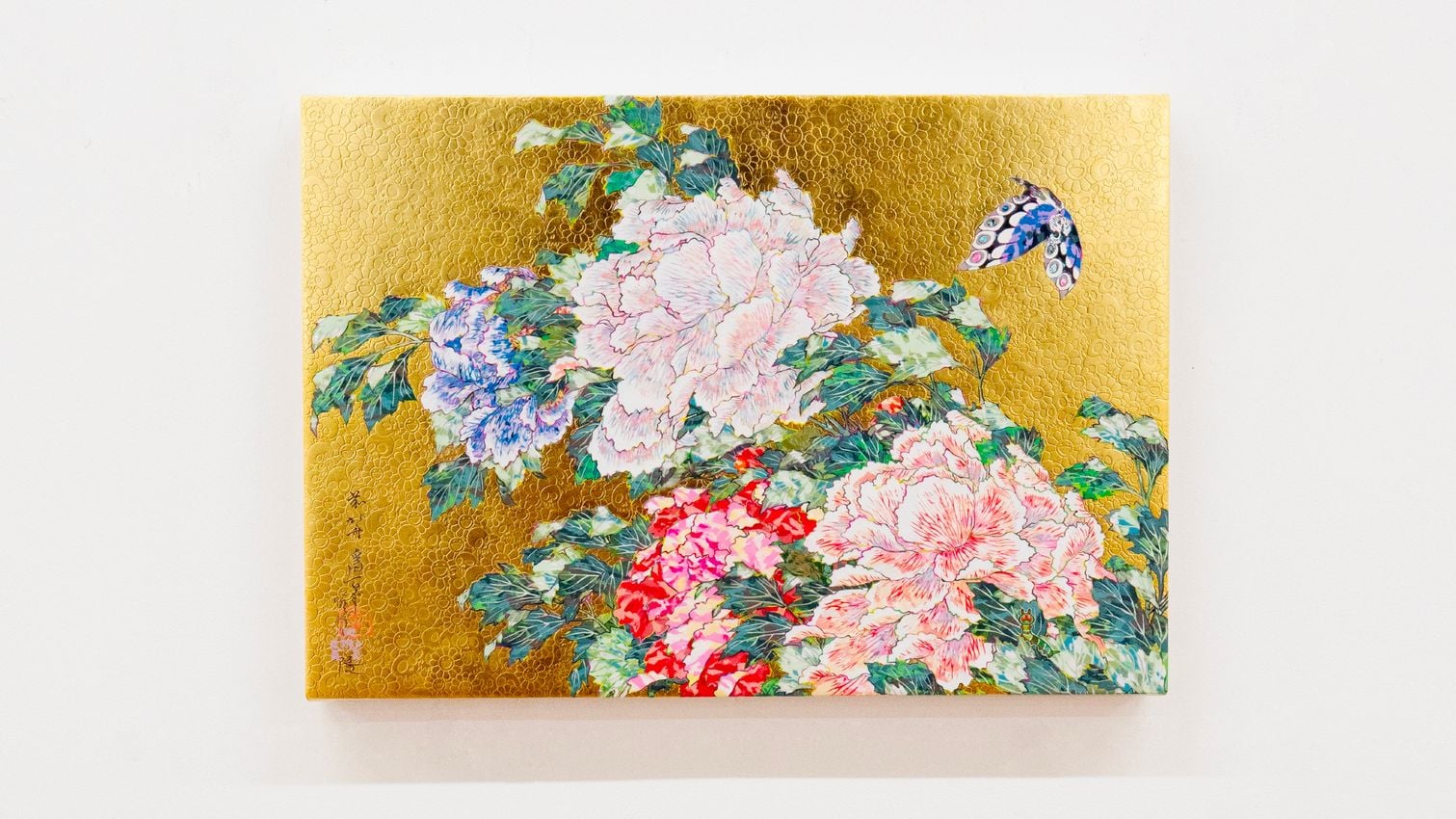
Perrotin Los Angeles is delighted to present a new solo exhibition by Takashi Murakami, Hark Back to Ukiyo-e: Tracing Superflat to Japonisme’s Genesis.
Freshly inspired by a visit to Monet’s Giverny, Takashi Murakami (b. 1962) explores the relationship between ukiyo-e and Impressionism in a suite of 24 new paintings at Perrotin Los Angeles. The latest works advance his theory of how ukiyo-e, or “floating world pictures,” transformed the global art scene in the late 1800s. In recent years, Murakami has reflected on how landscape prints from Japan spurred Impressionists to adopt more subjective and abstract approaches to composition and painting. Now the artist whose early sculptures HIROPON and My Lonesome Cowboy challenged the world to consider the theme of sexuality in Japanese art ponders the global impact of the ukiyo-e genre known as bijinga, or pictures of beautiful women.
Bijinga in ukiyo-e focused on the women, notably courtesans, geisha, and iconic attendants of teahouses of Edo (modern Tokyo). Often celebrities in their own right, or popular entertainment personalities, the women are presented as alluring figures, alone or gathered like hothouse flowers at the pleasure quarters or teahouses where they entertained; from casual everyday gestures to viewing seasonal displays of flowers or moonlight; or sometimes traveling to assignations. Drawn to their novel compositions, exotic costumes, and erotic elements, Monet and other Impressionists drew inspiration for new depictions of modern life in France.
The Perrotin show opens with an in-depth guide to Edo fashions and tastes in the form of f
Part three extends the connection between ukiyo-e and Monet to the kawaii culture of contemporary Japan. Camille Doncieux Painting Outdoors and Contrail and Flower-Chang on the Hill originated as designs for collectible trading cards in the 108 Flowers Revised series, a product line released in 2024 by Kaikai Kiki, Ltd., the general trading company led by Murakami. The trading card designs were inspired by The Wind Rises, a hit manga and anime film by Hayao Miyazaki. Miyazaki’s depiction of the character Nahoko outdoors with her easel was in turn inspired by Monet’s Woman with a Parasol. In Murakami’s version, the demure heroine of Miyazaki’s classic is sexualized with a view of long bare legs, and Monet’s impressionistic blossoms are replaced by Murakami’s iconic happy flowers. The companion piece, Flower-Chang on the Hill, replaces Camille’s son (shown on the hillside by Monet) with Murakami’s flower-shaped character Ohana. A contrail above the clouds alludes to the theme song of The Wind Rises and references youth who die young (as did both Camille and Nahoko)
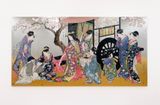
our monumental paintings based on bijinga by Kitagawa Utamaro and Torii Kiyonaga. Kitagawa Utamaro’s ”Flowers of Yoshiwara” Dogs and Cats Intoxicated by Cherry Blossoms - SUPERFLAT and Kitagawa Utamaro’s ”Snow in Fukagawa” Samurais and Many Cats in Edo during the Little Ice Age - SUPERFLAT reprise two of Utamaro’s most celebrated works, large-scale paintings of women gathered at teahouses in spring and winter. (In the late 1800s both paintings were in Paris, in the collection of Siegfried Bing, an influential figure in the world of Japonisme; Monet may have had the opportunity to see them first-hand.) At an impressive two meters by four meters, Murakami’s versions convey the originals’ grand scale. Two large-scale copies of woodblock-printed bijinga triptychs by Utamaro and Kiyonaga hang with them.
These paintings showcase the devices Utamaro and Kiyonaga used to express sensuality, for example views of the slender white nape of a woman’s neck, her bare feet or a langorous pose. Murakami observes that even the women’s hairlines are detailed in a sensual manner. The Impressionists absorbed such elements alongside other novel features: uptilted ground planes, shallow space, silhouetted figures, flat areas of bright color defined by curving outlines. Copying the originals, Murakami had his own intimate encounter with these features, recognizing in the process the meticulous care taken in pursuit of delicate effects. He interprets them in his signature style, composed of layer upon layer of silkscreened acrylic paint, applied with a special squeegee work application method and coated in a glossy finish.
A second series explores the route from bijinga to Monet’s 1875 portrait of his first wife, Camille, a work known as Woman with a Parasol – Madame Monet and Her Son. Here Murakami pairs a copy of Monet’s portrait with twelve enlarged versions of ukiyo-e prints by Kikukawa Eizan and his teacher, Utamaro. Through these examples Murakami shapes a narrative of Monet’s encounter with bijinga. They suggest the elements that Monet absorbed in his study of prints: statuesque threequarter figures; sensual outlines; parasols viewed from below; cloudlike masses of cherry blossoms; windswept skirts. Another selection, Utamaro’s Yamauba and Kintarō, is an example of a bijinga sub-genre in which women are shown with young children. In his copy of Woman with a Parasol, Murakami’s intricate squeegee work patterns evoke Monet’s expressive brushwork and light-dappled surfaces.
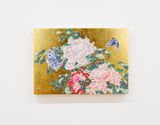
Five other paintings offer a coda for the show in the form of precedents for Murakami’s happy flowers: three copies of exquisite flower prints by ukiyo-e artists Hokusai and Hiroshige, beside four paintings of hollyhocks modeled on compositions by Edo period painters Ogata Korin and Kenzan, members of the Rinpa school.
As Murakami has pointed out, copying has a long history in Japan. It was a practice central to the training of students in most painting ateliers. By revisiting key works from the past he is hoping to learn from his predecessors, in the process clarifying for himself the chain of relationships from ukiyo-e to modern abstraction. This creative examination and interpretation of Edo-period artworks is a key project of his later years, as seen in a string of recent exhibitions at the Asian Art Museum, Brooklyn Museum, Kyocera Museum (Kyoto), and Cleveland Museum of Art .
Alongside the exhibition, from February 6 through February 28, we will open a Perrotin Store featuring limited-edition prints and merchandise by Takashi Murakami and other gallery artists. Located next to our Los Angeles gallery, at 5040 West Pico Boulevard, the store will be open from Tuesday through Saturday, 1 - 6pm.
The artist will also be in conversation with MOCA Chief Curator & Director of Curatorial Affairs, Clara Kim, on February 12, at 6:30pm, at The Geffen Contemporary at MOCA. The conversation will address Murakami’s long engagement with and theories on Japanese art, reflecting on the seminal exhibition Superflat, curated by Murakami, which was presented at MOCA in 2001.
Courtesy Perrotin.


Takashi Murakami, who has a PhD in Nihonga painting, combines the most cutting-edge techniques with the precision and virtuosity of traditional Japanese art. Inspired by manga and kawaii culture, his irresistible world is peopled by monstrous and charming characters alike, as facetious descendants of past myths. His theory of the Superflat aesthetic, which he introduced in 2001 with the trilogy exhibition he curated (the third part was entitled Little Boy, which refers to the codename for the atomic bomb dropped on Hiroshima in 1945), attempts to blur the boundaries between popular art and high art; it has explored the evolution of Japan’s understanding of its post-Hiroshima condition and the interrelationships between vanguard art, manga, anime and their forerunner, Ukiyo-e woodblock prints. The absence of perspective, the two-dimensionality of ancient Japanese art, filters in to every medium.


A respected voice in contemporary art discourse.
Focusing on ambitious storytelling and insightful art-world commentary. Ocula Magazine publishes in-depth interviews, critical essays and timely analysis on the artists, exhibitions and ideas driving the global art world.
Learn more about Ocula Magazine
Showcasing the best of the art world.
Ocula partners with galleries from around the world to highlight their artists, artworks and exhibitions. Gallery membership is by application and invitation, with each member vetted by an independent panel.
Learn more about Ocula Membership

Specialises in the sale of major artworks.
Led by a team with deep ties to the world’s leading auction houses, galleries and collectors. Ocula’s advisory team offers bespoke services to high-net-worth clients from around the world who are looking to acquire the best of contemporary and modern art.
Learn more about our team and services