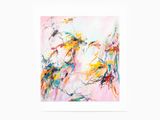
Perrotin is proud to announce an exhibition of new works by China-born and Germany-based artist, Xiyao Wang, her first solo show inThe United States. Wang is known for her immersive paintings inwhich gestural lines evoke landscapes, bodies, movements, andthoughts. At Perrotin, she will present ten new canvases which willdebut her first paintings made entirely of charcoal, marking a shiftin the artist’s practice from high energy to reflective compositions.Merging Chinese philosophy, Western art history, and global massculture, Wang’s lyrical minimalist paintings transcend prescribedtraditions, creating a sense of boundlessness and freedom.
With swooping lines and a unique perspective, the movement in Wang’spaintings creates the illusion of ever-expanding spatial relationships.Drawing on her knowledge of both classical Chinese mountain-and-seascrolls and the minimalism of Cy Twombly, these artworks appear togrow larger upon each viewing. While this effect is certainly within thetradition of Chinese painting, Wang invents her own interpretation ofcalligraphic gestures, using paint, charcoal, and oil sticks. Wang’spresence is visible in these gestural strokes like a shadow of a dancermoving behind a screen.
This series marks a significant return to Chinese influences for an artistwho left her country nine years ago. For example, several worksincorporate the well-known parable of Dao Master Zhuangzi creating avisual reflection on the concepts of existence and perspective:
_“Once upon a time, I dreamt I was a butterfly, fluttering hither and thither,to all intents and purposes a butterfly...Now I do not know whether I wasthen a man dreaming I was a butterfly, or whether I am now a butterfly,dreaming I am a man.”_
Taking in the significance of this story, Wang painted two large-scaleworks. In Zhuangzi Dreaming of Becoming a Butterfly No. 2, Wang’sown calligraphic notation system guides viewers physically from left toright, back and forth to interact from several perspectives. Its partner, TheButterfly Dreaming of Becoming Zhuangzi No. 1, embraces color topunctuate the charcoal strokes as if looking at a dream in a paralleluniverse.
“Am I a Chinese artist who wakes up in Berlin, or am I a Berlin artist,dreaming I am in China?” This is a question that so many of hergeneration, born in China but educated and living in the West, must ask themselves. Being in Germany for almost one decade has made Wangkeenly homesick for her family and culture. She shifted her interests fromkickboxing and techno-music to lessons on the Guqin, the stringedinstrument whose distinctive sound is a tool for meditation. A Chineseculture that was everywhere in her childhood, rendering it invisible, cameinto clear focus only when she was far from home.
Do you hear the waterfall? No.1, 2023, the painting for which theexhibition is named, hums with the white noise of an out-of-controlwaterway, using arcs of charcoal lines on primed canvas. Of course, wecannot “hear” but we are moved to listen. Sound, music, and silentmeditation are influences on this artist who practices yoga, kickboxing,ballet, and sitting. It is telling that when she was a child, Wang wanted tobe a dancer, but her father, himself an artist, informed her that dancershave short careers while artists can work throughout their lives and beremembered even in death. Her gestural lyricism performs as a songagainst a whispering soundtrack.
It would be too easy to label this work “a bridge between East and West,“as if Wang’s innovations were merely a matter of cut-and-paste. Thatwould ignore the synthesis of transnational influences, particularly global
Liang Xiao Yin No. 6, 2023. Charcoal on canvas. 53 1/8 × 49 3/16 inch. Photographer: Roman März.Courtesy of the artist and Perrotin.
abstraction, now readily available to artists of this generation. Forexample, do not assume that Wang studied calligraphy and brushpainting at her college in Chongqing; the Sichuan Academy is known forits emphasis on European realism. In Hamburg, Wang rejected Chineseelements and embraced Gunther Forg or Albert Oehlen, their eccentricuse of form and line and their roles as artist-as-liberator. From them,Wang absorbed the ways she could slip from the demands of realistpainting as well as calligraphy to build a new aesthetic vocabulary.
Whether standing before magnificent Buddhist paintings in the caves ofthe Silk Road or experiencing the endless rushing of Niagara Falls, it isimpossible to escape the awe inspired by these encounters. Generationsof artists have tried to capture this sense of wonder, but few with thesophistication, experimentation and license of young Chinese artist XiyaoWang.
Press release courtesy Perrotin. Text: Barbara Pollack.
Chinese artist Wang Xiyao paints expressive works on canvas, translating life experiences, embodied tensions, and movement into collections of gestural marks.


A respected voice in contemporary art discourse.
Focusing on ambitious storytelling and insightful art-world commentary. Ocula Magazine publishes in-depth interviews, critical essays and timely analysis on the artists, exhibitions and ideas driving the global art world.
Learn more about Ocula Magazine
Showcasing the best of the art world.
Ocula partners with galleries from around the world to highlight their artists, artworks and exhibitions. Gallery membership is by application and invitation, with each member vetted by an independent panel.
Learn more about Ocula Membership

Specialises in the sale of major artworks.
Led by a team with deep ties to the world’s leading auction houses, galleries and collectors. Ocula’s advisory team offers bespoke services to high-net-worth clients from around the world who are looking to acquire the best of contemporary and modern art.
Learn more about our team and services