Press Release

SCAI PIRAMIDE is pleased to present a solo exhibition of works by Pratchaya Phinthong from 15 February to 26 April, 2025.

Curator, David Teh contributed an essay for this exhibition.

Pratchaya Phinthong belongs to a generation of Thai artists born in the 1970s who after overseas studies established themselves internationally but were determined to return to Thailand, despite its political instability and weak art infrastructure. Unlike previous generations, their identity was not legible on the face of their work. They eschewed the official symbols of Thainess (Buddhism, Nation, Monarchy) in favour of stories and materials drawn from the fringes of the national experience. In Pratchaya’s case: the hopes of rice farmers, shattered by failed government schemes; an internet kiosk in a village barely connected to the country’s road system; the ingenuity of migrant workers, improvising in a remote, foreign landscape... Neither the artist nor his subjects were representatives of what Naoki Sakai terms the “national body” (kokutai), a marked departure from the mode of Southeast Asian contemporary art established since the 1990s.

Pratchaya was born and raised in Thailand’s northeast (“Isaan”), a region with its own ethno-culture that is more Lao than Siamese. His current body of work stems from long-term dialogue with villagers in the Xiangkhouang Province of neighbouring Laos, known as the most heavily-bombed place on Earth. The families collect and recycle the shrapnel and ordinance rained down on their land by the U.S. military during Operation Barrel Roll (1964-73), its failed campaign to disrupt the storied Ho Chi Minh Trail. Through this cottage industry, the resourceful Laos give new life to the dangerous waste metal, turning the stuff of destruction into a range of valuable products—from building materials and cutlery to jewelry and even contemporary art—to sustain their families.

In previous iterations, Pratchaya engaged with NGOs working to heal the physical and mental wounds of that Cold War violence. One such initiative trains therapists in the treatment of amputees suffering from phantom limb pain, a debilitating but curable condition, with specially designed mirrors that they distribute to affected communities. The mirrors have become a key device in the artist’s installations. Rendered now in polished bomb metal—poison become cure—their forms give ground to a stunning liberation, as syllables in an expansive, reparative play of association and transference. (Cutlery, currency, tufts of raw cotton; trees protected from logging by shrapnel they have absorbed; stealth bombers mistaken for the endangered birds that thrive in a “demilitarised” zone...)

Recalling the karmic economy of Theravada Buddhism, Pratchaya’s method has been compared to alchemy. Substances acquire new value as they transit through different states and contexts—from one use to another, from solid to liquid to gas, from the mundane to the exalted. But the exchange is never simply physical, as the artist’s materials gain entry to another economy that is quasi-linguistic. Like migrants (or contemporary artists), they leave behind a local matrix of identification and meaning, making their way in a larger world. This poetic movement is neither programmatic nor illustrative—indeed, its operation is subject to chance and in this sense anti-representational, a “nominalism” perhaps akin to that of Duchamp’s readymade.

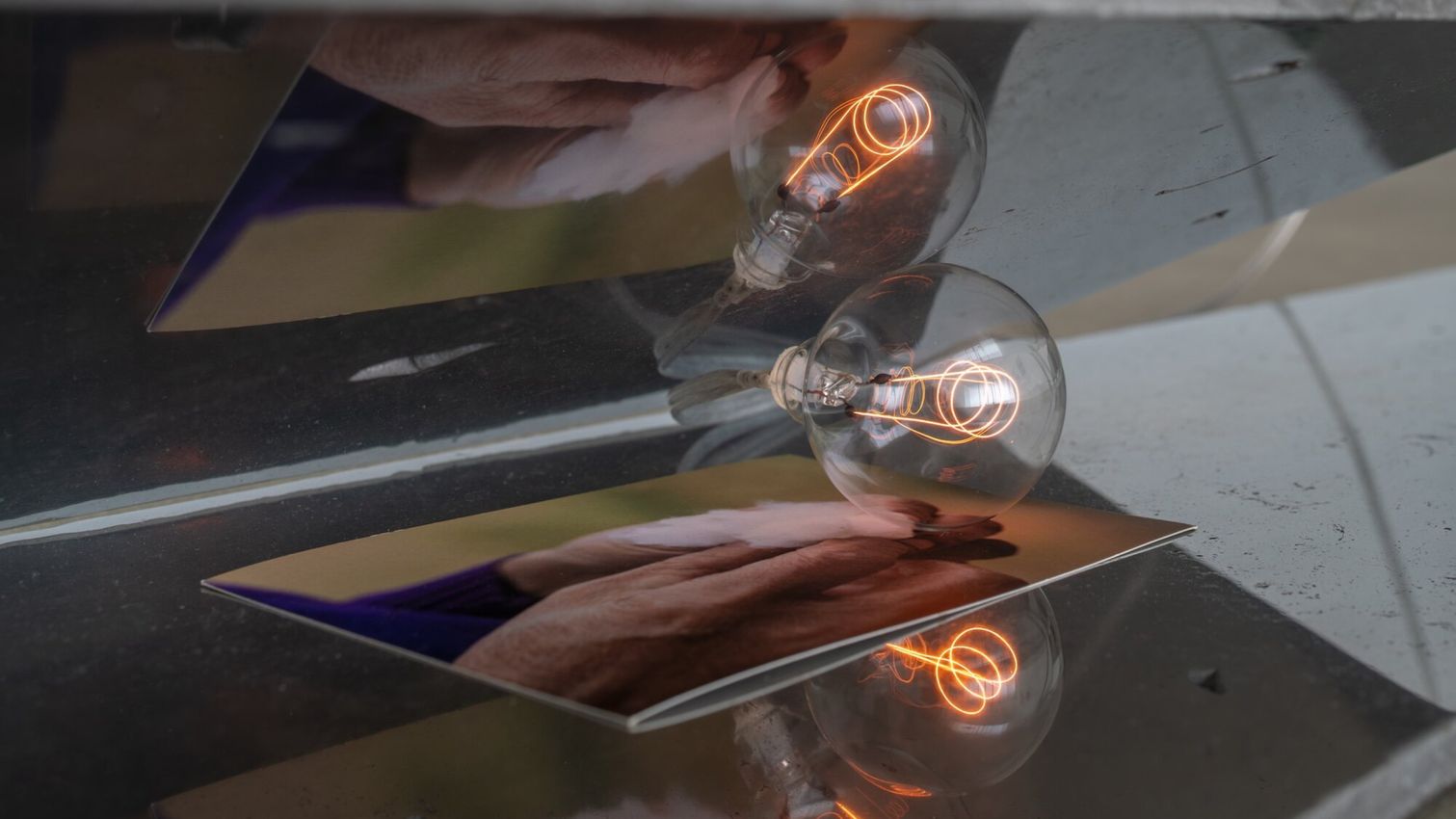
In his first solo exhibition in Japan, the artist finds novel vectors for his materiel in Japanese light industry. The metal is worked through the practical geometry and templates of golf club manufacture, in experimental collaboration with a factory in Himeji (Hyogo Prefecture), yielding a subtle, dashed-line framing element for the gallery space. Meanwhile, his mirrors are illuminated by cotton-filament light bulbs, an 1879 innovation of Thomas Edison, long-since obsolete for industrial purposes but still produced by specialist fabricators at a factory in the north of Tokyo. Cotton happens to be a cognate of the bomb metal, a common intercrop planted in rotation with rice and other foods, processed at household scale in Laos and much of the Mekong region. Mounted precariously between mirrors, like familiars of our waning, carbon-based civilisation, the fragile bulbs emit a short-lived warmth, animated by the pulsing song of the Asian bell cricket (suzumushi – Meloimorpha japonica), a domesticated insect and metonymic “seasonword”(kigo) standing for autumn in Japanese poetry.

This muted mimicry evokes the fundamental interdependence between living and non-living, a relation honoured by art, but properly consummated by craft. Though no longer Asia’s technological standard-bearer, Japan remains a living museum of the manual, artisanal knowledge that won early recognition in the project of national modernity. Utility objects and techniques, revalorized as “local culture” worthy of maintenance as tradition, command a market premium despite the dominance of mass reproduction. This model lent itself to imitation, as in the One Tambon One Product (OTOP) scheme implemented by Thailand’s government to revive its economy after the 1997–1998 Financial Crisis. The last in a long line of Siamese efforts to emulate Japan’s modernisation, OTOP appropriated a ground-up model pioneered in Oita Prefecture in the 1970s, and since adopted across the developing world. Japan is not the only society to realise this value but surely one of the most defensive, even as its masters of light industry become less and less integral to the contemporary “national body.”

Asian art’s modernity has seldom rested on a putative separation from craft. Pratchaya’s collaboration with farmers, scientists, village enterprises and niche manufacturers shows an abiding respect for practical intelligence and a distinctly non-essentialist understanding of art. Perhaps that is why his poetic license can still unlock new meanings, new applications, for arcane techniques on the verge of obsolescence, opening the work of art itself up to new, unanticipated purposes and suggestive deviations.

Read More
About the Artist

Pratchaya Phinthong lives and works in Bangkok, Thailand. Phinthong creates situations as an invitation made to the visitor to share an experience with him. His projects (without any specific or pre-defined forms) suggest a crack in which the spectators are invited to fill the gaps. He builds a set, a fiction, or a process where he can test our perceptions. He proposes to his audience a story with multiple paths. A trip down memory lane combined with subjective perceptions. His projects are often constructed in a dialogue between the artist and the others, making the artist’s movement glide towards the social field. Beyond any artistic or formal experience, the artist is looking to find his place and his identity playing on the economic representations and cultural existences.The ‘gallery’ space becomes a free area.

View Artist Profile

Also Exhibiting at SCAI THE BATHHOUSE

About the Gallery
SCAI PIRAMIDE seeks to foster thoughtful exchanges and further advance the contemporary art scene in Tokyo. Going beyond the existing gallery framework, it aims to propose renewed perspectives on art and update our contextual understanding in response to changing times.
View Gallery Profile
Address
3F, 6-6-9 Roppongi
Minato-ku
Tokyo
Japan
Opening Hours
Tuesday – Saturday
12pm – 6pm
(1)
Tokyo 3F, 6-6-9 Roppongi, Minato-ku
SCAI PIRAMIDE
3F, 6-6-9 Roppongi, Minato-ku, Tokyo, Japan

Opening hours
Tuesday – Saturday
12pm – 6pm
The art world in focus