




Icons of German postwar photography, Bernd and Hilla Becher meticulously documented industrial architecture across Europe and North America, challenging the distinction between documentary and fine art photography.
The artist duo and couple used large-format cameras to create striking black-and-white images of industrial forms, strictly adhering to their formal aesthetic principles and typological approach. Their photography simultaneously distils each construction into a taxonomy of visually and functionally homogeneous structures, whilst emphasising the particular and eccentric character of each.
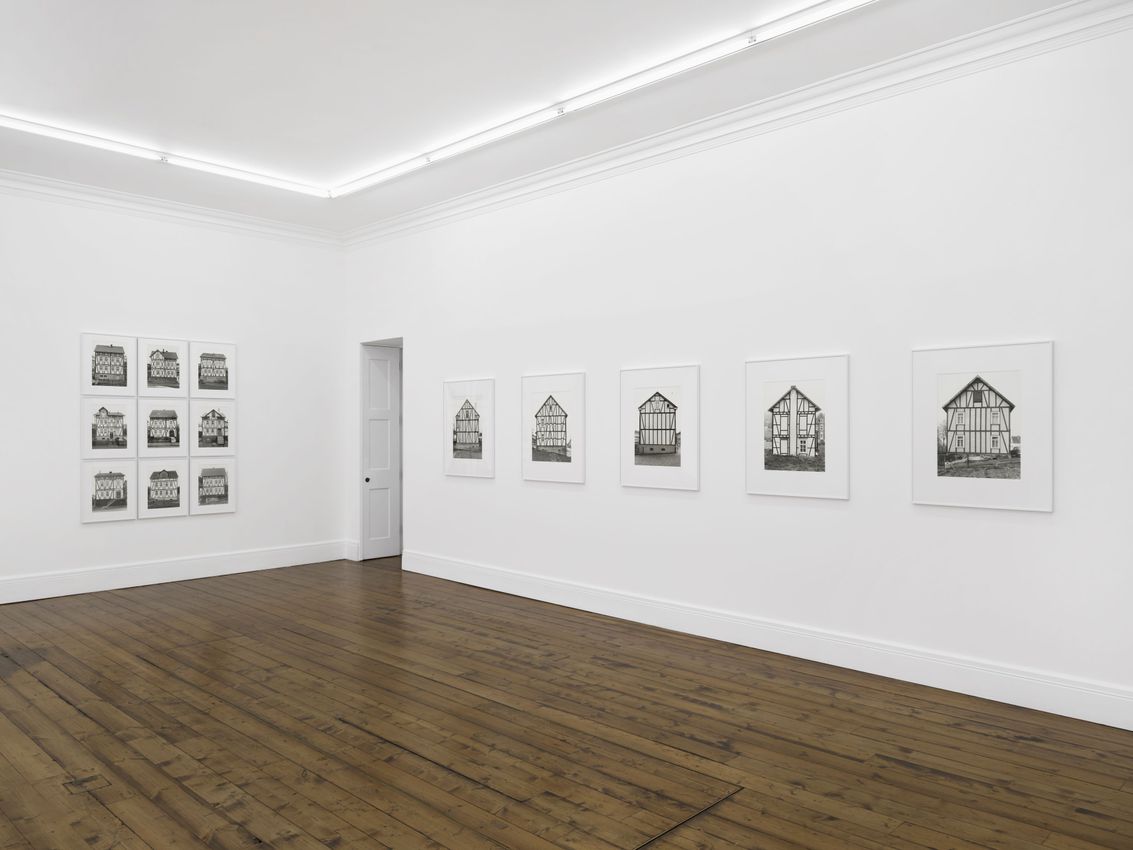
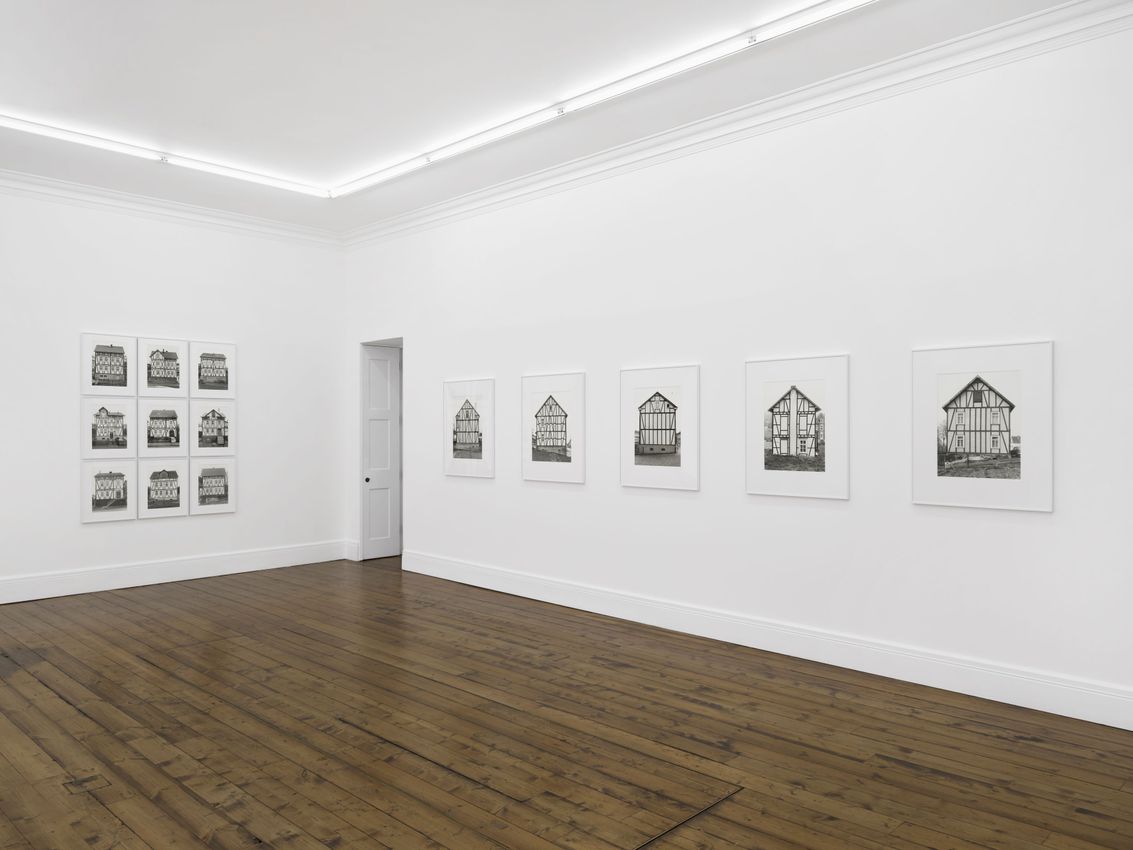
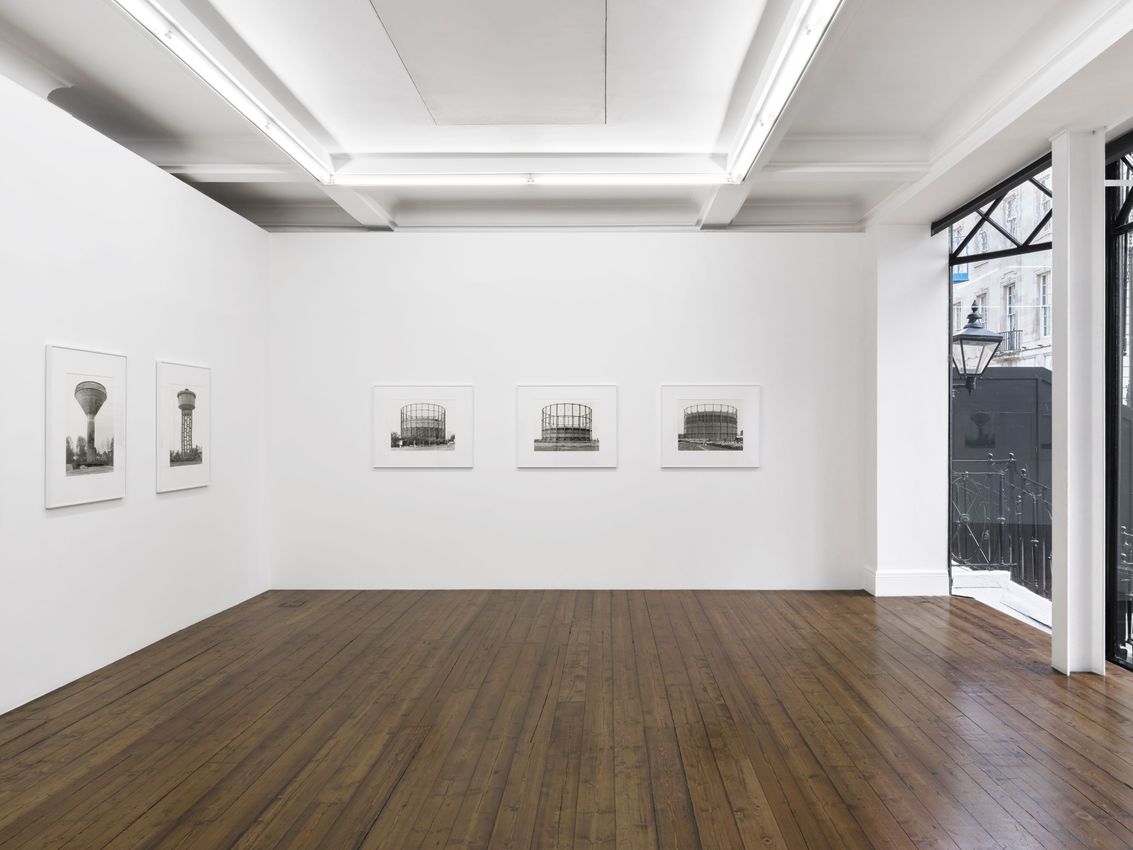
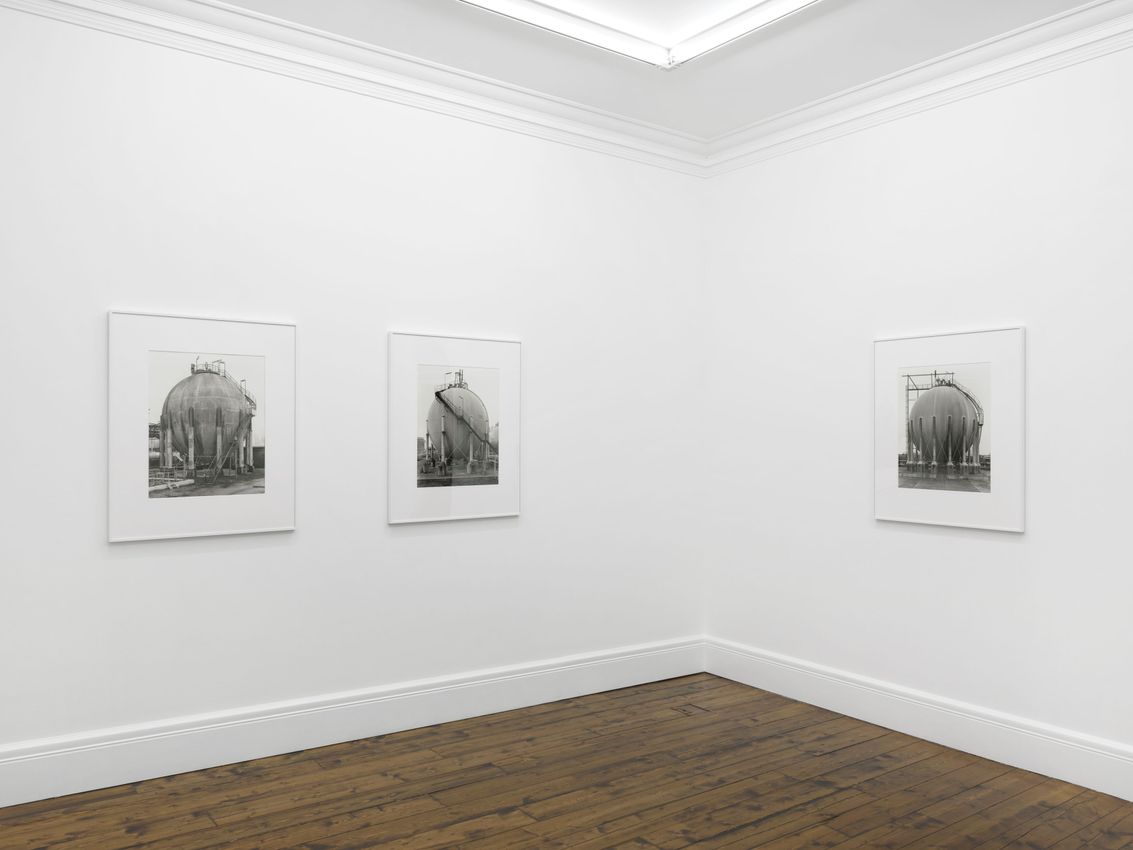
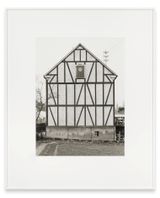
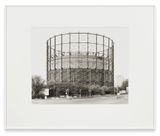
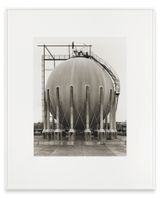
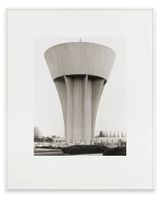
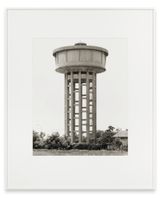
The eponymous solo exhibition features several groupings of the Bechers’ most recognisable archetypal forms: gas tanks, water towers, winding towers, framework houses and preparation plants. The French, Belgian and even two rare Italian water towers reflect the formal diversity that can arise from buildings with corresponding functions across national borders and within them.
This is the artists’ first solo exhibition at Sprüth Magers, London, in over a decade, marking the first since Hilla Becher’s passing in 2015. In recognition of this fact, the five gas tanks that commence the exhibition are from Great Britain, several from London specifically, and most of the work has never been shown in the country before.
The Bechers’ photographs of gas tanks depict the circular edifice characteristic of historic gasometers: a metal guide frame with an expandable and retractable storage vessel within. These photographs record these gasometers at various levels of containment. Yet, unlike the other gas tanks on view, Gas Tank, Ilford, London, UK (2009) captures the gasometer at a moment in which it is nearly empty, thus revealing the complete ring of the structure’s discoid form. This visual distinction is made all the more apparent by the Bechers’ rigorous aesthetic approach and commitment to objectivity, which encourages close looking and the identification of difference.
Interweaving early and later work by the Bechers across a range of building types, including both single pieces and a typology, this exhibition reflects the profound variety produced from the artists’ concise methodology. Within the gas tanks on display, there are further formalistic groupings of structures that read as vertical, horizontal and even circular.
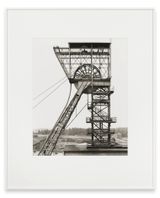
On the second floor, several winding towers are also presented. Unlike gas tanks and water towers built for containment, the purpose of these structures was operational, transporting materials and workers in and out of underground mines, and the corresponding photographs do not depict the full structure, which is partially underground.
The framework houses are the earliest works in the exhibition and record the distinctive architecture of Germany’s industrial Siegen region, one of the oldest iron-producing parts of Europe.


Bernd and Hilla Becher met in 1959 and first exhibited together in 1963. The typologies for which they are now well known grew out of their expansive, impartial approach when they first started taking photographs of commonplace industrial buildings in post-War Germany and across Western Europe. After collating thousands of pictures of individual structures, they noticed that the various edifices—of cooling towers, gas tanks and coalbunkers, for instance—shared many distinctive formal qualities. Systematically photographing each structure from both a frontal and a three-quarter perspective, they examined them the way a biologist might look at a specimen collected during fieldwork, comparing and contrasting to organise them into groups, or species. Presented in grids, the typologies reveal the many forms that the buildings share, while at the same time each picture within the grid describes the unique details of each particular structure. The rigour and clarity of the Bechers’ methodology has influenced a generation of photographers and conceptual artists.
Sprüth Magers has expanded from its roots in Cologne (Germany) to become an international gallery dedicated to exhibiting the very best in groundbreaking modern and contemporary art. With galleries located in Berlin Mitte, London’s Mayfair and the Miracle Mile in Los Angeles–as well as an office in Cologne and an outpost in Hong Kong–Sprüth Magers retains close ties with the studios and communities of the German and American artists who form the core of its roster.

A respected voice in contemporary art discourse.
Focusing on ambitious storytelling and insightful art-world commentary. Ocula Magazine publishes in-depth interviews, critical essays and timely analysis on the artists, exhibitions and ideas driving the global art world.
Learn more about Ocula Magazine
Showcasing the best of the art world.
Ocula partners with galleries from around the world to highlight their artists, artworks and exhibitions. Gallery membership is by application and invitation, with each member vetted by an independent panel.
Learn more about Ocula Membership

Specialises in the sale of major artworks.
Led by a team with deep ties to the world’s leading auction houses, galleries and collectors. Ocula’s advisory team offers bespoke services to high-net-worth clients from around the world who are looking to acquire the best of contemporary and modern art.
Learn more about our team and services