Press Release

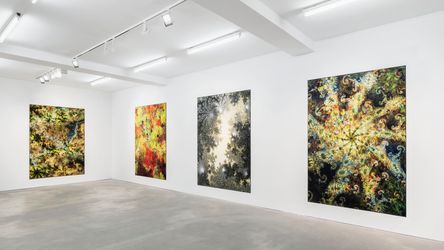
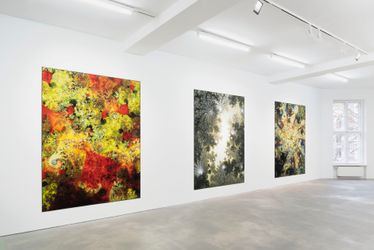
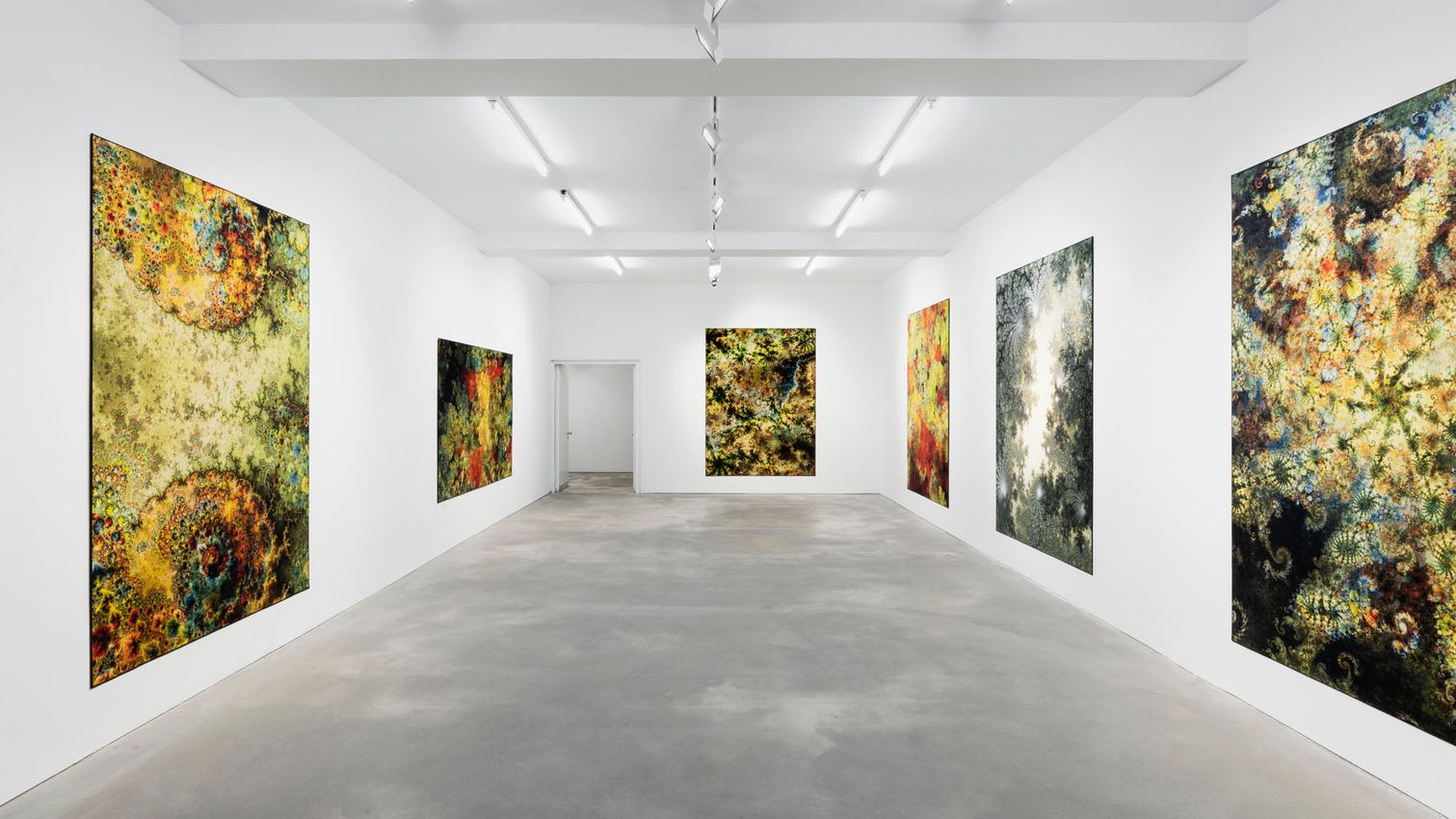
Monika Sprüth and Philomene Magers are delighted to announce Thomas Ruff’s d.o.pe., asolo exhibition at the Berlin gallery. The featured, eponymous series of new works is thefirst to find Ruff using large wall tapestries as a textile carrier for his images. Featuringfractal patterns the tapestries reflect Ruff’s long-standing interest in the beauty andvisualisation of complex mathematical phenomena. The title of the series refers to AldousHuxley’s The Doors of Perception, a 1954 essay describing the British philosopher’sexperiments with mind-altering drugs and the consciousness-expanding potential ofartificial sensory impressions. The psychedelic imagery in d.o.pe. continues Ruff’songoing exploration of human perception, specifically as it relates to both real andconstructed reality.

Ruff’s multi-faceted practice mines the ever-changing possibilities of photography,investigating visual and cultural phenomena to address the ways in which technologyinfluences our seeing. It manifests across a wide range of subjects and methods rangingfrom classical portrait photography to algorithmically generated digital images.

In the early 2000s, Ruff first turned his attention to the visualised geometric structures, forwhich the mathematician Benoît Mandelbrot coined the word ‘fractal’ in 1975. Fractalpatterns exhibit a high degree of self-similarity, which is to say that magnifying any part ofthe original shape shows the same shape repeated over and over again. Self-similarstructures can be created mathematically but also occur in nature. They can be generatedas a two- or three dimensional digital image in virtual space and at the same time appearin simplified form as a natural construct – in the crystalline structure of a snowflake, forexample. Ruff’s initial attempts at fractal imagery were unsuccessful, as the computerprograms available at the time lacked the necessary precision. He returned to the idea offractals in 2022, after coming across software that could be used to create andmanipulate psychedelic imitations of nature with the degree of complexity he was lookingfor. The correlation between fractals as both natural and artificial structures chimes withRuff’s ongoing investigation of human perception. What happens when the line betweenreal and constructed reality blurs, when the two are no longer entirely distinguishable?

In his experiments for The Doors of Perception, Aldous Huxley engaged with his everydaysurroundings and their aesthetic beauty. His journey of the senses resulted, among otherthings, in a number of newly articulated insights into art, music, and nature. Formal, visualaspects of d.o.pe. echo the kind of 1960s and 70s psychedelic art and imagery that Ruffencountered on posters and record covers in his youth. Abounding with floral-decorativeornament, mandalas, and kaleidoscope patterns, they illustrated the hallucinations thatoften accompany the experimental use of mindexpanding hallucinogens including LSDand mescaline. These images – visual phenomena that exist outside the realm of rationalimagination but are nevertheless perceived as real – resonate with Ruff as they point to anexpanded concept of perception. Adding to this visual language are the materialproperties of the velvety, shiny velour tapestries themselves: Velour was popular in interiordécor and saw a particular heyday in the 1970s and 1980s. The industrially manufacturedtextile has a soft, organic feel that underscores Ruff’s interest in artificially constructednaturalness. The choice of printed tapestries gives the psychedelic patterns in d.o.pe. anobject-like character and contribute to a sense of spatial depth. With his new series, Rufftakes up a historical image-making technique and reinterprets traditional tapestry bychoosing industrially produced velour carpets.

Ruff’s d.o.pe. evokes the highly detailed Renaissance style of painters like HieronymusBosch and Matthias Grünewald–artists whose subject matter and colour palette took fewcues from the real world. Their work, with its surreal architectural structures and richnessof figures, reminds Ruff of the limitlessness of artistic imagination. Ruff’s image-ladentapestries ask the human mind to look beyond the usual limits of perception. In the wordsof William Blake, as quoted in Aldous Huxley’s titular essay, ‘If the doors of perceptionwere cleansed everything would appear to man as it is, infinite.’

Thomas Ruff (*1958, Zell am Harmersbach) lives and works in Dusseldorf. Selectedsolo exhibitions include the K20, Kunstsammlung Nordrhein-Westfalen (2020–21), theNational Portrait Gallery; Whitechapel Gallery, London (2017), the National Museum ofModern Art, Tokyo (2016), S.M.A.K., Ghent, which travelled to the KunsthalleDüsseldorf (both 2014) and the Haus der Kunst, Munich (2012). In 2017 Thomas Ruff’sexhibition New Works was exhibited at the Gallery Sprüth Magers, Berlin. Recently hiswork was on view at group shows at the Guggenheim Museum, Bilbao (2021),Kunsthaus Zürich (2020), the Museum of Modern Art, New York (2019), the TateModern, London (2018) and the Victoria and Albert Museum, London (2018). In 2021,Thomas Ruff presented his first major solo exhibition in South East Asia at theNational Taiwan Museum of Fine Arts, Taichung.

Read More

Installation Views

About the Artist

Since the 1970s, Thomas Ruff’s photographic practice has included, but is not limited to: portraiture, domestic interiors and exteriors, manipulation of found images, astronomical documentation, photograms, digital abstractions created by algorithms, and 3D imagery. Studying under Bernd and Hilla Becher at the Kunstakademie Düsseldorf, Ruff was part of what came to be known as the ‘Düsseldorf School.’ In his iconic early series of portraits, subjects are pictured from the chest up, their blank faces are set against plain backgrounds that recall the expressionless genre of the passport photo. His photographs of interiors and exteriors reveal an egalitarian mode of representation. Grey post-war apartment blocks are presented not as failed utopian idylls but as objects of contemplation, whilst photographs of the interiors of the homes of friends and family are subject to an inscrutable eye for detail, be it a carefully placed houseplant or neatly ruched curtain. In the 1990s, found imagery became a point of interest for Ruff. His Nudes series took pornographic images from the Internet and subjected them to extreme distortion, refocusing attention on the act of looking itself rather than on the content, and referencing notions of voyeurism and exhibitionism in image production and reception. More recent work has looked to scientific archives and technologies. NASA has proved particularly influential, furnishing him with interplanetary images that he then enlarges and augments, using the latest methods of digital modelling to present abstract ribbons of computer-generated curves and maps that seemingly belong to the fields of mathematics and physics.

View Artist Profile

Also Exhibiting at Sprüth Magers

About the Gallery

Sprüth Magers has expanded from its roots in Cologne (Germany) to become an international gallery dedicated to exhibiting the very best in groundbreaking modern and contemporary art. With galleries located in Berlin Mitte, London’s Mayfair and the Miracle Mile in Los Angeles–as well as an office in Cologne and an outpost in Hong Kong–Sprüth Magers retains close ties with the studios and communities of the German and American artists who form the core of its roster.

View Gallery Profile
Address
Oranienburger Straße 18
Berlin
Germany
Opening Hours
Tuesday - Saturday
11am - 6pm
(1)
Berlin Oranienburger Straße 18
Sprüth Magers
Oranienburger Straße 18, Berlin, Germany
+49 302 888 4030
http://www.spruethmagers.com

Opening hours
Tuesday - Saturday
11am - 6pm
The art world in focus