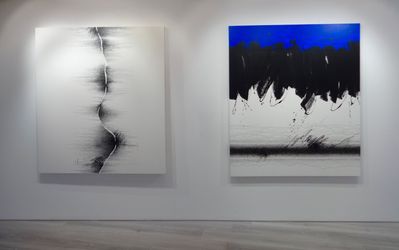
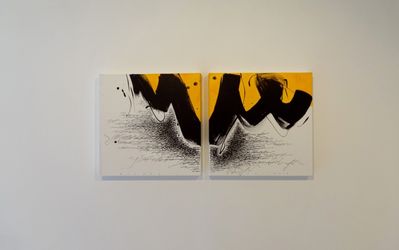
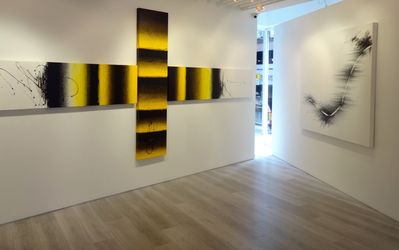
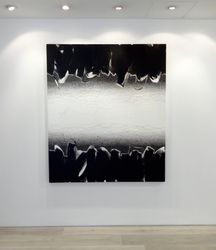
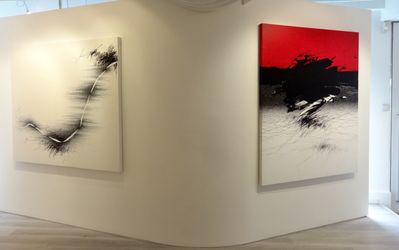
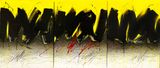
Iranian artist Golnaz Fathi, who divides her time between Tehran and Paris, presents new and recent paintings on canvas for her debut solo exhibition in Hong Kong.
Drawing on her extensive training as a classical calligrapher, Fathi uses texts and letters as formal elements, transforming traditional calligraphy into a personal artistic language. Using fine pen, mostly on varnished raw, rectangular, polyptych canvases, Fathi draws thousands of minute marks that echo the curvilinear forms of calligraphic letters and words.
The basis of Fathi’s current practice is a reinterpretation of siah-mashq or ‘black practice,’ a traditional exercise in which the calligrapher writes large, cursive letters repeatedly across the page in a dense, semi-abstract formation. This is the calligrapher’s practice sheet and the letters are not meant to form legible words or convey meaning, but rather strengthen the skill and the hand of the scribe. For Fathi, this is the most artistic aspect of the revered tradition of calligraphy because each sheet has a degree of freedom and uniqueness unseen in the finished script.
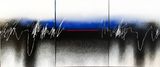
Drawing inspiration from various Western and Eastern sources, including American Abstract Expressionism, as well as the work of Iranian and Middle Eastern modernists who pioneered the use of the written word as a pictorial element in the late 1950s and early 1960s, Fathi transforms siah-mashq into intricate compositions. Lines coalesce across, up, down and off the edge of the canvas. The compositions are a result of intense time commitment and mental and physical dedication, as well as a form of meditation. To viewers, they become polysemic and are often read as landscapes, electronic transmissions or atmospheric phenomena. Fathi encourages free reign of interpretation and prevents preconceived notions by refraining from giving titles to her works.
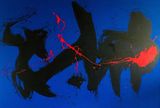
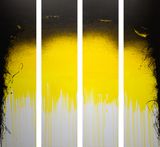
Prior to working with pen on canvas, Fathi worked with acrylic in the form of action painting, creating large, gestural brushstrokes in a limited palette of red, blue and yellow. A recent development in her practice is the pairing of these approaches. The colour and sweeping brushstrokes represent an impulsive feeling she feels compelled to translate; the monochromatic areas represent calmness. By skillfully combining these elements, she has created a distinctive visual language with universal appeal.
Born in Tehran in 1972, Golnaz Fathi has a Bachelor of Arts in Graphic Design from Azad University, Tehran, and a Diploma in Iranian Calligraphy from the Iranian Society of Calligraphy. For six years she underwent a rigorous and disciplined study to master the ancient script before establishing her own style of working.
She is the recipient of the Best Woman Calligraphist in Ketabat Style, Iranian Society of Calligraphy, in recognition of her achievements as a young female calligrapher in a field traditionally dominated by men.
Golnaz Fathi has works in the collections of the Metropolitan Museum of Art, New York; the British Museum, London; The World Bank, Washington D.C.; Chelsea Art Museum, New York; Brighton & Hove Museum, England; Carnegie Mellon University, Doha; the Islamic Arts Museum Malaysia, Kuala Lumpur; the Asian Civilisations Museum, Singapore; and The Farjam Collection, Dubai. Her work is currently on view in Frontiers Reimagined, a collateral event of the 56th Venice Biennale.


Iranian artist Golnaz Fathi, born in 1972, studied classical calligraphy before she established her own style of working. She received a Bachelor of Arts in graphics from Azad Art University, Tehran, and studied at the Iranian Society of Calligraphy. Drawing on her extensive training as a calligrapher, Fathi uses texts and letters as formal elements, transforming traditional calligraphy into a personal artistic language.
Sundaram Tagore Gallery was founded in 2000 by the eponymous Calcutta-born gallerist—formerly a director at New York’s Pace Wildenstein Gallery and also an established art historian and filmmaker—with the mission to further cross-cultural exchange in a world that is interconnected now more than ever. With four spaces—in Singapore, Hong Kong, and in two locations in New York—the gallery hosts quality exhibitions and not-for-profit events that encourage conversations across the arts.

A respected voice in contemporary art discourse.
Focusing on ambitious storytelling and insightful art-world commentary. Ocula Magazine publishes in-depth interviews, critical essays and timely analysis on the artists, exhibitions and ideas driving the global art world.
Learn more about Ocula Magazine
Showcasing the best of the art world.
Ocula partners with galleries from around the world to highlight their artists, artworks and exhibitions. Gallery membership is by application and invitation, with each member vetted by an independent panel.
Learn more about Ocula Membership

Specialises in the sale of major artworks.
Led by a team with deep ties to the world’s leading auction houses, galleries and collectors. Ocula’s advisory team offers bespoke services to high-net-worth clients from around the world who are looking to acquire the best of contemporary and modern art.
Learn more about our team and services