






SHAHZIA SIKANDER
b. 1969, PakistanShahzia Sikander is a Pakistani American artist best known for transforming the meticulous techniques of Indo-Persian manuscript painting into complex visual narratives that probe intertwined histories of empire, migration, gender, and power. Signature works including the early painting The Scroll (1989–90), the hand-painted animation SpiNN (2003), and the recent moving-image commission 3 to 12 Nautical Miles (2026), shown on the façade of M+ during Art Basel in Hong Kong, demonstrate how she moves fluidly between intimate works on paper, animation, sculpture, installation, and monumental site-specific public projections.
Early life and Career
Born in Lahore, Sikander studied at the National College of Arts from 1987, where she chose to specialise in miniature painting under Bashir Ahmad at a time when the discipline was largely seen as unfashionable and conservative, embracing instead its potential for opening new territories of dialogue around tradition and contemporaneity. Her thesis work The Scroll (1989—90), a five-foot-long watercolour and gouache painting on tea-stained wasli paper, received critical attention in Pakistan for signalling a step beyond inherited narratives, demonstrating her ability to fuse traditional manuscript techniques with contemporary subject matter.
Expansion of practice and neo-miniature movement
Graduate study in the United States, including at the Rhode Island School of Design, introduced Sikander to wider conversations in contemporary art and encouraged her to expand her practice from the page into wall drawings, animation, and installation. After completing her M.F.A. at RISD in 1995, she undertook a two-year Core fellowship at the Glassell School of Art at the Museum of Fine Arts, Houston, where collaboration with artist Rick Lowe and time spent in the city’s historically Black Third Ward led her to weave local histories of race, community, and activism into her imagery. Works such as Eye-I-ing Those Armorial Bearings (1989–97), which layers a carefully rendered portrait of Lowe with European heraldic devices and caricatured Black figures, demonstrate how she brings disparate visual traditions into pointed, critical dialogue.
Sikander relocated to New York City in 1997 for exhibitions at the Whitney Biennial, the Drawing Center, and the Queens Museum, and has remained primarily based there while sustaining close connections to South Asia. During this period she emerged as a central figure in what has come to be termed the neo-miniature movement, pushing miniature painting into digital animation, large-scale drawing, and immersive installation as she examined the complexities of migration and diasporic life.
Works, Methods and the M+ Commission
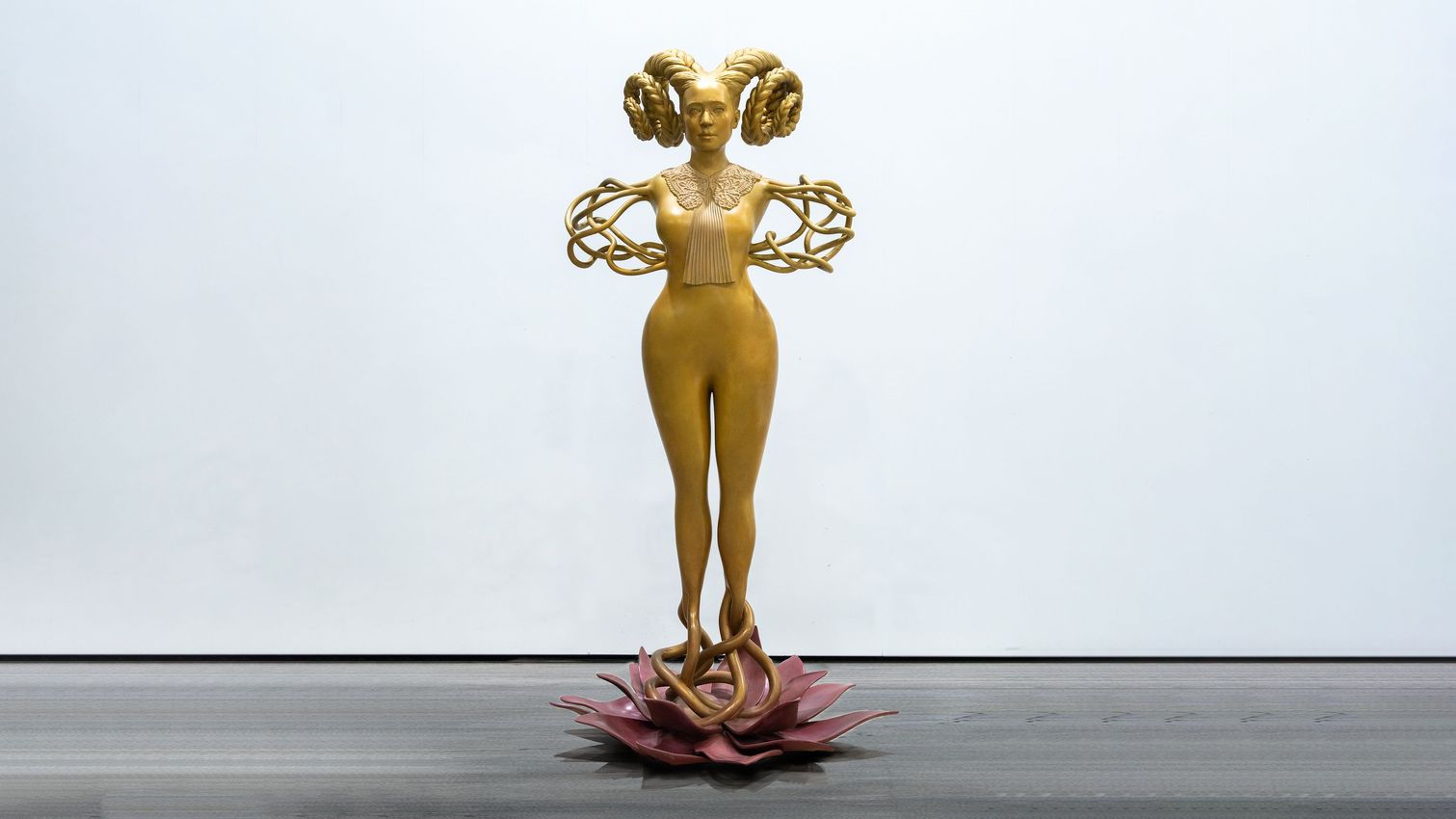
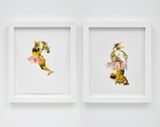
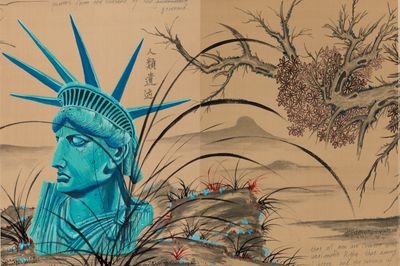
Sikander often begins with finely worked drawings and paintings in ink, gouache, and watercolour on paper, which she scans, layers, and reconfigures into digital and projected works. Across paintings, murals, and moving-image pieces, she returns to a constellation of motifs—hybrid female and androgynous bodies, curling foliage, ships and maps, fragments of architecture, and stylised weapons—that build up into dense, atmospheric fields of imagery at both page and architectural scale. Animation has become central to her process, allowing the implicit movement and narrative in her drawings to unfold as time-based sequences. In SpiNN (2003), for instance, an imperial Mughal court becomes the stage for an insurgent chorus of gopis whose elaborately drawn hair unravels into swarming, bird-like forms that overtake the scene, recasting a traditionally male-dominated setting through a collective feminine presence.
3 to 12 Nautical Miles (2026), commissioned for the M+ Facade in Hong Kong, pushes this language of miniature-derived animation into the realm of large-scale public art. Built from hand-painted source images, the work charts maritime routes connecting British imperial trade with Mughal India and Qing-dynasty China, drawing attention to how shipping lanes, the opium trade, and evolving maritime law have structured global power since the nineteenth century. Its title references the shift in international norms from a three- to a twelve-nautical-mile territorial sea, a change Sikander uses as a metaphor for expanding zones of sovereignty and control. Projected across the museum’s harbour-front façade, the animation operates as a glowing, slow-moving map of empire that folds historical cartography into the nightly visual life of Hong Kong’s skyline.
Themes, Feminism and Postcolonial Perspectives
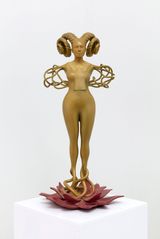
Throughout her practice, Sikander engages critically with colonial and postcolonial histories as they are encoded in visual archives, museum displays, and popular imagery. From early on, she responded to orientalist presentations of ‘Islamic’ or ‘Asian’ art in coffee-table books and institutional collections by reimagining detached artifacts as restless forms that could be reactivated and given agency within new narrative structures. This reanimation often takes the shape of hybrid figures—frequently female or androgynous—whose fragmented or floating bodies carry themes of severance, censorship, absence, and survival, complicating binary narratives of East and West, past and present.
Feminist perspectives also inform her reworking of miniature painting, as she uses the medium to ask whose stories have historically been preserved in images and legal records, and whose presence has been marginalised or erased. In 3 to 12 Nautical Miles, the sea becomes a liminal zone where boundaries remain unsettled, allowing her to reflect on contemporary debates around borders, migration, and contested sovereignties while evoking the fluidity of diasporic identity. By insisting on the permeability of cultural and geographic boundaries, her work frames “in-between” states not as deficits but as generative spaces of negotiation.
Exhibitions, Collections and Recognition
Over the past three decades, Sikander has presented major solo exhibitions at institutions across Asia, Europe, and North America, and her works are held in significant public collections internationally. Key presentations include Shahzia Sikander: Extraordinary Realities at the Morgan Library & Museum, New York (2021), the RISD Museum, Providence (2021), and the Museum of Fine Arts, Houston (2022), as well as Shahzia Sikander: Collective Behavior, a collateral event of the 60th Venice Biennale at Palazzo Soranzo Van Axel in 2024. Earlier solo shows and group exhibitions at venues such as the Museum of Contemporary Art, Sydney, MAXXI in Rome, the Frances Young Tang Teaching Museum, the Hirshhorn Museum and Sculpture Garden, Musée d’Art Moderne de Paris, the Museum of Modern Art in New York, the Museum of Contemporary Art Tokyo, Guggenheim Museum Bilbao, the Istanbul and Lahore biennials, and the Venice Biennale have also consolidated her institutional presence
Sikander has received numerous honours, including a MacArthur Fellowship (2006), the U.S. Department of State’s Medal of Arts (2012), the Asia Society Award for Significant Contribution to Contemporary Art (2015), the Fukuoka Arts and Culture Prize (2022), and the Pollock Prize for Creativity (2023), underscoring her influence in bringing miniature painting into contemporary global discourse. She has also contributed to academia through roles such as Visiting Assistant Professor of the Practice in the Arts at Brown University, influencing a younger generation of artists and reinforcing her standing as a key figure in the ongoing evolution of miniature-based contemporary art.
Shahzia Sikander FAQs
What is Shahzia Sikander best known for?
Shahzia Sikander is best known for revitalising South and Central Asian miniature painting within contemporary art, expanding its techniques into drawing, animation, sculpture, installation, and large-scale public works. Her intricate, hand-painted imagery examines histories of empire, migration, gender, and representation while moving between intimate manuscript formats and monumental urban screens.
What is Shahzia Sikander’s work ‘3 to 12 Nautical Miles’ (2026) shown on the M+ façade in Hong Kong during Art Basel about?
3 to 12 Nautical Miles (2026) is a hand-painted animated tableau for the M+ Facade in Hong Kong that maps maritime routes connecting British imperial trade with Mughal India and Qing-dynasty China, with particular attention to the opium trade and legal definitions of territorial waters. By referencing the historical expansion of territorial seas from three to twelve nautical miles, the work reflects on shifting notions of sovereignty, control, and the lingering impact of colonial power in the region.
How does Shahzia Sikander use miniature painting in a contemporary way?
Rather than treating miniature painting as a fixed historical craft, Shahzia Sikander uses its small scale, layered ornament, and dense symbolism as a framework for experimentation. She samples and recombines motifs, translates them into wall drawings and moving-image works, and animates them into large-scale projections that address current social and political questions
What themes does Shahzia Sikander explore in her work?
Across media, Shahzia Sikander’s work investigates the legacies of colonialism, the construction of borders, and the politics of representation, often through a feminist lens. She repeatedly explores hybridity and in-between spaces, visualising how identities and histories are negotiated rather than fixed.
Where can I see Shahzia Sikander’s work?
Shahzia Sikander’s work can be seen in museum collections and exhibitions worldwide, including institutions such as the Morgan Library & Museum, the RISD Museum, the Museum of Fine Arts, Houston, the Museum of Modern Art in New York, the Hirshhorn Museum and Sculpture Garden, and Guggenheim Museum Bilbao, as well as in international biennials including Venice, Istanbul, and Lahore. Recent projects like 3 to 12 Nautical Miles at M+ in Hong Kong and Havah...to breathe, air, life in New York’s Madison Square Park also bring her work into prominent public spaces.
Ocula | 2026

View Shahzia Sikander's Artworks



















Explore Shahzia Sikander's Exhibitions




Shahzia Sikander in Ocula Magazine




Explore and Follow Artists Shaping Contemporary Art
A respected voice in contemporary art discourse.
Focusing on ambitious storytelling and insightful art-world commentary. Ocula Magazine publishes in-depth interviews, critical essays and timely analysis on the artists, exhibitions and ideas driving the global art world.
Learn more about Ocula Magazine
Showcasing the best of the art world.
Ocula partners with galleries from around the world to highlight their artists, artworks and exhibitions. Gallery membership is by application and invitation, with each member vetted by an independent panel.
Learn more about Ocula Membership
Specialises in the sale of major artworks.
Led by a team with deep ties to the world’s leading auction houses, galleries and collectors. Ocula’s advisory team offers bespoke services to high-net-worth clients from around the world who are looking to acquire the best of contemporary and modern art.
Learn more about our team and services