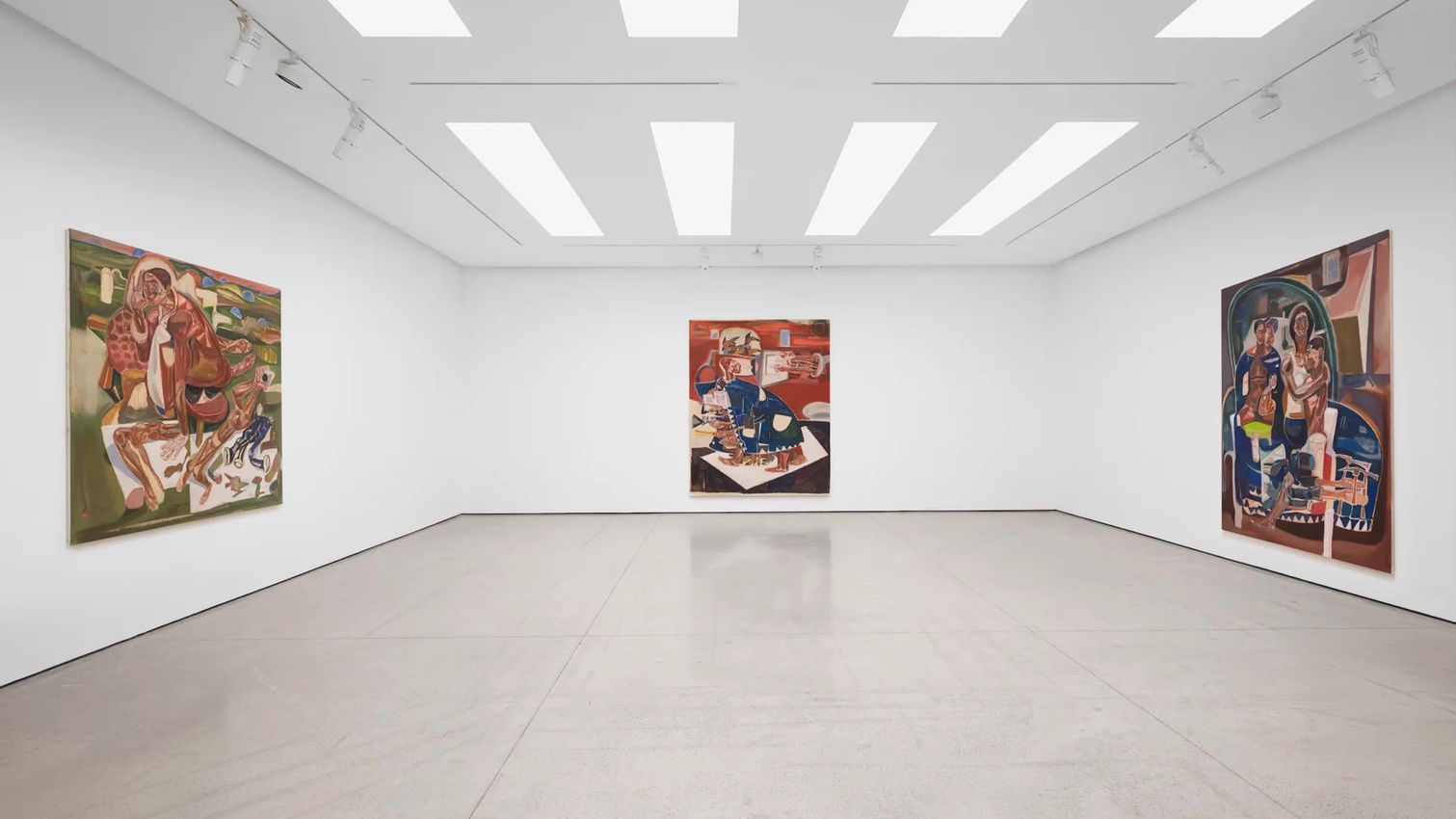
White Cube Hong Kong is pleased to present ‘Deep Dive’, a solo exhibition by Tunji Adeniyi-Jones and the artist’s first in the region. For this, the artist has created a new suite of paintings and delicate lithographs that address historical subjects – such as mythology, religion and the spectacle of ceremony – through the lens of the contemporary diaspora.
As a British Nigerian living and working in Brooklyn, New York, his influences are wide ranging, and comprise African, American and European references. Grounded though the works are in the myth and culture of his own Yoruba heritage, Adeniyi-Jones also looks to the Black-American culture of his immediate surroundings, embracing both the similarities and differences between this lineage and his own. Executed in oil on canvas or in acrylic on board, the paintings feature near life-size figures in vibrant colours set against a background of foliage, making reference to the intricate patterns of the 19th-century Arts and Crafts movement, specifically the tile designs of William de Morgan. With its roots in Modernism, the movement aimed to combine human ingenuity with natural form to advance a utopian vision. At the same time, the artist’s use of foliage as motif is an allusion to West African literature, wherein the jungle often appears as a symbol of exploration, transition and potential.
Rotating the canvas while working allows the artist to create a space with indeterminate horizon line and orientation; it is within this space that the solid ground becomes destabilised, its gravitational pull undermined. Enabling Adeniyi-Jones to choreograph the dance between bodies and natural forms also is a conception of the body as both a specific and open-ended entity. This idea is realised through his use of the silhouette, a reference to American artist Aaron Douglas (1899–1979) – who used silhouettes in his work as an expression of multiplicity – as well as the effortless fluidity of paintings by Nigerian Modernist Ben Enwonwu (1917–94). As Adeniyi-Jones says: ‘The silhouette increasingly creates an open space for any viewer to assume the position of what they’re seeing.’
Confined within a shallow picture plane, the gender-fluid bodies are muscular to the point of appearing stylised, each toned limb, torso and head emphatically delineated. Working against the flattened pictorial space championed by abstraction, figures dip and dive, emerging and retreating from their backgrounds, the sinuous outlines of leaves subtly echoing the curves of the body in endless rhythmic iteration. The paintings result from a drawing-centred process (in which lines can be overdrawn as much as five times in a single work), as such, the figures are outlined with thin black paint. The eyes, the last element to be added, punctuate each composition, their directional gaze lending agency and autonomy to each of the figures as well as serving to draw the viewer’s gaze into and around the complex pictorial space.
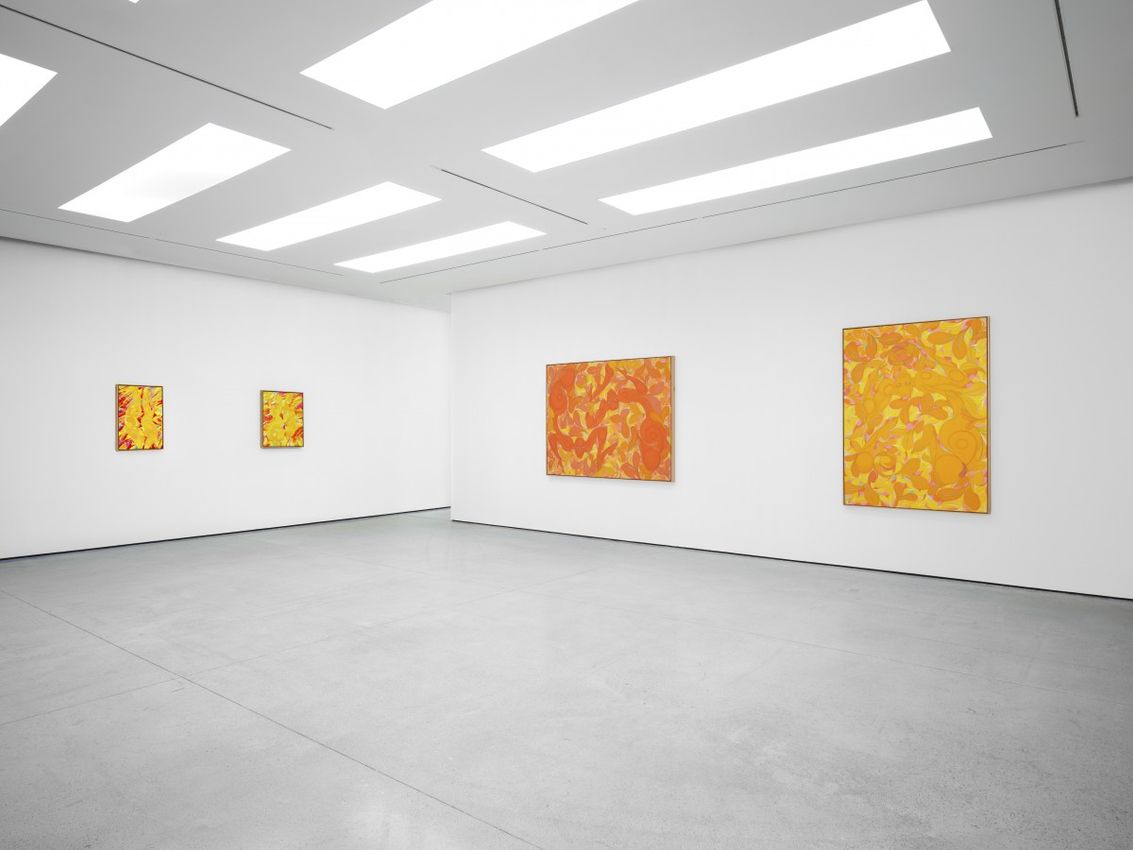
‘I often try to place my figures in environments that are complementary’ he has stated. ‘So, most of my compositions consist of a body situated in a large field of colour. I like to use this colour space to emphasise motion flowing in and around the figure.’ Harnessing the potential of colour, what the artist terms ‘chromatic space’, the saturated, monochromatic character of the paintings is activated by the interplay of textures made possible by the applications of gesso, matte medium and varnish. The two groups of works in the ground and first floor galleries are installed against similarly-hued exhibition walls, creating for the viewer an enveloping, emotional landscape.
Echoing the dynamism of the larger canvases, a new body of lithographs extend the themes of the paintings at a personal scale. Printmaking forms a generative part of the artist’s practice; one that is collaborative and, as he sees it, less predictable, and which connects him to a lineage of Nigerian artists including Bruce Onobrakpeya, Demas Nwoko and Yusuf Grillo. The series of six new ‘Midnight Voices’ lithographs directly inform the new paintings, featuring silhouetted bodies lying in repose against complex patterns of foliage and flora. Possessing the quality of a looser touch of hand, they offer an ‘intimate insight into the thought process behind my larger works’.
Tunji Adeniyi-Jones’s paintings emerge from a perspective of what the artist describes as ‘cultural addition, combination and collaboration’. Born and educated in the UK and now living and working in the USA, his practice is inspired by the ancient history of West Africa and its attendant mythology, and by his Yoruba heritage.


An international art powerhouse, White Cube was established in 1993 in London by art dealer Jay Jopling. In its space on Duke Street, it served as the early exhibition venue for many now internationally acclaimed British artists, including Tracey Emin, Gilbert & George, Rachel Kneebone and Antony Gormley, who still show with the gallery today.

A respected voice in contemporary art discourse.
Focusing on ambitious storytelling and insightful art-world commentary. Ocula Magazine publishes in-depth interviews, critical essays and timely analysis on the artists, exhibitions and ideas driving the global art world.
Learn more about Ocula Magazine
Showcasing the best of the art world.
Ocula partners with galleries from around the world to highlight their artists, artworks and exhibitions. Gallery membership is by application and invitation, with each member vetted by an independent panel.
Learn more about Ocula Membership

Specialises in the sale of major artworks.
Led by a team with deep ties to the world’s leading auction houses, galleries and collectors. Ocula’s advisory team offers bespoke services to high-net-worth clients from around the world who are looking to acquire the best of contemporary and modern art.
Learn more about our team and services