





PATRICK CAULFIELD
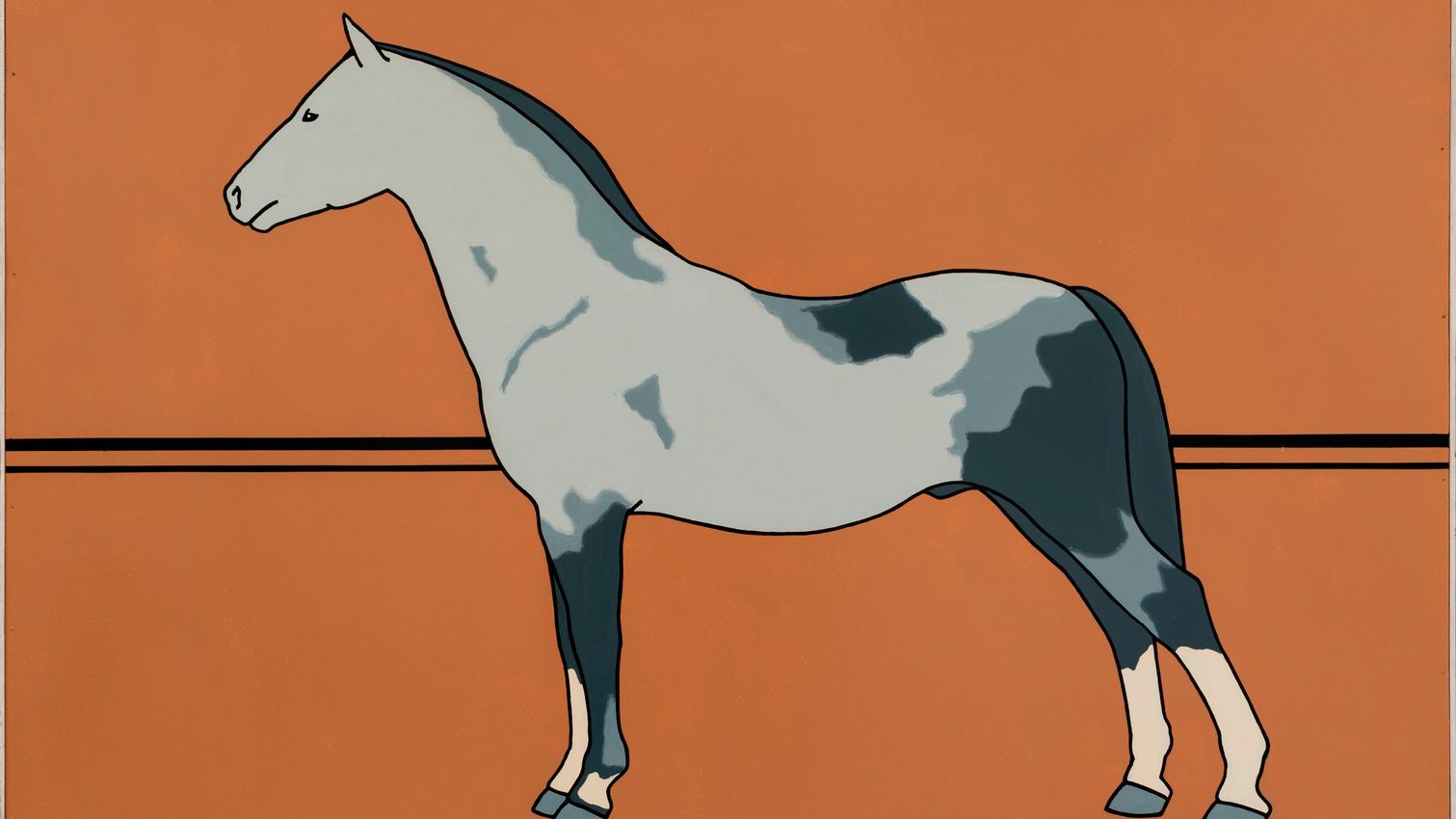
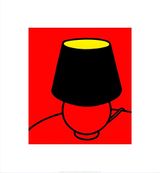
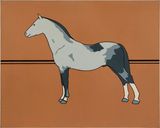
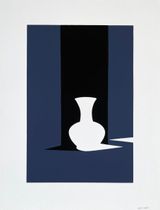
1936-2005, United KingdomPatrick Caulfield (b. 1936, London, England; d. 2005, London, England) is a British painter and printmaker known for his pared down, still lifes and interiors, carefully composed with thick black lines and even fields of colour. Human figures are rarely depicted, but tell-tale signs of human presence abound in Caulfield’s enigmatic world.
Often, it is impossible to resolve perspective in his painting, an effect mirrored by the depiction of hidden spaces: jugs, pots, windows and blind corners. At the Royal College of Art, Caulfield was a contemporary of R.B. Kitaj, David Hockney, Allen Jones, Derek Boshier, and Peter Phillips. Although Caulfield came to be associated with British Pop art after participating in the Whitechapel Gallery’s The New Generation exhibition in 1964, he saw himself as a formalist painter working in the tradition of Braque, Gris and Matisse.
Admired by fellow artists throughout his time, Caulfield worked privately and painstakingly until each picture was fully resolved, leaving nothing to chance. In his later work, Caulfield introduced elements of photorealism and trompe-l’oeil to further undermine the illusionary power painting.
Caulfield studied at Chelsea School of Art (1956–1960) and the Royal College of Art (1960–1963), subsequently teaching at Chelsea from 1963 until 1971. His first solo exhibition was at the Robert Fraser Gallery, London in 1965. He took part in many solo and group exhibitions both in Britain and internationally. Important group exhibitions in which he participated include the Whitechapel Art Gallery, London, 1964 and the Royal Academy of Arts, London, 1987.
In 1991 Caulfield took part in Pop Art, again at the Royal Academy of Arts, which toured to Museum Ludwig, Cologne and Centro de Arte Reina Sofia, Madrid. Retrospectives of his work have been held at the Walker Art Gallery, Liverpool, touring to the Tate Gallery, London, 1981, and at the Serpentine Gallery, London, 1992–1993. A major retrospective of Caulfield’s paintings, organised by the British Council, was shown at the Hayward Gallery, London, in 1999, and subsequently toured to the Musée National d’Histoire et d’Art, Luxembourg, the Calouste Gulbenkian Foundation, Lisbon, and the Yale Center for British Art, New Haven, Connecticut, 1999–2000. In 1987, Caulfield was nominated for the Turner Prize for his show The Artists’s Eye at the National Gallery in London, and in 1996 he was made a CBE. In 2013, Tate Britain hosted a major survey exhibition of Caulfield’s work.
Text courtesy Waddington Custot.






Explore Patrick Caulfield's Exhibitions



Explore and Follow Artists Shaping Contemporary Art
A respected voice in contemporary art discourse.
Focusing on ambitious storytelling and insightful art-world commentary. Ocula Magazine publishes in-depth interviews, critical essays and timely analysis on the artists, exhibitions and ideas driving the global art world.
Learn more about Ocula Magazine
Showcasing the best of the art world.
Ocula partners with galleries from around the world to highlight their artists, artworks and exhibitions. Gallery membership is by application and invitation, with each member vetted by an independent panel.
Learn more about Ocula Membership
Specialises in the sale of major artworks.
Led by a team with deep ties to the world’s leading auction houses, galleries and collectors. Ocula’s advisory team offers bespoke services to high-net-worth clients from around the world who are looking to acquire the best of contemporary and modern art.
Learn more about our team and services