






ALEXANDER CALDER
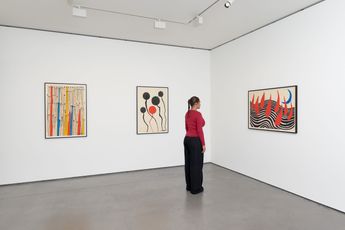
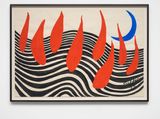
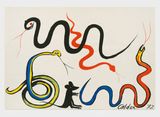
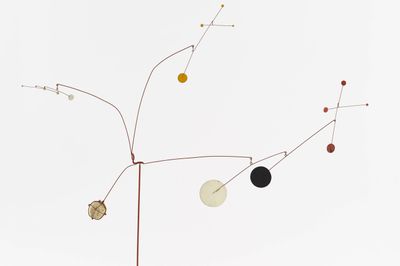
1898-1976, United StatesAlexander Calder is an iconic American sculptor whose career, spanning much of the 20th century and across continents is said to have profoundly changed the course of modern art.
Early Years
Alexander “Sandy” Calder, was born in 1898 in Lawton, Pennsylvania, to a family of celebrated, if more classically trained artists. Calder initially studied mechanical engineering at Stevens Institute of Technology in New Jersey, graduating in 1919. This mechanical and mathematical knowledge is reflected in the creative complexity of his seminal works.
It was only years later that Calder pursued an artistic career, enrolling at the Arts Student League in New York in 1923 and working as an illustrator for National Police Gazette. In 1926 he moved to Paris to further his artistic pursuits and would later become friendly with artists such as Joan Miró, Fernand Léger, Marcel Duchamp, Piet Mondrian and the influential Abstraction-Création group.
Calder began by developing a new method of sculpting that involved bending and twisting wire, which enabled him to essentially ‘draw’ three-dimensional figures in space. Initially, these took figurative forms. One of the most beloved early Alexander Calder artworks, Calder’s Circus (1926–1931), which he made in Paris, featured a plethora of items and articulated characters formed from twisted wire and other materials. The kinetic element of this work would inform Alexander Calder’s sculptures in the years to come.
Alexander Calder Artworks
[Artworks Content]
Public Commissions
Calder’s legacy in the realm of public sculpture spans multiple continents. Alexander Calder sculptures can be found in public spaces ranging from Sydney, Australia, to Carracas in Venezuela and Jerusalem.
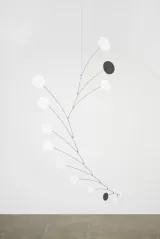
Major monumental commissions include .125 (1957), a suspended in Idlewild Airport (now John F. Kennedy International), Spirale, made for Maison de l’UNESCO in Paris (1958); El Sol Rojo , installed outside the Aztec Stadium in Mexico City for the 1968 Olympic Games; and the stabile Flamingo (1973), made for the General Services Administration in Chicago.
Website and Instagram
The Calder Foundation website can be found here and the Calder Foundation’s Instagram can be found here.
Courtesy Bailly Gallery

Recently Exhibited


Exhibiting Elsewhere

Works Elsewhere






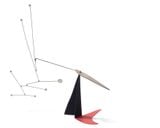








Alexander Calder in Ocula Magazine






Explore and Follow Artists Shaping Contemporary Art
A respected voice in contemporary art discourse.
Focusing on ambitious storytelling and insightful art-world commentary. Ocula Magazine publishes in-depth interviews, critical essays and timely analysis on the artists, exhibitions and ideas driving the global art world.
Learn more about Ocula Magazine
Showcasing the best of the art world.
Ocula partners with galleries from around the world to highlight their artists, artworks and exhibitions. Gallery membership is by application and invitation, with each member vetted by an independent panel.
Learn more about Ocula Membership
Specialises in the sale of major artworks.
Led by a team with deep ties to the world’s leading auction houses, galleries and collectors. Ocula’s advisory team offers bespoke services to high-net-worth clients from around the world who are looking to acquire the best of contemporary and modern art.
Learn more about our team and services