





DAVID ALTMEJD
b. 1974, CanadaDavid Altmejd’s work is a unique and heady mix of science and magic, science fiction and gothic romanticism: a post-apocalyptic vision which is at the same time essentially optimistic, containing as it always does the potential for regeneration, evolution and invention.
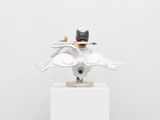
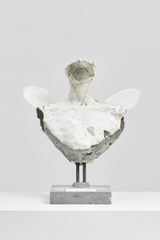
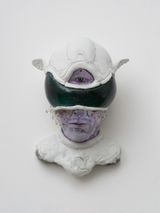
‘A perfect object for me’, the artist has said, ‘is something that is extremely seductive and extremely repulsive at the same time’. Decay exists in balance with regeneration, the exquisite in tandem with the grotesque. The sculpted heads that have been Altmejd’s recent focus provoke that shiver of the uncanny lifelike sculpture tends to induce, but skilfully realistic features are interspersed with crude expressionism, gobbets of raw matter or hanks of fur. They have a hallucinatory quality–vivid and startling. One head might sprout another, inverted, so that they they share a pair of eyes, or a face is split into a trio of profiles and half-a-dozen eyes, as if refracted by a kaleidoscope. In others the faces are gone, as if they have been scooped out, but the gaping wounds reveal cavities of dazzling crystal or the inside of a hollowed-out fruit, as if to collapse the categories of animal, vegetable and mineral. There is an immediate sensuality in the artist’s juxtaposition of finely-wrought realism with crude gesture; the proximity of crystals and delicate gold chains with fur and abject matter suggesting ever-present decay.
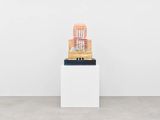
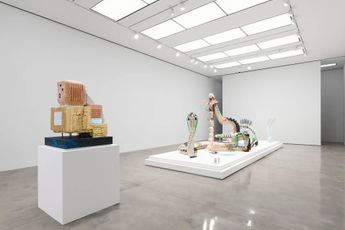
In counter-balance to the aesthetic of profusion is a sculptural impulse to containment and order, evinced in gridded forms and orthogonal mirrored structures recalling Sol Lewitt or Lucas Samaras. Some of Altmejd’s best-known works are his vast, labyrinthine vitrines built of Plexiglas, and often with mirrored elements. They play on the aesthetics of design and display as well as minimalism, but these structures are not simply a means to contain or protect the elements housed within. Rather, the entire structure is an organism or a machine, making visible the processes of growth and decay, generation and destruction that take place inside it. Movement is frozen, but sculptural elements are animated through repetition and incremental change, like the stuttering frames of stop-motion film.
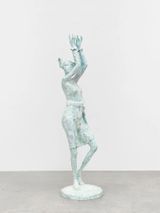
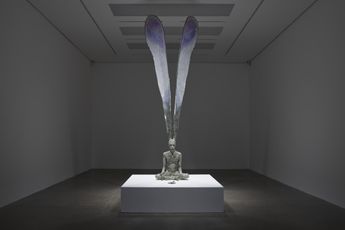
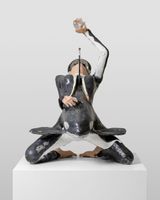
Altmejd described himself early in his career as a ‘process artist’. His works not only reveal the process of their making, but suggest that those processes have simply been paused in their unfolding. His monochrome relief panels are austere in comparison to the heads, focusing our attention on the plaster-like material and the actions wrought on it−where it has fallen in wet splats, where a brittle, chalky surface is scratched or fractured, where hands have gouged and clawed. Hands themselves, in cast form, appear and multiply in some of the sculptures, fostering the illusion that the works create themselves. Monumental figures, such as the Bodybuilders and the Watchers, are similarly engaged in their own making or unmaking, sprouting hands that clutch and mould the very substance of their bodies.
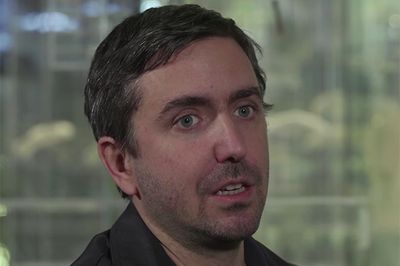
David Altmejd was born in Montreal in 1974 and lives and works in Los Angeles. He studied at the University of Quebec in Montreal and graduated with an MFA from Columbia University, New York in 2001. His numerous international exhibitions include a major survey exhibition, Flux, which travelled from Musée d’Art Moderne de la Ville de Paris to the MUDAM in Luxembourg and the Musée d’Art Contemporain de Montréal, Canada (2014-15). In 2007 he represented Canada at the 52nd Venice Biennale with his installation The Index, and he was included in the Istanbul and Whitney Biennials in 2003 and 2004 respectively.
Courtesy White Cube

Works at White Cube




Recently Exhibited



Works Elsewhere









Explore and Follow Artists Shaping Contemporary Art
A respected voice in contemporary art discourse.
Focusing on ambitious storytelling and insightful art-world commentary. Ocula Magazine publishes in-depth interviews, critical essays and timely analysis on the artists, exhibitions and ideas driving the global art world.
Learn more about Ocula Magazine
Showcasing the best of the art world.
Ocula partners with galleries from around the world to highlight their artists, artworks and exhibitions. Gallery membership is by application and invitation, with each member vetted by an independent panel.
Learn more about Ocula Membership
Specialises in the sale of major artworks.
Led by a team with deep ties to the world’s leading auction houses, galleries and collectors. Ocula’s advisory team offers bespoke services to high-net-worth clients from around the world who are looking to acquire the best of contemporary and modern art.
Learn more about our team and services