





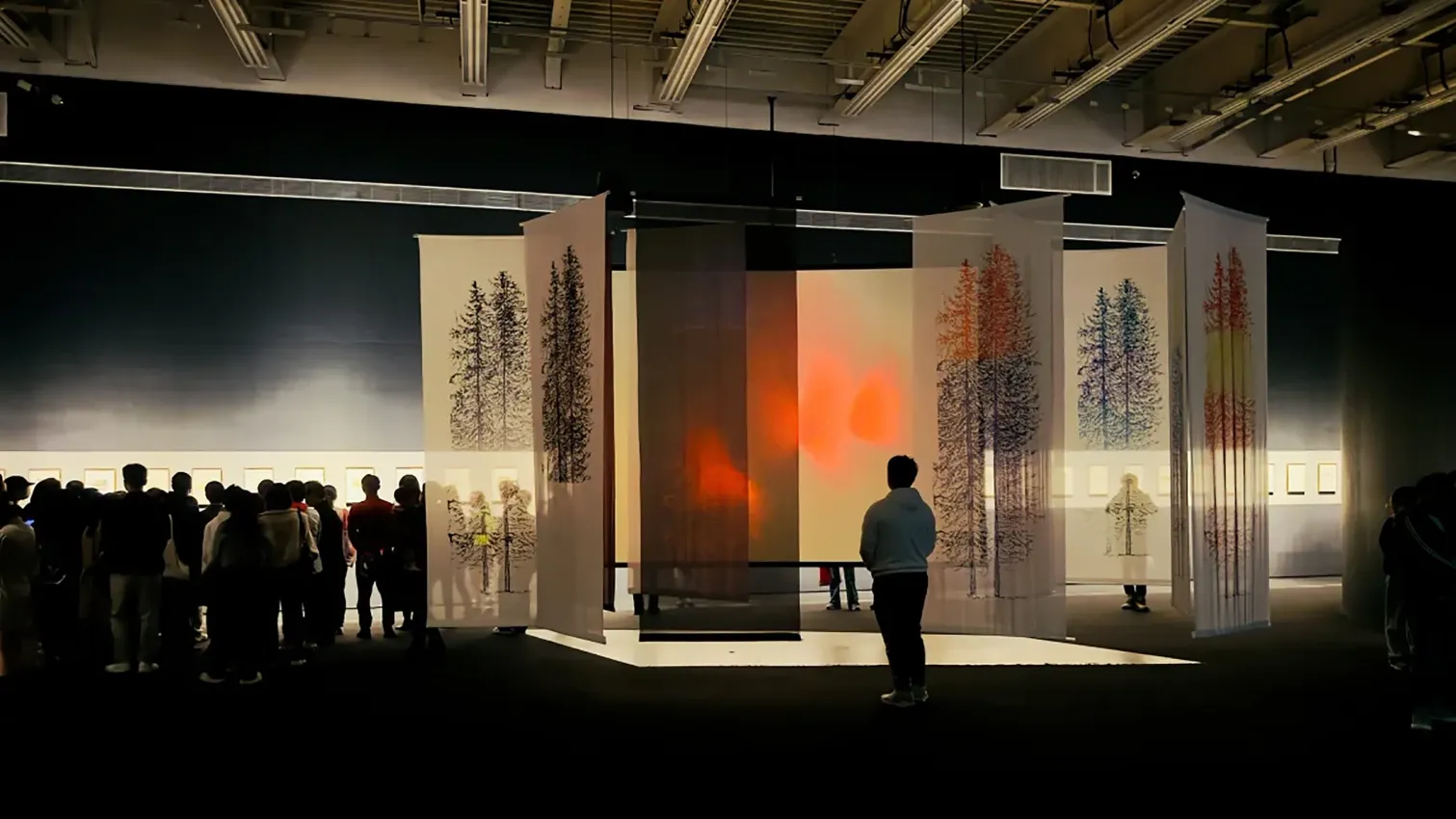
ELDA CERRATO
1930-2023, ItalyElda Cerrato was a visionary Italian-born Argentine artist whose six-decade career forged new paths in contemporary art through a unique synthesis of abstraction, science, mysticism, and political engagement. In 2022, Cerrato was awarded the prestigious Premio Velázquez de Artes Plásticas.
Early Years
Born in Asti, Italy, Cerrato’s life was shaped by migration: her family moved to São Paulo, Brazil, in 1937, then to Buenos Aires in 1940, and later to Caracas, Venezuela. These displacements—and the shifting political and cultural landscapes she encountered—deeply informed her art.
Cerrato initially studied biochemistry at the University of Buenos Aires, a background that sparked her lifelong fascination with the intersections of art, science, and spiritual inquiry. In the early 1960s, she and her partner, composer Luis Zubillaga, immersed themselves in the teachings of Gurdjieff and joined avant-garde circles in Caracas, including El Techo de la Ballena. Cerrato returned to Buenos Aires in 1964, where she lived, worked, and taught for nearly 40 years, shaping generations of artists through her academic roles at the Universidad de Buenos Aires and the Universidad Central de Venezuela.
Elda Cerrato Artworks
Cerrato’s contemporary art practice is defined by its cross-disciplinary approach, integrating painting, drawing, installation, film, and performance. Her visual language, rooted in abstraction and surrealism, is shaped by her studies in science, her engagement with esoteric philosophies, and her response to the political realities of Latin America.
Abstraction, Science, and the Cosmos
Cerrato’s earliest works in Caracas in the 1960s were abstract biomorphic paintings, soon followed by her ‘cosmovision’ series after returning to Argentina. These paintings, such as Maternidad (1971) and the ‘Beta Being’ series (1967–1973), merge geometric forms, biological motifs, and cosmic references, drawing on Surrealist poetry, science fiction, and ancestral knowledge. Her art often functions as a diagram of the invisible, mapping connections between the unconscious, the cosmos, and lived experience.
Political Engagement and Conceptual Art
The social and political upheavals of the 1960s and 1970s in Argentina prompted Cerrato to create some of her most iconic works. Her ‘Maps and Multitudes’ series pairs maps of the Americas with images of ordinary people, addressing Latin American identity, class conflict, and the struggle for sovereignty. Through conceptual strategies and the visual language of mass media, Cerrato’s art became a critical testimony to the region’s history, as seen in works featuring crowds, demonstrations, and Peronist symbols.
Esoteric Abstraction and Recapitulation
In the 1980s and 1990s, Cerrato returned to esoteric abstraction, working at a larger scale and with an expanded sociopolitical vision. Her paintings from this period are layered cartographies of ancestral cosmologies, myths, and memories. In the last two decades of her life, Cerrato developed the ‘Recapitulation Paintings’, revisiting and layering symbols from her own lexicon against fields of abstraction, reflecting on memory, transformation, and the passage of time.
Public Commissions
- Site-specific installations and public interventions in Argentina and Venezuela
Awards and Accolades
- Premio Nacional a la Trayectoria Artística, Argentina (2019)
- Premio Velázquez de Artes Plásticas, Spain (2022)
- Multiple awards at international biennials
Exhibitions
Elda Cerrato has been the subject of both solo and group exhibitions at important institutions and galleries. Below is a selection.
Solo Exhibitions
- El día maravilloso de los pueblos, Museo de Arte Moderno de Buenos Aires (2021)
- Memory in Edges, Museo de Bellas Artes de Caracas (1986)
- The Eye and the Fissure, Arte Nuevo Gallery, Buenos Aires (1989)
- Picturae Lapidis Volantis, Buenos Aires (1990)
- ArteUna, Buenos Aires (1978)
Group Exhibitions
- 3rd Jinan International Biennale, China (2025)
- Biennale Arte 2024, Venice Biennale, Italy (2024)
- 35th Bienal de São Paulo, Brazil (2023)
- 14th Shanghai Biennale, China (2023)
Cerrato’s works are held in major collections including Museo Reina Sofía (Madrid), Museo Nacional de Bellas Artes (Argentina), Museo de Arte Latinoamericano de Buenos Aires, Museo de Arte Moderno de Buenos Aires, Museo de Bellas Artes de Caracas, Museo Tamayo (Mexico City), and the Art Museum of the Americas (Washington, D.C.).
Elda Cerrato FAQs
Where can I see Elda Cerrato’s art?
Cerrato’s works are in the collections of Museo Reina Sofía in Madrid, Museo Nacional de Bellas Artes and Museo de Arte Moderno in Buenos Aires, Museo Tamayo in Mexico City, Museo de Bellas Artes de Caracas, and the Art Museum of the Americas in Washington, D.C.
What themes did Elda Cerrato explore?
Cerrato’s art explored the intersections of art, science, spirituality, and politics, often investigating the mysteries of the cosmos, the unconscious, and the realities of Latin American history.
Was Elda Cerrato involved in teaching?
Yes, she was a professor and researcher at the Universidad de Buenos Aires and the Universidad Central de Venezuela, and influenced generations of artists and scholars.
What awards did Elda Cerrato receive?
She received the Premio Velázquez de Artes Plásticas in 2022, the Premio Nacional a la Trayectoria Artística in 2019, and multiple awards at international biennials.
Ocula | 2025






Explore and Follow Artists Shaping Contemporary Art
A respected voice in contemporary art discourse.
Focusing on ambitious storytelling and insightful art-world commentary. Ocula Magazine publishes in-depth interviews, critical essays and timely analysis on the artists, exhibitions and ideas driving the global art world.
Learn more about Ocula Magazine
Showcasing the best of the art world.
Ocula partners with galleries from around the world to highlight their artists, artworks and exhibitions. Gallery membership is by application and invitation, with each member vetted by an independent panel.
Learn more about Ocula Membership
Specialises in the sale of major artworks.
Led by a team with deep ties to the world’s leading auction houses, galleries and collectors. Ocula’s advisory team offers bespoke services to high-net-worth clients from around the world who are looking to acquire the best of contemporary and modern art.
Learn more about our team and services