





KARL MAUGHAN
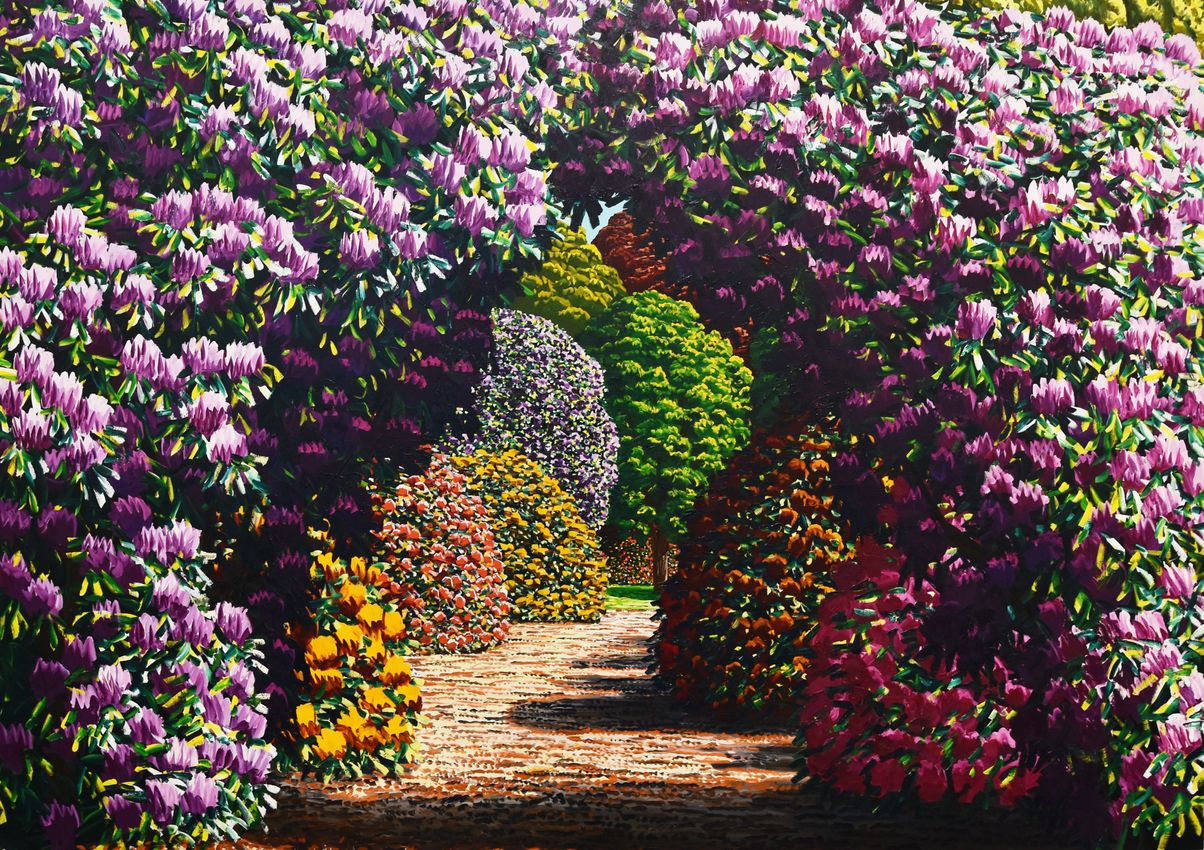
b. 1964, New ZealandOver a career spanning three decades, New Zealand artist Karl Maughan has painted fantastical hyper-real garden-scapes, lush with floral arrays and both neat and unkempt shrubbery. Alongside the formal qualities of flora, his works explore the cultural space of the garden and the human desire to tame and manage the wilderness.
Being raised in Manawatu by avid gardening parents perhaps influenced Maughan’s choice of floral subject-matter early on. Nature, as seen in the garden (predominantly larger public gardens), has been his exclusive muse. Attempting to paint and sketch en plein air in his early career, but faced with the practical challenges of an outdoors practice—particularly following a shift to working from a studio in London’s East End—the artist subsequently moved to working from photographs.
Having built up an archive of garden imagery captured on film, the artist brings together different elements to create composite images, playing with and reconfiguring colours, lighting, and perspective. These are garden fantasies—imagined arcadias for the viewer’s wonderment. Sometimes they are tidy, manicured places with man-made paths, lined with neatly arranged plantings. Others, such as Vinegar Hill (2018) or Riverena (2010) can be wildernesses where the path forward is obscured. However, always absent is the sense of natural decay or rotting vegetation; the artist seems to take joy in the viewer engaging with and envisioning themselves within peaceful, beautiful spaces.
Maughan’s large-scale oil paintings are rich canvases filled with vivid colours and an array of textures. Painting in a fashion that is simultaneously hyper-real and expressionistic, the artist makes small, painterly brush strokes—akin to Monet or Seurat—that reveal the artist’s hand up close but appear near-photorealistic from afar. Like those Impressionist forbears, Maughan’s greater concern seems to be with colour and light than an accurate rendition of his subjects. Works such as Ngaio Road (2015)—a snapshot segment of flora without a broader location context beyond the title—read like abstract canvases exploring patterns of light, colour, and texture in nature. To that end his works are becoming more vivid in colour and form, losing some of the realism created by sharp white lighting in favour of softer colour contrasts and quick brushwork that shows a greater affinity with the likes of fellow New Zealander Rita Angus’ regionalist paintings from the 1940s and 1950s.
Maughan studied at Elam School of Fine Arts in Auckland, completing his Master of Fine Arts in 1987. Working in London between 1994 and 2005, he was a finalist in the biennial 1997 John Moores Paintings Prize at Liverpool’s Walker Art Gallery and his works were acquired by the Arts Council of England and the Charles Saatchi collection. The artist’s works also feature in prominent public and private New Zealand collections including The Suter Art Gallery Te Aratoi o Whakatū, Nelson; Christchurch Art Gallery Te Puna o Waiwhetū; and Museum of New Zealand Te Papa Tongarewa.
Michael Irwin | Ocula | 2019

Explore Karl Maughan's Exhibitions


Explore and Follow Artists Shaping Contemporary Art
A respected voice in contemporary art discourse.
Focusing on ambitious storytelling and insightful art-world commentary. Ocula Magazine publishes in-depth interviews, critical essays and timely analysis on the artists, exhibitions and ideas driving the global art world.
Learn more about Ocula Magazine
Showcasing the best of the art world.
Ocula partners with galleries from around the world to highlight their artists, artworks and exhibitions. Gallery membership is by application and invitation, with each member vetted by an independent panel.
Learn more about Ocula Membership
Specialises in the sale of major artworks.
Led by a team with deep ties to the world’s leading auction houses, galleries and collectors. Ocula’s advisory team offers bespoke services to high-net-worth clients from around the world who are looking to acquire the best of contemporary and modern art.
Learn more about our team and services