





KELLY AKASHI
b. 1983, United StatesExploring themes of permanence and human concepts of duration, Los Angeles-based sculptor Kelly Akashi works in bronze, glass and stone, although continually studies new methods and techniques, from glass-blowing to stone carving and candle-making. Her work references the Japanese concept of mono no aware, “the pathos of things”.
Early Years
Born in Los Angeles in 1983 to Japanese American parents, Kelly Akashi was inspired by Nan Goldin and trained in photography at Otis College of Art and Design. Graduating in 2006 with a BFA, she told Art Basel in 2023 that “Everyone was so excited about the potential of digital that there was an assumption that darkrooms would be dead within 10 years.” Briefly taking up painting, she then transferred her artistic practice to sculpture, enjoying the tactile experience, which she found reminiscent of making a negative into a photographic print. She studied at Städelschule in Frankfurt in 2010, then gained her MFA at the University of Southern California in 2014.
Kelly Akashi: Artworks
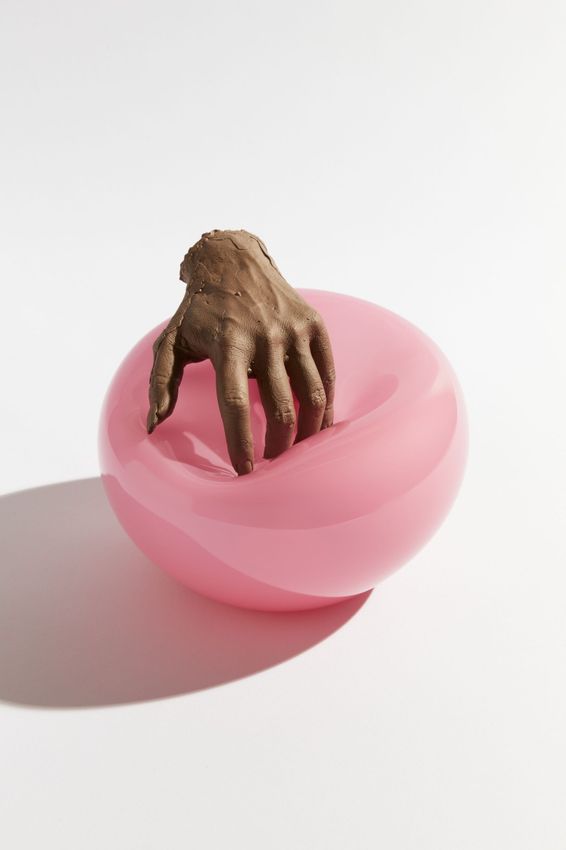
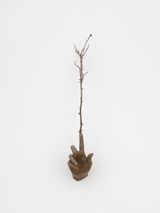
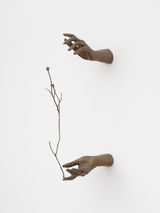
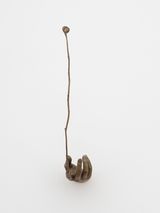
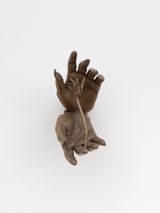
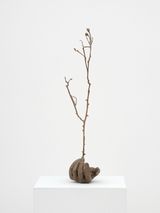
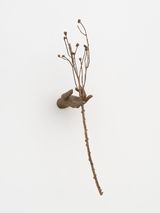
Kelly Akashi marries concept and process in her sculptural practice, which focuses on the impermanence of the natural world. Hands are a recurring motif in her work, suggesting the passing of time via ageing flesh or lengthening fingernails. Her interest in time crosses into studies of the natural world, for example using shells, flowers and rocks as points of departure for considering questions of the idea of existence itself.
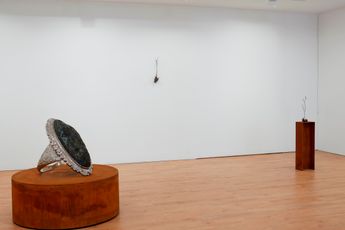
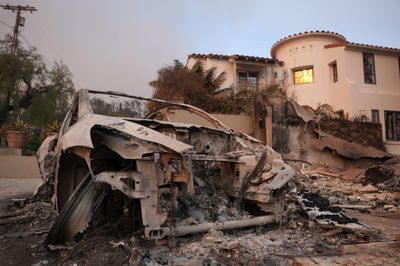
- Akashi lost her home and studio in the 2025 LA wildfires and in 2026’s Heirloom exhibition she expanded her devastation at the destruction of key pillars of her existence into a wider examination of grief and loss. The outsized Monument (Heirloom) (2026) is a large-scale re-creation of her grandmother’s ring, which did not survive the blaze. Relying on memory and zooming in on her fingers in photographs for visual inspiration, she chose to make the reproduced ring giant because of its huge personal significance.
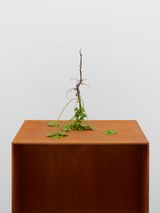
- In the same exhibition, Akashi used glass to add elements of fragility to the artworks. A glass version of the mallow plant, complete with root system, was symbolic of the emergence of biodiversity following the quelling of the fires.
- Botanical and natural themes of impermanence are also evident in Akashi’s earlier work, such as 2024’s Time Twine, a suspended sculpture featuring blown-glass flowers inspired by Mexican marigolds (the flowers of Día de los Muertos), bringing together memory and fragility.
Kelly Akashi: Select Public Commissions
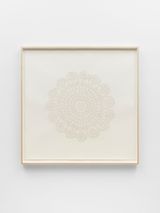
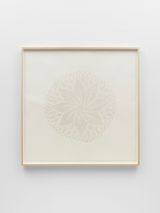
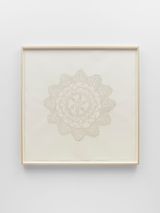
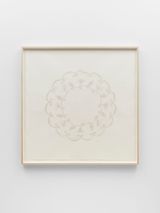
- As part of the Whitney Biennial 2026, Kelly Akashi was commissioned to create a site-specific installation on the museum’s fifth-floor outdoor gallery. Following the loss of her home and 2tdio in the 2025 LA wildfires, she produced Monument (Altadena), a glass-brick recreation of her chimney, the only part of her home left standing. This stood alongside Inheritance (Distressed), a Cor-Ten steel reproduction of one of her grandmother’s doilies (lost in the fire) and an examination of how female artists consider family histories.
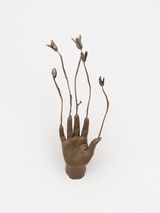
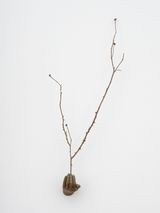
- The international terminal at New York’s John F Kennedy Airport, scheduled to open between 2026 and 2030, will feature a 5.5-metre (18-foot) sculpture by Kelly Akashi, one of seven site-specific artworks by international artists celebrating the history, culture and diversity of New York and the borough of Queens. Migration of Flora will depict native flowers rising from a bronze hand, which symbolise New York’s strength, togetherness and international influence.
Kelly Akashi: Select Exhibitions
Select Solo Exhibitions
- Kelly Akashi: Heirloom, Lisson Gallery, New York City (2026)
- Kelly Akashi, Lisson Gallery, Los Angeles (2025)
- Converging Figures Fondazione Furla and The Galleria d_Arte Moderna, Milan (2024)
- Encounters, Henry Art Gallery, Seattle (2023)
- Formations, Museum of Contemporary Art, San Diego and Frye Art Museum, Seattle (2023)
- Infinite Body, Tanya Bonakdar Gallery, New York City (2023)
- Life Forms, Barbati Gallery, Venice, (2022)
- Faultline, François Ghebaly, Los Angeles (2021)
- Cultivator, Outdoor Sculpture Project, Francois Ghebaly, Los Angeles (2021)
- Mood Organ, Tanya Bonakdar Gallery, New York City (2020)
- Cultivator, Aspen Crown Commons, Aspen Art Museum, Aspen (2020)
- Residency exhibition, Headlands Center for the Arts, Sausalito (2019)
- a thing among things, Arch, Athens (2019)
- Figure Shifter, François Ghebaly, Los Angeles (2019)
- Shadow Film, François Ghebaly, Los Angeles (2018)
- Long Exposure, SculptureCenter, Queens, New York City (2017)
- Being as a Thing, François Ghebaly, Los Angeles (2016)
- &, Tomorrow Gallery, New York City (2015)
- HxVxT, Between Arrival & Departure, Düsseldorf (2015)
- SSOftllY, Michael Jon Gallery, Miami (2015)
- Mirror Image, MFA thesis show, USC, Los Angeles (2014)
- Hit Me Lightning, Chin_s Push, Highland Park (2013)
- Silver Strand, 3001 Gallery at USC, Los Angeles (2011)
- w’o mhnwa e mx mjgg nxc dxojm twae wok xhmam tjhj, Beige Cube, Frankfurt (2010)
Select Group Exhibitions
- An Incomplete Survey on Portraiture. Vol 1 Galerie Hussenot, Paris (2026)
- Whitney Biennial 2026 Whitney Museum of American Art, New York (2026)
- Roppongi Crossing 2025: What Passes Is Time. We Are Eternal., Mori Art Museum, Tokyo (2025)
- Woman in a Rowboat Olivia Foundation, Mexico City (2025)
- On Ma, Galeria Pedro Cera, Lisbon (2024)
- Eyes Unspoken Adler Beatty, New York City (2024)
- I’ve got a feeling: The five senses in contemporary art, Musée des Beaux-Arts d_’ngers, Angers (2023)
- Imperfect Paradise, Barbati Gallery, Venice (2023)
- Durian on the Skin, François Ghebaly, Los Angeles (2022)
- Four Flags Kunst in de Heilige Driehoek, Oosterhout (2021)
- The Inconstant World, ICA LA, Los Angeles (2021)
- Winterfest, Aspen Art Museum, Aspen (2020)
- Eureka! Creativity in California: Artists of the Golden State at the Governor’s Mansion, Sacramento (2020)
- Bad Peach, François Ghebaly, Los Angeles (2019)
- Seeing Believing Having Holding, i8 Gallery, Reykjavik (2018)
- 99 Cents or Less, Museum of Contemporary Art, Detroit (2017)
- Streams of Warm Impermanence, David Roberts Art Foundation, London (2016)
- And There is an End II, James Harris Gallery, Seattle (2015)
Further Reading
- Kelly Akashi’s Instagram
- Artist profile page at Lisson Gallery
- 2026 interview from The New York Times
- Ocula magazine interview from 2024
- Vanity Fair interview from 2026
Kelly Akashi FAQs
What happened to Kelly Akashi in the Los Angeles wildfires?
Kelly Akashi lost her home and studio in the Eaton Fire of January 2025. She and her cat, Turnip, were able to evacuate but she suffered devastating losses. After the fire, she was able to recover some bronze sculptures that survived the heat, which she displayed in a show at Lisson Gallery in LA.
Why did Kelly Akashi make Witness in 2022?
After the Second World War attack on Pearl Harbour, the US government f incarcerated around 120,000 Japanese Americans in 10 concentration camps throughout the United States. Kelly Akashi’s black-and-white photography series Witness (2022) documents the former site of a Japanese internment camp in Poston, Arizona, where her grandparents, her father and his siblings were interne. Akashi’s father died when she was 21 and rarely talked about this part of his life. Akashi told Ocula in 2026: “There are things that family members don’t tell you, and you just wonder, or they say: ‘You don’t want to know.’”
What materials and techniques does Kelly Akashi use?
Craft and labour are key tenets of Kelly Akashi’s practice: glass-blowing, stone carving and bronze casting. Many materials she uses (including borosilicate glass and silicone) transform under hot conditions from liquid to solid, allowing her work to become a record of the changes in their properties.
Ocula














Explore Kelly Akashi's Exhibitions







Explore and Follow Artists Shaping Contemporary Art
A respected voice in contemporary art discourse.
Focusing on ambitious storytelling and insightful art-world commentary. Ocula Magazine publishes in-depth interviews, critical essays and timely analysis on the artists, exhibitions and ideas driving the global art world.
Learn more about Ocula Magazine
Showcasing the best of the art world.
Ocula partners with galleries from around the world to highlight their artists, artworks and exhibitions. Gallery membership is by application and invitation, with each member vetted by an independent panel.
Learn more about Ocula Membership
Specialises in the sale of major artworks.
Led by a team with deep ties to the world’s leading auction houses, galleries and collectors. Ocula’s advisory team offers bespoke services to high-net-worth clients from around the world who are looking to acquire the best of contemporary and modern art.
Learn more about our team and services