





NAUFUS RAMÍREZ-FIGUEROA
b. 1978, GuatemalaNaufus Ramírez-Figueroa is a Guatemalan artist whose performance, installation, video, and sculptural practice probes memory, trauma, and the afterlives of political violence, often drawing on the Guatemalan Civil War and its impact on everyday life.
Best known for dreamlike, theatrical works that fuse absurd humour with haunting imagery, Ramírez-Figueroa has developed a body of work in which masks, sleep, and ritual actions recur as motifs that transform personal and collective histories into vivid, bodily encounters. His practice has been presented at major institutions including Museo Reina Sofía, Tate Modern, and M Leuven, and in 2026 the Museum of Modern Art in New York presented its first presentation of his multimedia project Lugar de Consuelo (Place of Solace) in the Kravis Studio.
Across key works such as Blue Abstraction (2014), Life in His Mouth, Death Cradles Her Arm (2016), Print of Sleep (2016), and Lugar de Consuelo (2020), Ramírez-Figueroa is known for turning performance into a site where the body carries histories of disappearance, mourning, and resistance.
Early life and Career
Born in 1978 in Guatemala City, Naufus Ramírez-Figueroa spent his early childhood amid the Guatemalan Civil War before relocating with his family to Canada at the age of six. This experience of displacement and growing up between Central America and North America underpins his later exploration of exile, violence, and fractured memory in his performances and installations. He went on to study at Emily Carr University in Vancouver and completed an MFA at the School of the Art Institute of Chicago, later joining the Jan van Eyck Academie in Maastricht as a research fellow, a period that consolidated his interest in experimental theatre, sound, and sculptural staging.
Returning to Guatemala City, where he now lives and works, Ramírez-Figueroa began to articulate a practice that merges performance with sculptural environments, often produced in dialogue with local histories, cemeteries, and vernacular architecture. Over the past two decades, his work has steadily moved from intimate, low-budget actions to complex installations in museums and biennials, while maintaining a focus on how political events inscribe themselves onto bodies and everyday objects.
Works, Series and Methods
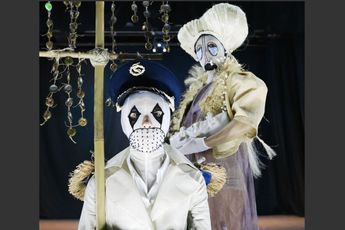
Ramírez-Figueroa often builds environments that feel like fragments of a stage set or a dream, populated by costumes, props, and sculptural elements activated through choreographed actions. Works such as Blue Abstraction (2012–14) engage the visual language of early cinema, painting bodies to appear as if they vanish against their surroundings, evoking how traumatic memories are both erased and persist in distorted form. In Three Ghosts (2014) and Illusion of Matter (2015), recurrently shown alongside Blue Abstraction, he conjures spectral figures and fragile constructions to imagine the “spirits” of demolished modernist buildings and suppressed historical narratives.
Performance is central to his method, and video frequently serves to extend these live actions into time-based installations. In Life in His Mouth, Death Cradles Her Arm (2016), the artist stands motionless in a cemetery in Guatemala City, cradling a shrouded bundle that slowly “weeps” water onto the ground, turning a simple gesture into a meditation on mourning, disappearance, and the unspoken dead of the conflict. Print of Sleep (2016) shows the artist using a bedframe to press patterns onto participants’ bodies, staging sleep as a ritual through which collective anxieties and memories are transferred and made visible. These works exemplify his approach to performance as a way to materialise intangible psychological states through modest but charged objects.
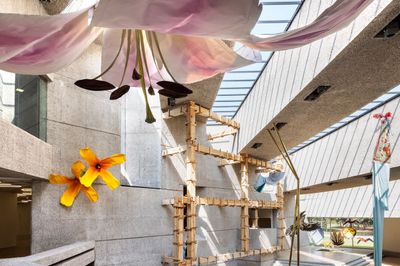
Alongside performance and film, Ramírez-Figueroa has developed sculptural and print-based series that expand his interest in colonial histories and material economies. A recent group of sculptures produced for his exhibition at M Leuven engages the history of silk production in Guatemala, tracing links between Mayan culture and trade routes that connect the country to China, Mexico, Spain, and beyond. Across media, his installations often feature plants, animals, and organic forms—sometimes humorous, sometimes ominous—through which he examines how bodies and landscapes absorb and reflect geopolitical forces.
Lugar de Consuelo at MoMA
In 2026, MoMA’s Kravis Studio in New York hosts Naufus Ramírez-Figueroa: Lugar de Consuelo (Place of Solace), the museum’s first presentation of this ambitious multimedia work acquired for its collection in 2022–23. Created in 2020, Lugar de Consuelo comprises a high-definition video, costumes, props, nine aquatints, and 27 watercolour sketches, forming a dense environment that blurs the boundaries between performance document, sculptural installation, and drawing. The project revisits political and personal histories of the Guatemalan Civil War, weaving together imagery of domestic spaces, ritualised actions, and fantastical figures that register the lingering effects of state violence on private life.
At MoMA, Lugar de Consuelo is presented not only as a film but as an ensemble of objects and works on paper that foreground the artist’s process, from costume designs to gestural notations. The installation underscores Ramírez-Figueroa’s proposition that memory can be made public through highly visual, theatrical forms that refuse straightforward documentary realism. By staging this work in the Kravis Studio—a space dedicated to time-based and performance-related practices—MoMA positions Ramírez-Figueroa as a key voice in contemporary performance and Latin American art, making his exploration of Guatemalan history visible to a broad New York audience.
Themes and Context
Ramírez-Figueroa’s practice is rooted in experimental theatre and performance art, but he brings these traditions into dialogue with installation, sculpture, and printmaking to develop a distinctly Central American vocabulary of memory and resistance. His work repeatedly addresses the Guatemalan Civil War—particularly its approximately 200,000 dead and disappeared—and the ways in which this violence continues to shape bodies, landscapes, and domestic spaces. Rather than offering straightforward historical accounts, he creates allegorical scenes where absurd humour, dream logic, and playful imagery coexist with undercurrents of grief, pointing to how trauma is often processed through fantasy and storytelling.
Beyond civil war histories, his more recent projects expand to questions of colonialism, extractive economies, and the relationship between humans and nature. Installations that focus on materials such as cocoa, tea, or silk draw out the entangled histories of global trade, Indigenous knowledge, and environmental exploitation, situating Guatemala within broader transnational networks. Across these contexts, Ramírez-Figueroa consistently treats the body as a site where histories accumulate, whether in the form of literal imprints, gestures of mourning, or choreographed acts that evoke both vulnerability and resilience.
Exhibitions and Recognition
Over the last decade, Ramírez-Figueroa has presented significant solo exhibitions and performances at institutions including Museo Reina Sofía in Madrid, MAMBO in Bogotá, MAMM in Medellín, and M Leuven in Belgium. The survey exhibition Singing to the Plants: Performances 2001–2023 at MAMBO and MAMM offered an anthological view of his performance practice, highlighting his sustained engagement with colonialism, conflict, and the interface between ritual and theatre. His inclusion in major group exhibitions—among them the 58th Carnegie International in Pittsburgh, shows at Times Art Center Berlin, and displays at Tate Modern—has cemented his position as a central figure in contemporary art from Central America.
In addition to MoMA’s acquisition of Lugar de Consuelo, his works are held in other prominent public collections, reflecting growing institutional interest in his contributions to performance and politically engaged installation. Critics have emphasised the distinctive combination of “memory, phantasy and resistance” in his work, noting how his exhibitions construct thematic journeys through childhood, struggle, and justice that remain visually compelling while addressing complex histories. This visibility has contributed to renewed attention on Central American art within global discourses, with Ramírez-Figueroa often cited as a key artist bridging regional narratives and international performance-based practices.
Naufus Ramírez-Figueroa FAQs
What is Naufus Ramírez-Figueroa best known for?
Naufus Ramírez-Figueroa is best known for performance-based installations that address the legacies of the Guatemalan Civil War and the politics of memory through theatrical, dreamlike imagery. Works such as Blue Abstraction, Life in His Mouth, Death Cradles Her Arm, Print of Sleep, and Lugar de Consuelo (Place of Solace) exemplify his use of simple gestures and props to evoke disappearance, mourning, and the imprint of history on the body.
What is the MoMA exhibition “Lugar de Consuelo (Place of Solace)” about?
MoMA’s exhibition Naufus Ramírez-Figueroa: Lugar de Consuelo (Place of Solace) presents a 2020 multimedia work that combines video, costumes, props, aquatints, and watercolor sketches. The project revisits political and personal histories of Guatemala’s civil war, transforming domestic and ritual scenes into a dense environment that reflects on how state violence permeates intimate spaces.
What themes does Naufus Ramírez-Figueroa explore in his work?
Ramírez-Figueroa’s work explores themes of historical trauma, displacement, and cultural identity, with a particular focus on the Guatemalan Civil War and its aftermath. He also addresses broader issues of colonialism, extractive economies, ecology, and the relationship between humans and nature, often through allegorical scenes that mix humour with unease.
Where can I see Naufus Ramírez-Figueroa’s work?
His work can be seen in exhibitions and collections at institutions such as the Museum of Modern Art in New York, Museo Reina Sofía in Madrid, Tate Modern in London, and M Leuven in Belgium, among others. In 2026, MoMA’s Kravis Studio in New York presents Lugar de Consuelo (Place of Solace), offering a focused view of his recent multimedia practice.
How does performance function in Ramírez-Figueroa’s practice?
Performance is a core method through which Ramírez-Figueroa stages the body as a carrier of memory, often using repetitive or restrained actions to evoke mourning, vulnerability, and resistance. These performances are frequently embedded within sculptural installations or translated into video, prints, and drawings, allowing transient gestures to persist as part of larger environments and long-term museum displays.
Ocula | 2026







Explore Naufus Ramírez-Figueroa's Exhibitions





Explore and Follow Artists Shaping Contemporary Art
A respected voice in contemporary art discourse.
Focusing on ambitious storytelling and insightful art-world commentary. Ocula Magazine publishes in-depth interviews, critical essays and timely analysis on the artists, exhibitions and ideas driving the global art world.
Learn more about Ocula Magazine
Showcasing the best of the art world.
Ocula partners with galleries from around the world to highlight their artists, artworks and exhibitions. Gallery membership is by application and invitation, with each member vetted by an independent panel.
Learn more about Ocula Membership
Specialises in the sale of major artworks.
Led by a team with deep ties to the world’s leading auction houses, galleries and collectors. Ocula’s advisory team offers bespoke services to high-net-worth clients from around the world who are looking to acquire the best of contemporary and modern art.
Learn more about our team and services