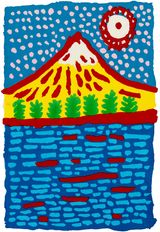
Yayoi Kusama is recognised as one of the most important female artists of the contemporary art world.
Early ArtWork
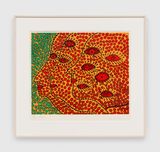
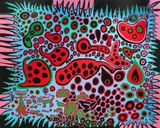
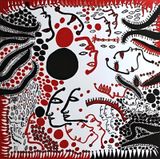
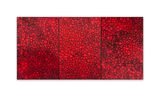
In 1958, Yayoi Kusama moved to New York, where she found herself in the thick of the avantgarde movements of the time. Surrounded by Minimalism and Pop art and incorporating elements of both into her work, the artist’s critical acclaim is pinned to the ‘Infinity Net’ series (1958–ongoing) that she began at this time: canvases engulfed by hundreds or thousands of small, colourful loops of paint.
Accumulation
Yayoi Kusama’s artwork has often referred to repetition of form as offering her solace from the traumas she has battled with since her youth. ‘Accumulation’ comprises soft sculptures made of found furniture covered in sewn, white penis forms. As a young girl, the artist recalls that her mother would ask her to spy on her father and she has referred to the frequently incorporated phallic forms in her work, as seen in her ‘Accumulation’ series, begun in 1962, as an act of reconciliation with her childhood fears regarding what she might see. ’
Later, the artist would fill entire rooms with these soft forms, such as Compulsion Furniture (Accumulation) (c 1964): a room filled with phallus-covered furniture.
Infinity Mirror Rooms
The installations that Kusama created in the 1960s were precursors to her best-known infinity rooms of today.
In 1965, mirrors first appeared in Yayoi Kusama’s work Infinity Mirror Room—Phalli’s Field (1965), in which the floor of a square, mirrored room was covered in a layer of white, stuffed phalluses dotted in red.
In recent years, the artist’s repetitive dot motifs have spawned a set of infinity mirror-room exhibitions internationally, including Yayoi Kusama: Infinite Obsession, whose worldwide tour reached the biggest global audience for an art exhibition in 2015.
In 2017, the Hirshhorn Museum and Sculpture Garden in Washington, DC debuted another touring exhibition titled Yayoi Kusama: Infinity Mirror. Two-hour queueing times did not dampen the enthusiasm of thousands of visitors, who were granted a brief half-minute slot of solitude within the infinity mirror rooms.
Public Sculpture
Yayoi Kusama’s sculptures occupy numerous sites across the world.
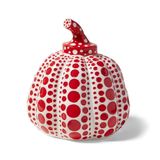
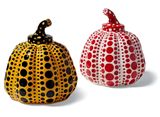
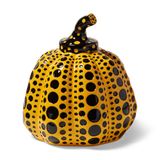
In August 2021, her yellow-and-black Pumpkin (1994) was swept away from its spot in Naoshima, Japan, by Typhoon Lupit.