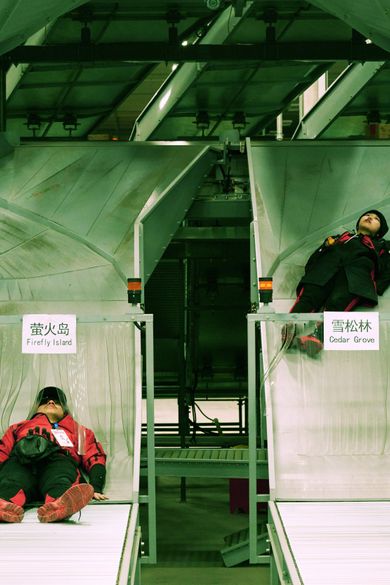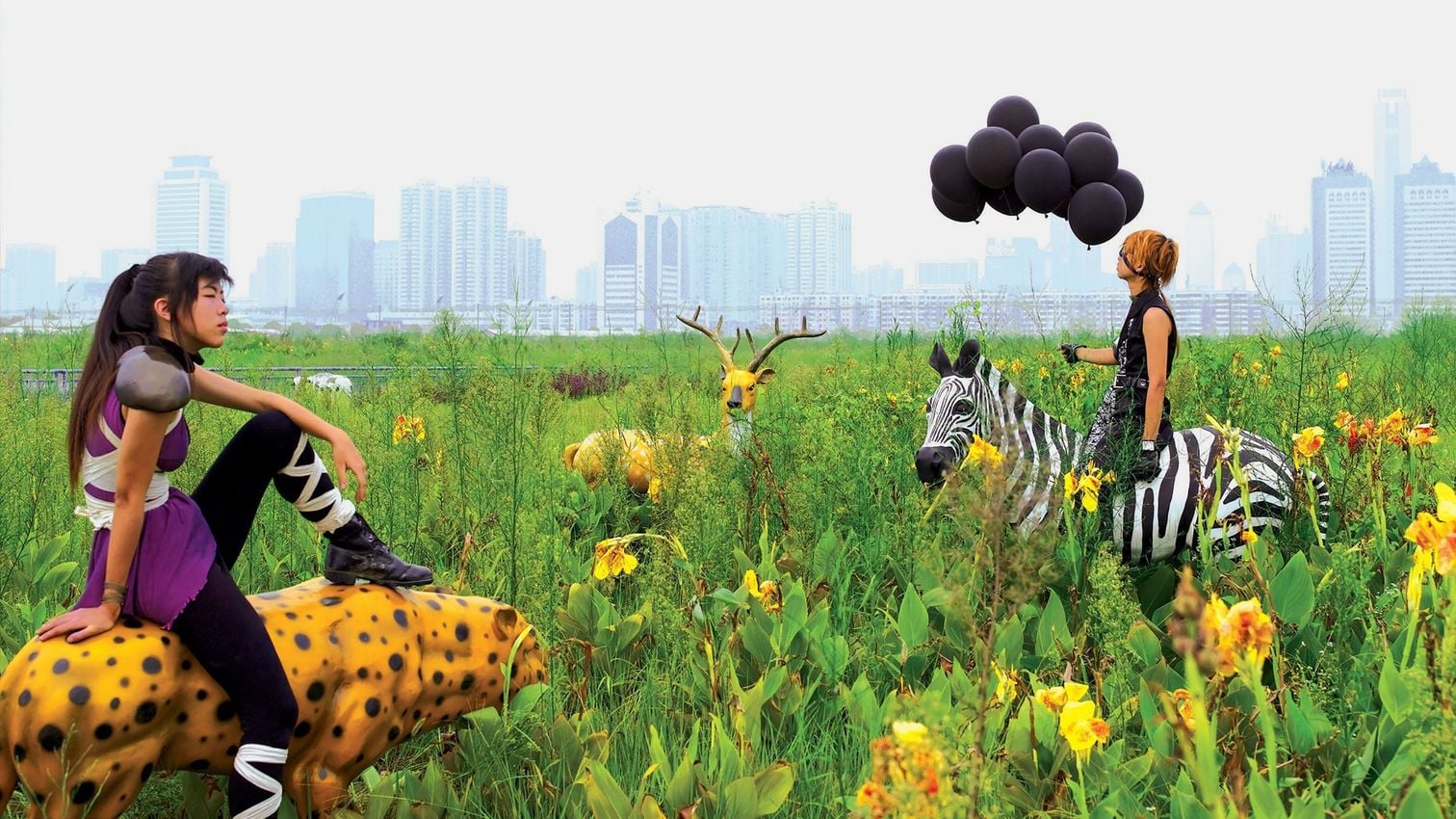
The Chinese artist Cao Fei (b. Guangzhou, 1978) is one of the defining voices of her generation. For her first solo exhibition in Switzerland, she transforms the Kunstmuseum Basel | Gegenwart into an immersive total work of art in the form of a city blending imposing installations and video universes from her oeuvre of the past twenty years.
Cao Fei’s achievement as a pioneering creator of digital worlds is uncontested. Her early works have influenced an entire generation of artists from Asia and beyond. For over two decades, she has made art—from video installations and digital simulations to virtual-reality settings—that grapples with the impact on human life of wrenching societal and technological transformations, establishing her renown as a leading thinker about art, media, technology, and the future.
Her videos, virtual realities, and game-based environments are situated in factories, dreamscapes, and visions of a future. Exploring aspects of work, change, and the peculiar beauty of a globalized world, they address questions of identity, embodiment, and recollection. Cao Fei examines how economic growth, technological development, and globalization influence our society, without ever descending into pessimism about the future. Among the centerpieces of the exhibition at the Kunstmuseum Basel | Gegenwart are seminal works like Whose Utopia (2006), RMB City (2007–), Asia One (2018), Nova (2019–), Oz (2022), and the Hip Hop series (2003–).
Perhaps the most remarkable feature of Cao Fei’s art is her gift for integrating speculative and surreal elements into works that are often almost documentary. This aspect is underscored by elaborate installations that materialize elements from the videos in the exhibition space, further blurring the boundary between the physical and virtual realms.
The exhibition, which extends over three floors of the Kunstmuseum Basel | Gegenwart, invites viewers to delve deep into Cao Fei’s extensive oeuvre and makes for a singular experience in three dimensions in which the video works are not just on display but become an immersive reality. The exhibition is designed by Cao Fei in collaboration with Small Production, Beijing.

Cao Fei uses video, multimedia installations and photography to explore the effects of digital capitalism on the Chinese population, considering how loneliness manifests itself in a tech-driven world, how fantasy plays a key role in subcultures and how human relations are driven by rapid urban development.


The Öffentliche Kunstsammlung Basel, the municipal art collection of Basel, dates back to 1661, when the city acquired the Amerbach Cabinet. It grew steadily over the centuries, necessitating several relocations within Basel. The Hauptbau on St. Alban-Graben was inaugurated in 1936. A first enlargement came in 1980, when the Kunstmuseum Basel | Gegenwart opened its doors; a third venue, known as the Neubau, was added in 2016.

A respected voice in contemporary art discourse.
Focusing on ambitious storytelling and insightful art-world commentary. Ocula Magazine publishes in-depth interviews, critical essays and timely analysis on the artists, exhibitions and ideas driving the global art world.
Learn more about Ocula Magazine
Showcasing the best of the art world.
Ocula partners with galleries from around the world to highlight their artists, artworks and exhibitions. Gallery membership is by application and invitation, with each member vetted by an independent panel.
Learn more about Ocula Membership

Specialises in the sale of major artworks.
Led by a team with deep ties to the world’s leading auction houses, galleries and collectors. Ocula’s advisory team offers bespoke services to high-net-worth clients from around the world who are looking to acquire the best of contemporary and modern art.
Learn more about our team and services