SUPERsystems is a joint exhibition featuring major new works by contemporary Melbourne-based artists Peter Atkins and Dana Harris. While these new projects by Atkins and Harris each express a highly distinctive visual language and materiality, they are closely aligned in their shared conceptual and formal concerns. Interested in the ways that systematic working methods can be applied as both a practical and conceptual framework, both artists employ geometry, repetition and seriality in their work as a means to reimagine the everyday world.
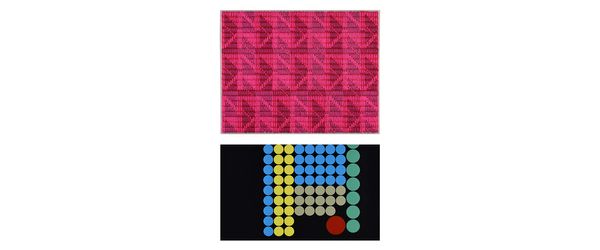
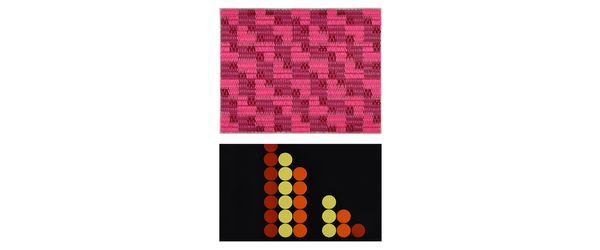
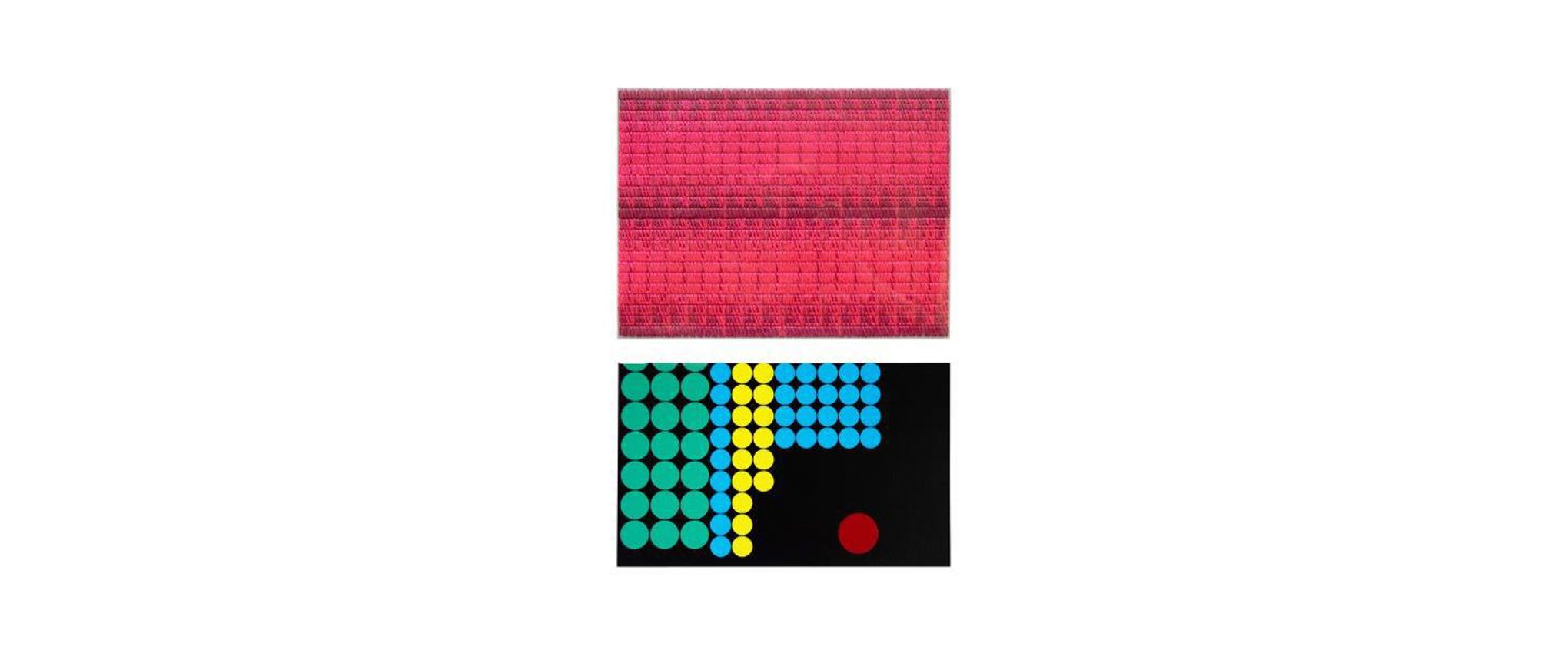
For many years, Peter Atkins’s practice has involved sourcing and appropriating colours, patterns and shapes from the everyday environment, distilling and reinventing them as abstract paintings and prints; a process he refers to as ‘readymade abstraction’. By incorporating familiar designs that evoke a collective experience in his work—such as movie posters, product packaging, road signs and record covers—Atkins blurs the boundaries between ‘High Art’ and popular culture. For SUPERsystems, Atkins has deconstructed Maurice Binder’s opening animated sequence for the first James Bond film Dr. No (1962) which he watched for the first time on his computer during the COVID–19 pandemic. Referencing this experience, the artist painted the 92 individual frames to the exact scale of his desktop screen. Presented in four horizontal rows, each part of the sequence is revealed as a unique, abstract composition, like a tangible, stop motion version of the original.
Dana Harris’s practice largely revolves around her self-described ‘obsession with mapping’. Working across small-scale drawings and weavings as well as large-scale site-specific installations, she employs a variety of techniques and media in her ongoing investigation of the relationships between natural and urban landscapes. For SUPERsystems, Harris presents a new project which emerged from her experience of walking the deserted streets of the CBD during the COVID–19 lockdowns. For the artist, exploring the city at a standstill allowed her to notice subtle shifts and spatial relationships in the built environment, inspiring her to explore this phenomenon through a series of intricately hand-embroidered panels which use repetition and complex patterns to express these new rhythms and connections. While the title of the project, fancywork, references the ornamental needlework of the Victorian era, Harris has adapted the technique in a contemporary format using a vibrant palette of pink lines and threads.
SUPERsystems is presented in conversation with The Industrial Design of Clement Meadmore: The Harris/Atkins Collection, a comprehensive collection of innovative modernist designs by the acclaimed sculptor and designer, Clement Meadmore. His distinctive visual language, like Harris and Atkins, was often informed by both Bauhaus and De Stijl principles as well as the geometry of built forms found in the urban environment. Also on display is Systems and Structures featuring a selection of works from the TarraWarra Museum of Art collection by Australian artists who also employ patterns, geometry, modules and repetition in their creative practices.
Dana Harris, fancywork has been assisted by the Australian Government through Creative Australia, its principal arts investment and advisory body.


Peter Atkins was born in Murrurundi, New South Wales in 1963. He studied at the Newcastle Art School, NSW (1983/84) and National Art School, Sydney (1985). Peter has had an extensive solo and group exhibition career with exhibitions including Quirky: From the Collection, Newcastle Regional Gallery, NSW (2010); Clemenger Contemporary Art Award, The Ian Potter Centre, National Gallery of Victoria, Melbourne (2009); Contemporaneous: Australian Contemporary Painting, Wangaratta Exhibitions Gallery, VIC (2008); Arthur Guy Memorial Painting Prize, Bendigo Art Gallery, Victoria (2007). Collections include the National Gallery of Australia, Canberra; Art Gallery of New South Wales, Sydney; Art Gallery of South Australia, Adelaide; Art Gallery of Western Australia, Perth; Museum of Contemporary Art, Sydney; National Gallery of Victoria, Melbourne; Queensland Art Gallery, Brisbane. Peter currently lives and works in Melbourne, Australia.
TarraWarra Museum of Art is a not-for-profit public art museum on Wurundjeri Country in the Yarra Valley, near Healesville, around an hour north-east of Melbourne. Founded by philanthropists Eva Besen AO and Marc Besen AC, who donated an award-winning purpose-built museum by architect Allan Powell along with more than 600 works of Australian art, TarraWarra opened to the public in 2003. The museum is renowned for its intimate scale, striking architecture set amid vineyards and rolling hills, and a focus on modern and contemporary Australian art from the 1930s to the present.

A respected voice in contemporary art discourse.
Focusing on ambitious storytelling and insightful art-world commentary. Ocula Magazine publishes in-depth interviews, critical essays and timely analysis on the artists, exhibitions and ideas driving the global art world.
Learn more about Ocula Magazine
Showcasing the best of the art world.
Ocula partners with galleries from around the world to highlight their artists, artworks and exhibitions. Gallery membership is by application and invitation, with each member vetted by an independent panel.
Learn more about Ocula Membership

Specialises in the sale of major artworks.
Led by a team with deep ties to the world’s leading auction houses, galleries and collectors. Ocula’s advisory team offers bespoke services to high-net-worth clients from around the world who are looking to acquire the best of contemporary and modern art.
Learn more about our team and services