






See the Giant Works Coming to The Armory Show This Fall

Michael Rakowitz, Installation view of The invisible enemy should not exist (Room F, Northwest Palace of Nimrud) (2019). Middle Eastern food packaging and newspapers, glue, cardboard on wooden structures, museum label. Courtesy the artist and Jane Lombard Gallery. Photo: Arturo Sanchez.

The Armory Show has shared images of the large-scale works that will show in the New York fair’s Platform section this year.
This year’s theme is Can you hear the fault lines breathing? Curated by Claudia Schmuckli, Curator-in-Charge of Contemporary Art and Programming at the Fine Arts Museums of San Francisco, the section features works that aim to bridge societal, historical and geographical divisions.
‘In a world in the grip of climate change and haunted by biological and social viruses that are decimating populations and dividing societies, this year’s Platform seeks to capture the breadth of the fault lines that currently define our experience of existence,’ Schmuckli said.
‘I hope the works featured in Platform offer strategies of overcoming and healing that provoke dialogue about new models of care for the self, each other and the planet we call home,’ she said.
The Armory Show will take place at its new home in the Javits Center, 15 blocks or so south of its former home on Piers 92 and 94, from 9 to 12 September.
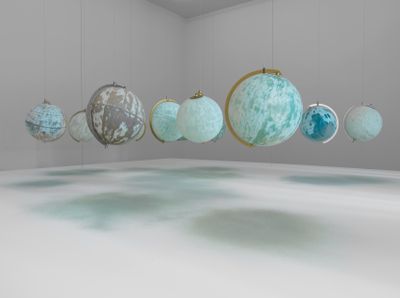
Julian Charrière, We Are All Astronauts
Inspired by the writing of Buckminster Fuller, Charrière’s globes feature maps from 1890-2011 that have been sanded away.

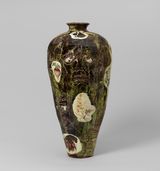
Cammie Staros, Come to Pass
Fascinated by Greco-Roman art, Cammie Staros created this totemic sculpture by stacking hand-built vessels made with a combination of ancient techniques and modern industrial materials.
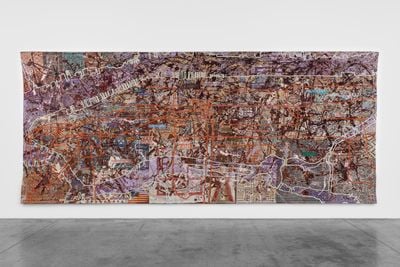
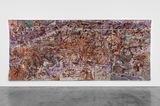
Grayson Perry, Very Large Very Expensive Abstract Painting
Grayson Perry’s vast tapestry was inspired by a trip across the United States on a custom-built motorbike. He spent time with different communities exploring the different political and cultural fault lines in American society.

Tau Lewis, Opus (The Ovule)
Tau Lewis describes Opus (The Ovule) as ‘the power source of consciousness’ in a fictional realm defined by abundance, safety, and justice.
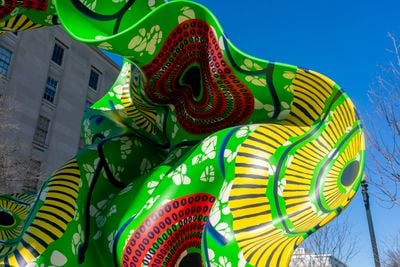
Yinka Shonibare, Material (SG) I
Material (SG) I (2019) is part of a series of wind sculptures that act as metaphors for migration.
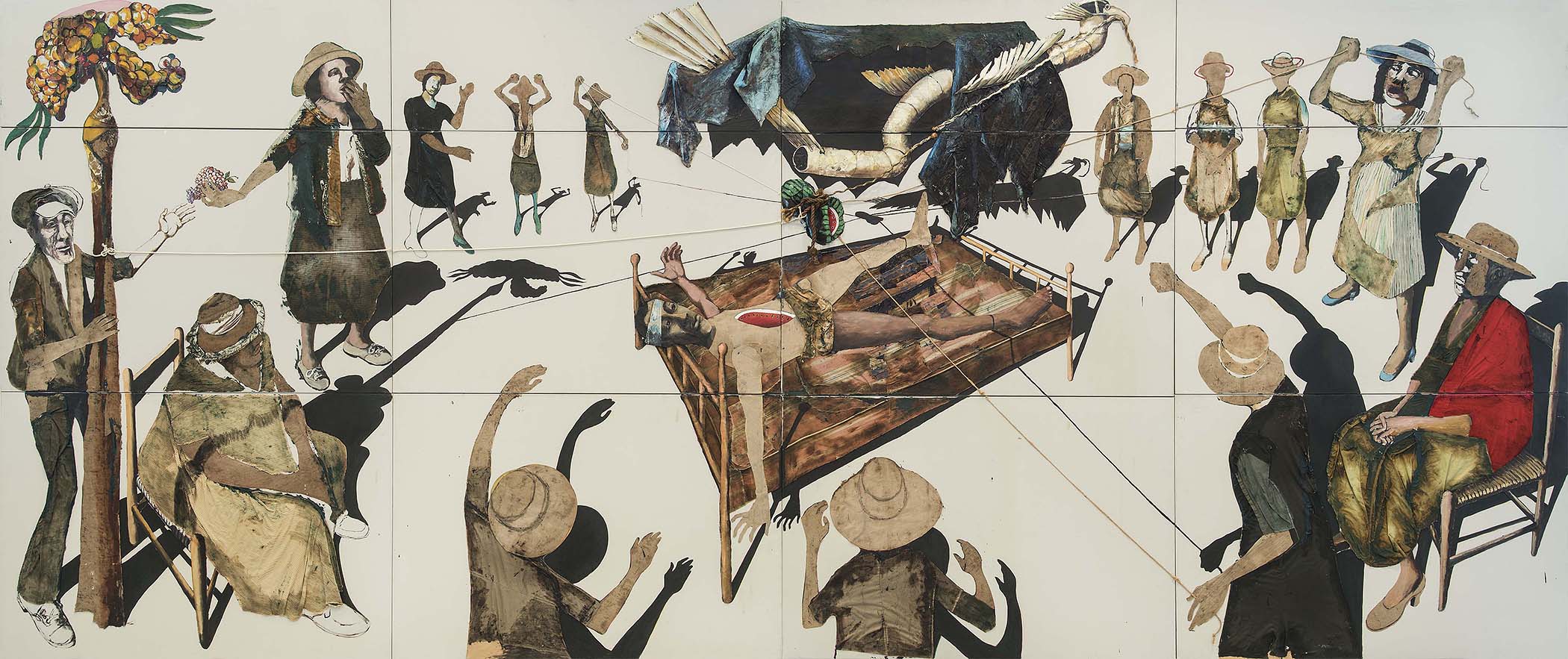
Benny Andrews, Circle (Bicentennial Series)
Over seven metres wide, this sprawling painting confronting white myths about Black Americans was created in anticipation of the American Bicentennial in 1976.
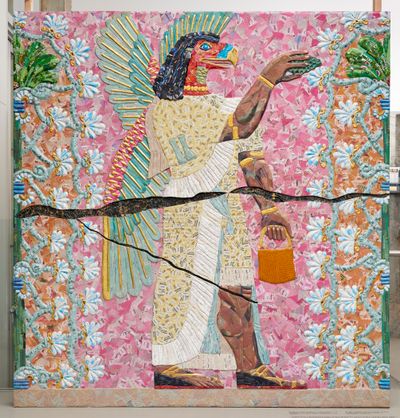
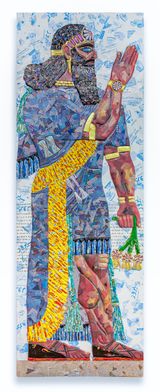
Michael Rakowitz, The invisible enemy should not exist (Room F, section 1, panel 15, Northwest Palace of Nimrud)
Michael Rakowitz recreates stone carved panels destroyed by ISIS or otherwise lost in these vibrant collages made using Middle Eastern food packaging.
(Diana Al-Hadid‘s work, Self-referential (2021) will be presented by Galleri Brandstrup, Oslo. Images of the work were unavailable at time of publication.) —[O]
Main image: Michael Rakowitz, Installation view of The invisible enemy should not exist (Room F, Northwest Palace of Nimrud) (2019). Middle Eastern food packaging and newspapers, glue, cardboard on wooden structures, museum label. Courtesy the artist and Jane Lombard Gallery. Photo: Arturo Sanchez.





A respected voice in contemporary art discourse.
Focusing on ambitious storytelling and insightful art-world commentary. Ocula Magazine publishes in-depth interviews, critical essays and timely analysis on the artists, exhibitions and ideas driving the global art world.
Learn more about Ocula Magazine
Showcasing the best of the art world.
Ocula partners with galleries from around the world to highlight their artists, artworks and exhibitions. Gallery membership is by application and invitation, with each member vetted by an independent panel.
Learn more about Ocula Membership
Specialises in the sale of major artworks.
Led by a team with deep ties to the world’s leading auction houses, galleries and collectors. Ocula’s advisory team offers bespoke services to high-net-worth clients from around the world who are looking to acquire the best of contemporary and modern art.
Learn more about our team and services